Vietnamese Cosmology is the invisible logic behind almost everything you will notice once you slow down in Hanoi: why a shopkeeper sweeps outward before sunrise, why a bride checks the calendar before her wedding date, why an altar sits in the quietest corner of a noisy café. In short, it is Vietnam’s traditional understanding of how the universe, human fate, and daily life fit together. This article gives you the full map of that worldview, and every section links out to a deeper guide if you want to go further.
What is Vietnamese Cosmology?
Vietnamese Cosmology is the traditional framework the Vietnamese people use to explain the origin, order, and balance of the universe, and how humans fit inside that order. It is not a single organized religion with one holy book. Instead, it is a layered system built from native animism, ancestor reverence, and centuries of exchange with Confucian, Buddhist, and Taoist thought from China.
Think of it less as a belief you sign up for and more as a lens that Vietnamese people, even non-religious ones, still look through. It explains why the number of steps on a staircase matters, why certain years are considered better for having a baby, and why a bowl of fruit is arranged a specific way on Lunar New Year – Tet Holiday.
Where does Vietnamese Cosmology come from?
This worldview comes from two overlapping sources: a homegrown mythology tied to dragons, fairies, and nature spirits, and roughly two thousand years of contact with Chinese philosophical and religious systems. Neither source replaced the other. Instead, they merged into something distinctly Vietnamese.
The Dragon and the Fairy: Vietnam’s Founding Myth
Vietnam’s own creation story explains why locals sometimes call themselves “children of the Dragon and the Fairy” (Con Rồng, Cháu Tiên). According to legend, the dragon lord Lạc Long Quân married the mountain fairy Âu Cơ, and she gave birth to a sac of one hundred eggs that hatched into one hundred children, the ancestors of the Vietnamese people. When the couple could no longer live together, fifty children followed their mother to the mountains and fifty followed their father to the sea, which locals often point to as the mythic root of Vietnam’s unity between highland and coastal, water and mountain, Yin and Yang.
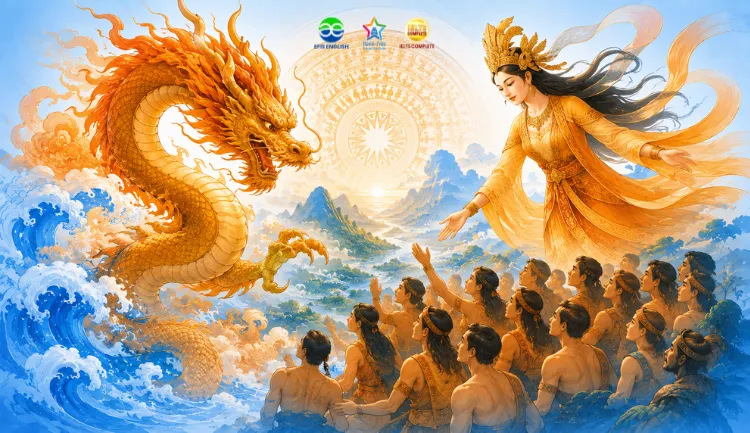
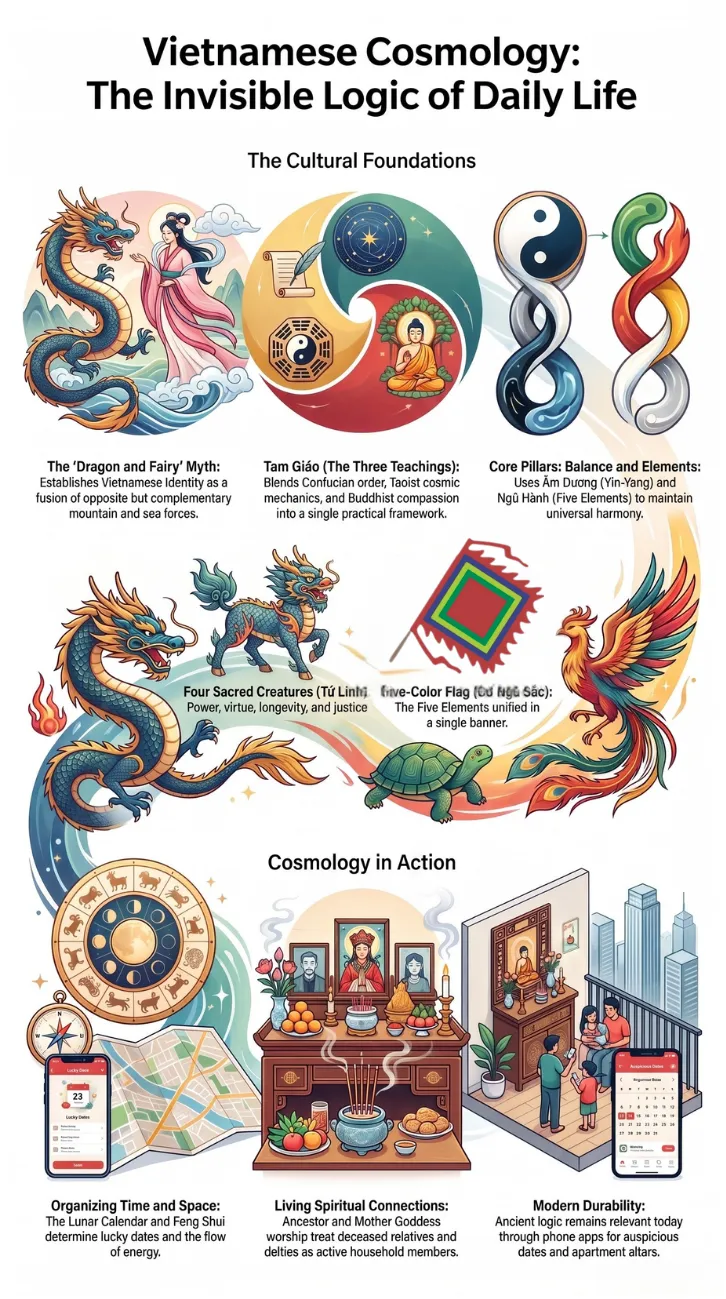
This myth is not treated as literal history, but it carries real cosmological weight. It frames the Vietnamese identity as a fusion of two opposite but complementary forces from the very beginning, long before Yin-Yang theory arrived from the north. You will still see the dragon and the phoenix, the fairy’s traditional pairing, carved into temple roofs, communal houses, and even modern wedding invitations across Vietnam.
Tam Giáo: When Confucianism, Buddhism, and Taoism Merged With Local Belief
Tam Giáo, or the “Three Teachings”, refers to the way Confucianism, Buddhism, and Taoism blended with Vietnam’s indigenous folk religion instead of competing against it. Confucianism supplied the social order (respect for elders, family hierarchy, and civic duty), Taoism supplied the cosmic mechanics (Yin-Yang, the Five Elements, and harmony with nature), and Buddhism supplied the spiritual and moral framework around karma and compassion. Vietnam already had its own popular religion long before these three teachings arrived, one centered on worshipping ancestors, local deities, and village gods, so the newcomers were absorbed into that existing structure rather than erasing it.
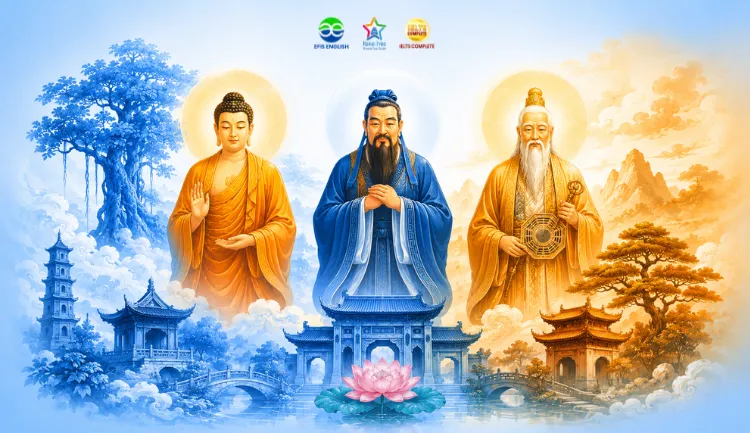
This is why a single Vietnamese pagoda can house a Buddha statue, a Taoist Jade Emperor figure, and a shrine to a local hero or Mother Goddess, all under one roof, without anyone finding that strange. It is also why this worldview feels so practical rather than doctrinal. People pull whichever tool fits the moment, whether that is a Confucian value for a family decision or a Taoist calculation for picking a wedding date.
What Are the Two Pillars of Vietnamese Cosmology?
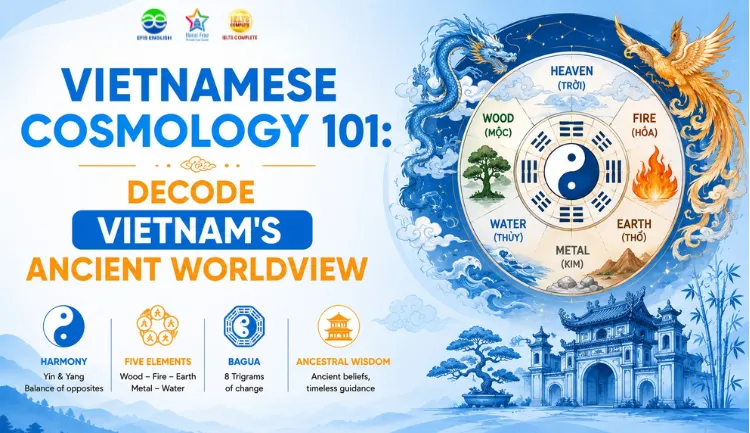
The two pillars of Vietnamese Cosmology are Yin and Yang (Âm Dương) and the Five Elements (Ngũ Hành). Together they form the working “operating system” that everything else in this article runs on, from the calendar to feng shui to fortune telling.
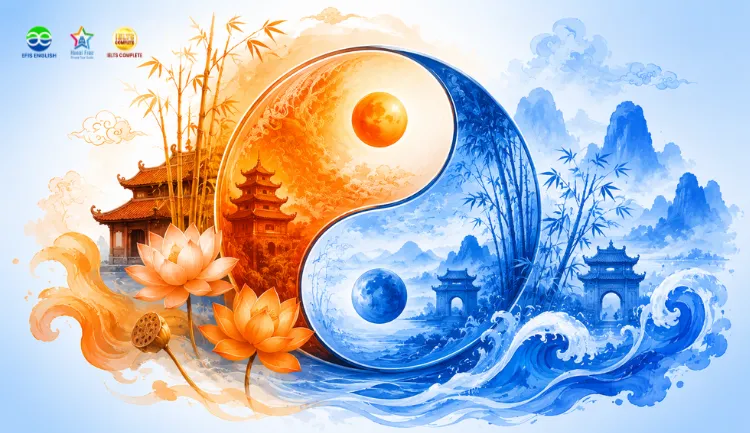
Yin and Yang describe the universe as a dance between two opposite but interdependent forces: Âm (Yin) is cool, dark, soft, and feminine, while Dương (Yang) is warm, bright, hard, and masculine. Neither force is good or bad on its own; illness, bad luck, or disorder are believed to come from an imbalance between the two, not from one force “winning”.
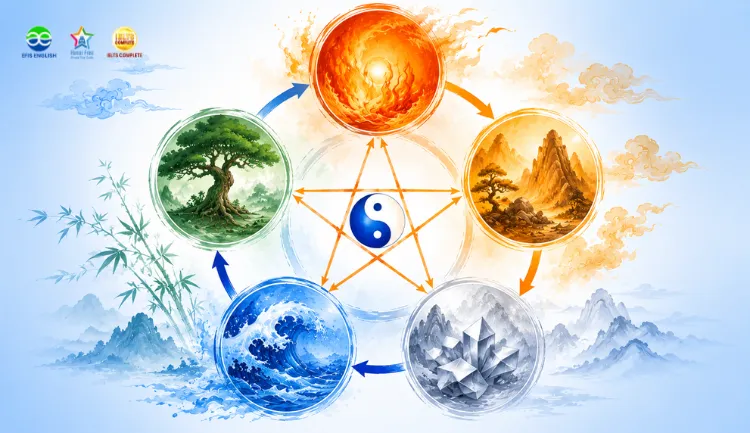
Five Elements sort the material world into five interacting elements, Kim (Metal), Mộc (Wood), Thủy (Water), Hỏa (Fire), and Thổ (Earth), which generate and restrain one another in a continuous cycle. A farmer choosing a planting season, a doctor practicing traditional medicine, and an architect designing a house all lean on the same five-element logic.
How Does Vietnamese Cosmology Organize Time, Space, and Fate?
This system turns Yin-Yang and the Five Elements into practical tools for three big decisions: when to act, where to build, and what to expect from life. Each of these has its own dedicated tradition, summarized briefly below.
Time: The Lunar Calendar and Auspicious Dates
The lunar calendar (Âm Lịch) is the timekeeping system that tells Vietnamese families when to celebrate Tết, when to worship ancestors, and when the Five Elements favor a particular activity. Because certain days carry stronger or weaker cosmic energy, many Vietnamese families still consult an almanac before booking a wedding, breaking ground on a house, or opening a new shop, a practice known as xem ngày tốt xấu (choosing lucky and unlucky dates). Our dedicated guide, Lunar Calendar in Vietnam: How It Shapes Daily Life, walks through exactly how this system works month by month.
Book our free tour guide!

Hanoi Old Quarter Walking Tour
❤❤❤❤❤ (TripAdvisor / GetYourGuide)
Historical Tour – Walking Tour – Small Group
⚑ 3 – 4 hours
✎ Free Tour – Free Cancellation

Hanoi Cultural Exchange
❤❤❤❤❤ (TripAdvisor / GetYourGuide)
Local – Most Popular – Small Group
⚑ 3 – 8 hours
✎ Free Tour – Free Cancellation
Space: Feng Shui in Homes and Cities
Feng shui (Phong Thủy) applies Yin-Yang and Five Elements theory to physical space, guiding how houses, graves, shops, and even entire streets are oriented. One of our longtime volunteer guides likes to point out that the crooked, narrow doorways in parts of the Old Quarter were not built that way by accident; older residents believed a straight, wide-open path let restless energy rush straight through a home. Whether or not a guest personally believes it, seeing that logic played out in real, centuries-old streets tends to land far better than reading it in a textbook.
Fate: Zodiac Animals, Tử Vi, and Lucky Numbers
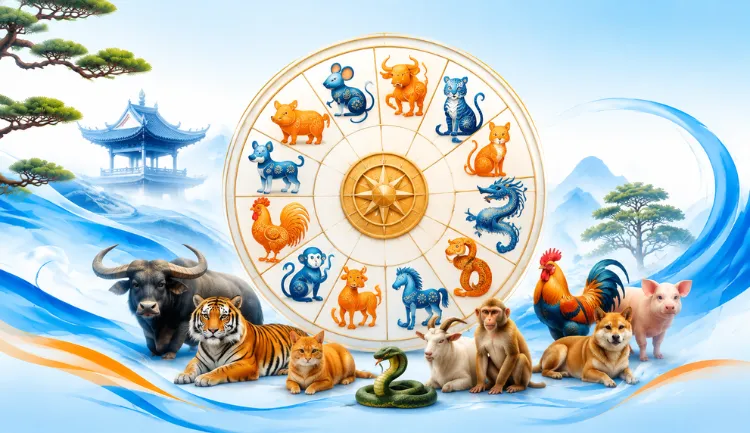
The Vietnamese zodiac (12 con giáp) assigns each birth year one of twelve animals, believed to shape a person’s temperament and life path, while Tử Vi charts and palm reading go a step further to map an individual’s fortune in more detail. These fate-reading traditions extend into everyday choices too, such as lucky numbers and colors, which influence everything from wedding dress shades to license plate preferences. Because these are rich topics on their own, we treat them as separate deep-dive guides elsewhere in this series rather than repeating them here.
The Sacred Symbols of Vietnamese Cosmology
This worldview expresses itself visually through a small set of recurring symbols found on temples, flags, drums, and even fruit trays. The table below summarizes the main ones so you can recognize them the next time you are walking through Hanoi.
| Symbol | Vietnamese Name | What It Represents | Where You’ll See It |
| Four Sacred Creatures | Tứ Linh | Dragon, Phoenix, Turtle, Qilin: Power, virtue, longevity, and justice | Temple roofs, imperial architecture, wedding decor |
| Four Seasons | Tứ Quý | The four seasons and a complete, balanced year | Lacquer paintings, home decor, Tết displays |
| Five-Color Flag | Cờ Ngũ Sắc | The Five Elements in one banner | Festivals, communal house ceremonies, pagoda courtyards |
| Bronze Drum | Trống Đồng | The sun, agricultural cycles, and Hùng King era origins | Museums, national monuments, ceremonial replicas |
| Yin-Yang Circle | Âm Dương | Balance between opposite, complementary forces | Roof tiles, altars, traditional art |
The Living Spiritual World: Ancestors, Mother Goddesses, and Village Spirits
This worldview is not only about abstract forces; it also populates the universe with specific beings that families and villages actively worship. Three traditions stand out, and each has earned a full article of its own on this site.
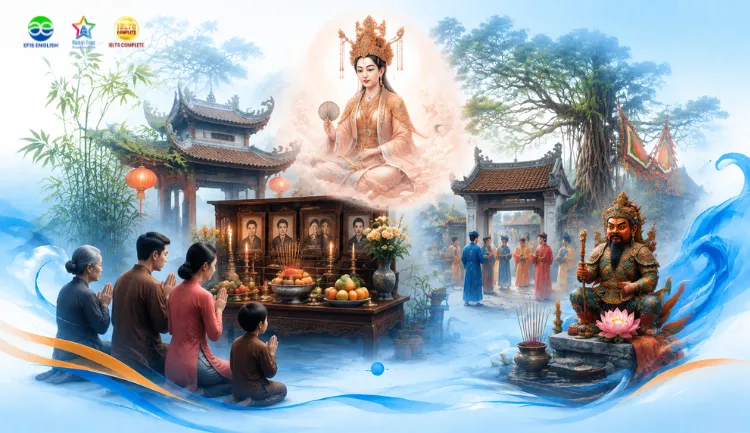
Ancestor worship treats deceased family members as active participants in household life, present at every altar and every Tết meal, not as distant memories. Đạo Mẫu, or Mother Goddess worship, honors feminine deities who preside over Heaven, mountains and forests, and water, most visibly through the trance ritual called hầu đồng, which UNESCO recognized as an Intangible Cultural Heritage of Humanity in 2016. Beyond the household and the Mẫu temples, nearly every village also has its own guardian spirit, or Thành Hoàng, honored at the communal house (đình), reflecting a folk religion layer that predates and still runs underneath the Three Teachings.
Vietnamese Folk Religion: A Living World You Can’t Unsee
Why Does Vietnamese Cosmology Still Shape Daily Life in Hanoi?
Vietnamese Cosmology still shapes daily life in Hanoi because it was never treated as an outdated belief system to be replaced by modernization; it was absorbed into ordinary habits until it stopped feeling like “religion” at all. A property developer in a glass tower still hires a feng shui consultant. A tech-savvy university student still avoids scheduling a job interview on a day their grandmother calls unlucky.
This durability comes from how flexible the system is. Because it was built by blending rather than replacing older beliefs, this belief system has room to absorb new context without breaking. Even Hanoi’s rapid urbanization has not erased it; it has just moved it indoors, onto phone apps that calculate auspicious dates and into the corner altar of a twenty-story apartment.
Where Can You Experience Vietnamese Cosmology in Hanoi?
You can experience Vietnamese Cosmology in Hanoi most directly at the Temple of Literature, Hoan Kiem Lake, and any of the city’s older pagodas, where the symbols and rituals described above are still active rather than roped off behind glass. These are not museum pieces; they are places where locals still come to pray, ask for luck, or mark a lunar milestone on the exact day the calendar recommends.
One of our club volunteers still remembers walking a small group through Hoan Kiem Lake during Tet Holiday and watching a guest connect the golden turtle legend to the same Yin-Yang balance she had just learned about an hour earlier at the Temple of Literature’s turtle stelae. That is usually the moment when Vietnamese Cosmology stops feeling like trivia and starts feeling like a living system, and it is exactly the kind of connection our free walking tours are built to create. If you would like a local guide to walk you through these layers in person, you can book a free personalized tour with Hanoi Free Private Tour Guide and shape the route around whichever thread of local cosmology interests you most.
Carrying This Worldview With You
Vietnamese Cosmology gives you a genuinely useful key to Hanoi: once you can spot Yin-Yang balance in a rooftop, a lucky number on a license plate, or an ancestor altar tucked behind a coffee counter, the whole city reads differently. It is not a checklist of superstitions but a coherent, centuries-old system that still guides real decisions today, from wedding dates to shop layouts to the timing of a family’s biggest celebrations. Every cluster topic in this series, the lunar calendar, feng shui, the zodiac, ancestor worship, and more, is one working part of this same larger picture, and none of them can be fully understood in isolation from the whole. Once you start noticing one thread, the rest tend to reveal themselves naturally as you keep exploring the city.
FAQs About Vietnamese Cosmology
No, it functions more like a cultural worldview than a single religion. It blends animist folk belief with elements of Confucianism, Buddhism, and Taoism, and most Vietnamese people follow parts of it regardless of their formal religious affiliation.
They share the same core tools, Yin-Yang and the Five Elements, but the Vietnamese version layers them on top of a distinct native mythology (the Dragon and Fairy origin story) and a strong tradition of ancestor and village-spirit worship that gives it a more localized, folk-religion character.
The most recognized symbols are the Four Sacred Creatures (dragon, phoenix, turtle, qilin), the Yin-Yang circle, the Five-Color Flag, and the Đông Sơn bronze drum, all of which appear throughout Vietnamese temples, festivals, and traditional art.
Visit sites like the Temple of Literature and Hoan Kiem Lake, watch for feng shui cues in traditional architecture, and consider joining a local-led walking tour where a guide can point out details that are easy to miss on your own.