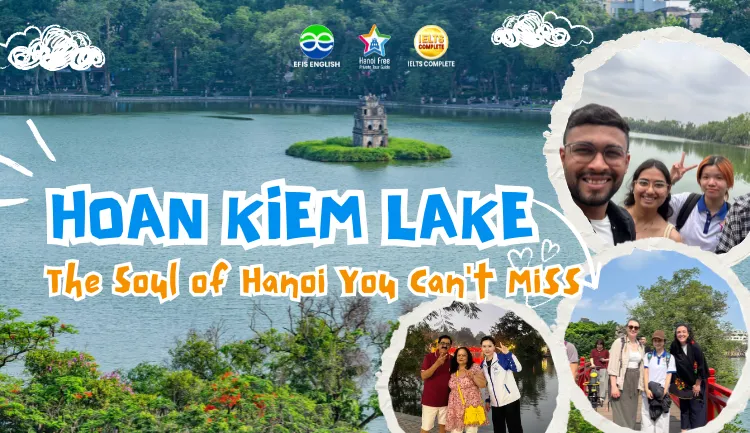
Hoan Kiem Lake sits at the very heart of Hanoi, and the moment you see its jade-green water glimmering between ancient trees and red-painted bridges, you will understand why Vietnamese people call it “the soul of the capital”. This article is your complete, insider travel guide to Hoan Kiem Lake: its history, legends, must-see landmarks, best visiting tips, and everything in between.
What is Hoan Kiem Lake and Why does Every Visitor fall in Love with it?
Hoan Kiem Lake is a natural freshwater lake covering roughly 12 hectares in the Hoan Kiem District, Hanoi, and it is the emotional and geographical center of the entire city. Unlike a typical tourist attraction, this lake is a living breathing daily ritual for Hanoians: elders practice Tai Chi on its banks at dawn, students hang out on its benches at dusk, and families pour in on weekends when the surrounding streets close to traffic. For foreign visitors, it delivers something rare: a single place where you can absorb Hanoi’s history, spirituality, and everyday life all at once.
The lake’s name translates to “Lake of the Restored Sword” (Hồ Hoàn Kiếm), referencing one of Vietnam’s most beloved legends. It has been the spiritual anchor of Hanoi for centuries, and even today, no trip to Hanoi is considered complete without at least one long, unhurried walk along its tree-lined promenade.
The lake sits right at the edge of the old streets, so it usually comes at the start or the end of a hanoi old quarter walking tour.

The Legend of Hoan Kiem Lake: The Story Behind the Name
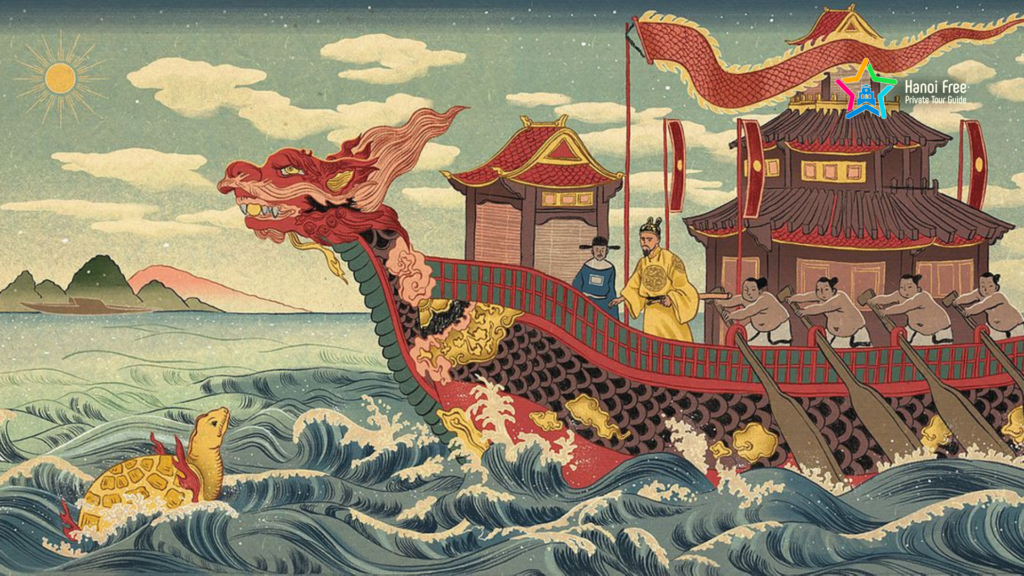
The name “Hoan Kiem” comes from a 15th-century legend about King Le Loi, who reportedly received a magical sword from a divine Golden Turtle to drive out Chinese invaders, and returned it to the lake after victory. This is not just mythology; it is the foundational story of Vietnamese national identity and pride, retold in schools, theaters, and households across the country for over 600 years.
According to the legend, after King Le Loi successfully liberated Vietnam and founded the Le Dynasty (1428), he was sailing on the lake when a giant golden turtle (Kim Qui) surfaced and reclaimed the sacred sword. The king understood this as a divine sign of peace: the weapons of war were no longer needed. From that day forward, the lake was renamed Hoan Kiem, replacing its older name, Luc Thuy (“Green Water Lake”).
Interestingly, the legend gained a layer of real-world mystery because giant softshell turtles (Rafetus swinhoei) were genuinely found living in the lake for centuries. The last known individual, affectionately called “Cu Rua” (Grandfather Turtle) by Hanoians, passed away in 2016, deepening the lake’s mystical aura. Today, a preserved specimen is displayed inside Ngoc Son Temple as a treasured relic.
The 4 Iconic Landmarks Around Hoan Kiem Lake
1. Turtle Tower (Thap Rua)
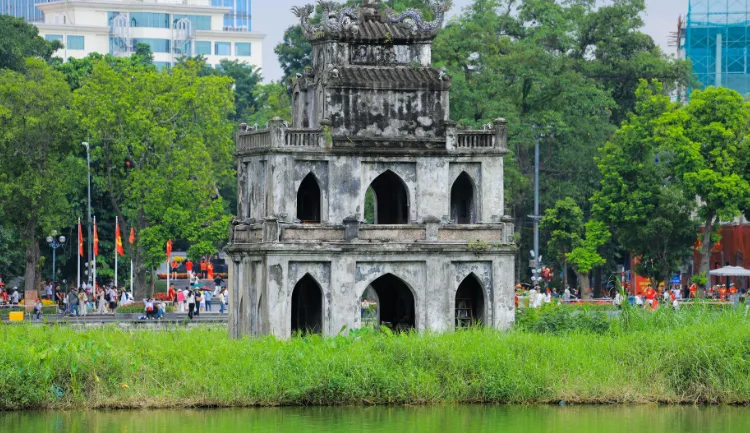
Turtle Tower is a small, elegant stone tower built on a tiny island in the southern part of the lake, and it is the single most photographed symbol of Hanoi. Constructed in the late 19th century (around 1886) during the French colonial period, it stands on the very spot where, according to legend, the divine turtle received the sword back from King Le Loi.
The tower is not open to the public, but its silhouette reflected in the lake’s green water, especially at golden hour or under fog, is an image that stays with you long after you leave Hanoi. It is the backdrop of countless paintings, postcards, and national emblems. Our club’s volunteer guides often point out that the tower looks completely different depending on the time of day and the season: ethereal under morning mist in winter, golden and sharp in the afternoon sun of autumn.
2. Ngoc Son Temple (Temple of the Jade Mountain)
Ngoc Son Temple is a revered Taoist and Confucian temple sitting on a small island in the northern part of Hoan Kiem Lake, connected to the shore by the iconic red Huc Bridge (The Rising Sun Bridge). It is one of the most visited spiritual sites in Hanoi and the only structure on the lake that visitors can enter and explore.
The temple honors General Tran Hung Dao, who defeated the Mongol invasions in the 13th century, alongside scholar Van Xuong and physician La To. Inside, you will also find the preserved body of the legendary giant Rafetus turtle displayed in a glass case. The combination of incense smoke, lacquered altars, and the view of the lake from the temple’s courtyard creates an atmosphere unlike anywhere else in Vietnam.
- Opening hours: 8:00 AM – 6:00 PM daily
- Entrance fee: approximately 30,000 VND (adults)
- Best time to visit: Early morning on weekdays to avoid crowds
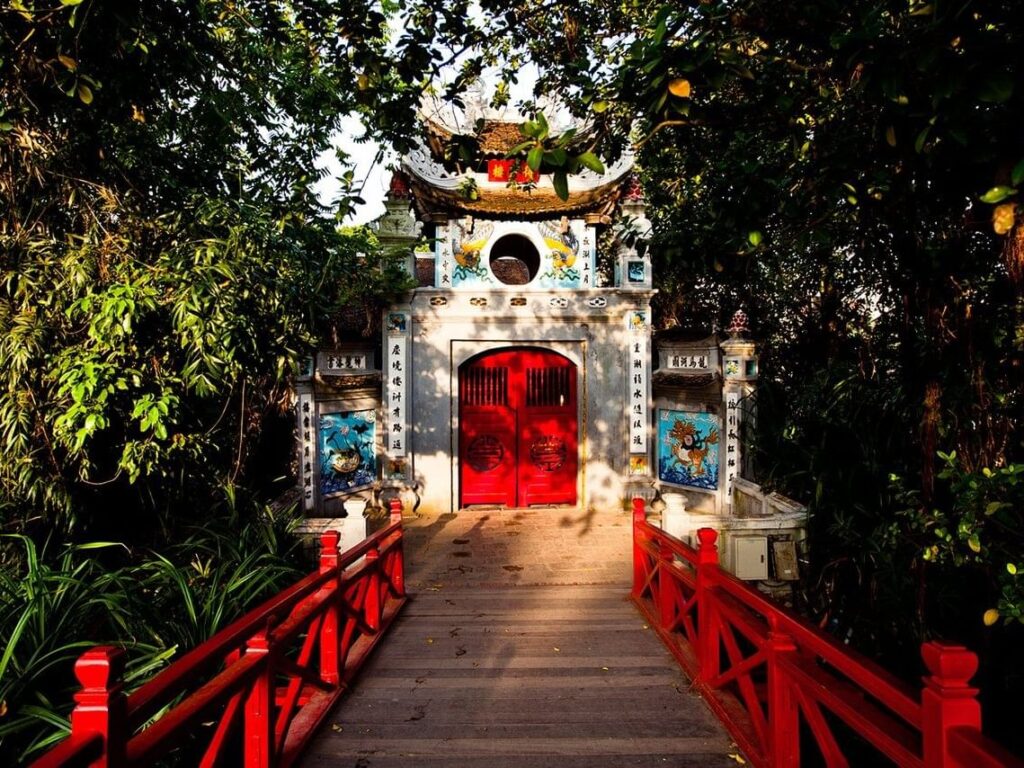
3. The Huc Bridge (Cau The Huc)
The Huc Bridge is the vivid red wooden bridge that connects the eastern shore of Hoan Kiem Lake to Ngoc Son Temple’s island, and it is one of the most photographed spots in all of Vietnam. Its name means “Place Where Morning Sunlight Rests,” and at sunrise, the name proves itself perfectly.
Originally built in 1865, the bridge has been reconstructed several times, most recently after a partial collapse in 2020. Its bold red color against the lake’s green water and surrounding trees creates a visual contrast that stops tourists in their tracks. Walk across it slowly; it is only about 30 meters long, but it deserves your full attention.
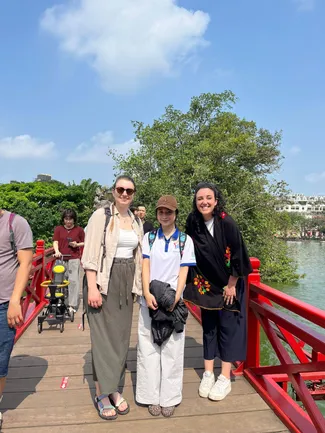
4. Pen Tower (Thap But) and Ink Slab (Dai Nghien)
Pen Tower and Ink Slab are two symbolic stone structures at the entrance of the path leading to Ngoc Son Temple, representing Vietnam’s deep reverence for scholarship and literature. The tower is shaped like a giant writing brush pointing to the sky, inscribed with the phrase “Ta Thanh Thien” (Writing on the Blue Sky). Together with the giant stone ink slab (Dai Nghien) carved in the shape of a peach resting on three toads, they form one of Hanoi’s most quietly meaningful monuments.
These structures are easy to walk past without a second glance, but understanding their symbolism fundamentally changes how you experience the area. They stand as a testament to a culture that has always placed education, writing, and intellectual life at the highest level of societal values.
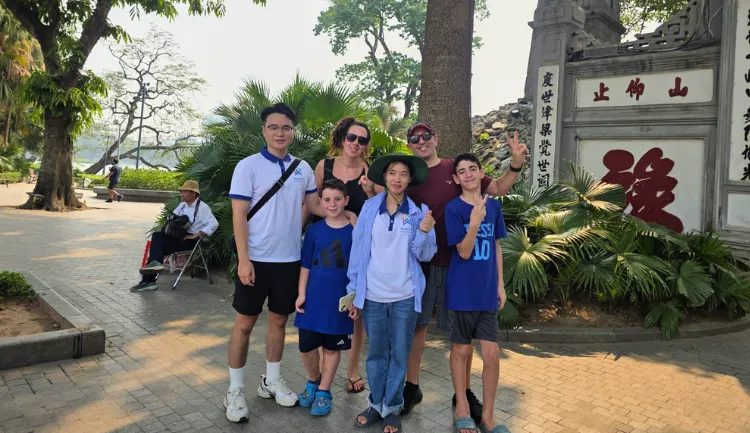
Hoan Kiem Lake Through History: From Ancient Waters to Modern Icon
Hoan Kiem Lake has been shaped by thousands of years of history, from its origins as a section of the Red River to its role as the symbolic heart of independent Vietnam. Knowing this timeline transforms a pleasant lakeside stroll into a walk through centuries.
| Period | Key Event |
| Pre-15th century | Lake known as “Luc Thuy” (Green Water Lake); connected to Red River system |
| 1428 | King Le Loi’s victory over Ming Dynasty; the sword-return legend is born |
| Late 1800s | French colonial development reshapes the lake’s surroundings; Turtle Tower built (~1886) |
| 1865 | Huc Bridge and Ngoc Son Temple complex completed in current form |
| 2004 | Hoan Kiem Lake pedestrian street pilot launched on weekends |
| 2016 | “Cu Rua,” the last Rafetus turtle in the lake, passes away |
| Today | One of the top 3 most visited sites in Vietnam; a UNESCO-recognized cultural heritage candidate |
How to Make the Most of Your Visit to Hoan Kiem Lake
The best way to experience Hoan Kiem Lake is to visit twice: once at sunrise for the meditative, local atmosphere, and once on a weekend evening for the electric energy of the pedestrian street festival. These two visits reveal completely different dimensions of the same place.
Sunrise visit (6:00 – 7:30 AM): This is when the lake belongs to Hanoians. Elderly locals practice Tai Chi and sword dancing on the promenade. Vendors sell hot sticky rice and banh mi from bamboo baskets. The air smells of lake water and incense drifting from nearby temples. There are almost no other tourists. Bring a light jacket; Hanoi mornings can be cool, especially from October to March.
Weekend evening (Friday – Sunday, from 6:00 PM): The roads encircling the lake are closed to motorbikes and cars, turning the entire area into a massive, joyful pedestrian zone. Street food stalls, live music, children learning to cycle, couples on benches, and the lake glowing under warm lights. This is Hanoi at its most alive. If you can only visit once, this is the slot.
Practical tips:
- Getting there: A taxi or Grab from Hoan Kiem District hotels costs under 2 USD. Walking is possible if you stay in the Old Quarter (most guesthouses are within 10 minutes on foot).
- Dress code: No strict code for the lakeside promenade, but cover shoulders and knees if entering Ngoc Son Temple.
- Photography: The best angles for the Turtle Tower are from the southwestern promenade. The Huc Bridge photographs best facing east in early morning light.
- Safety: The area is very safe at all hours, but watch your pockets during crowded weekend evenings.
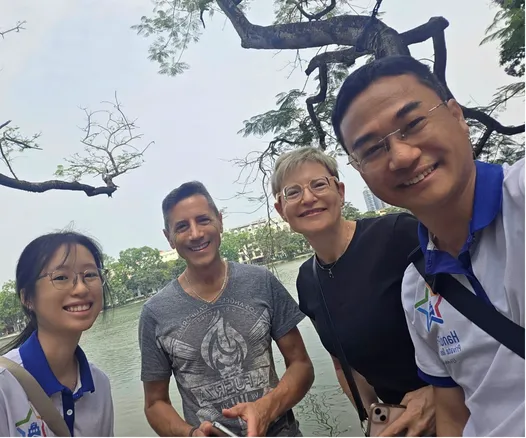
What to Do Near Hoan Kiem Lake: A Local’s Recommended Circuit
Within a 10-minute walk of Hoan Kiem Lake, you have access to Hanoi’s Old Quarter, the French Quarter, several excellent museums, and some of the city’s best street food. The lake acts as a natural hub; most of Hanoi’s unmissable experiences radiate outward from its shores.
Suggested half-day circuit:
- Start at Hoan Kiem Lake at sunrise – walk the full perimeter (~1.8 km), stop at the Huc Bridge view.
- Enter Ngoc Son Temple when it opens at 8:00 AM.
- Walk north into the Old Quarter – explore the 36 ancient guild streets (Hang Bac, Hang Gai, Hang Dao).
- Breakfast at Dinh Liet Street or Hang Bun Street: bun cha, pho, or banh mi from local vendors.
- Visit Ly Thai To Statue and the Indira Gandhi Garden on the southeastern shore.
- Optional: Head south to Hoa Lo Prison Museum (10 minutes on foot) or west to the Temple of Literature (20 minutes by Grab).
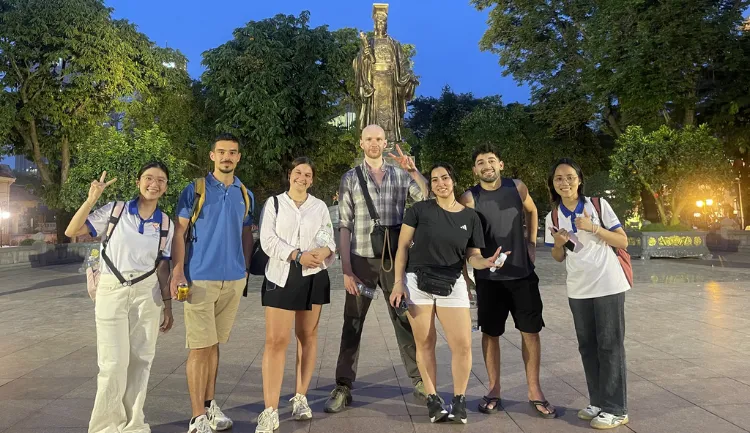
“Don’t rush the lake. Sit down on one of the stone benches for 20 minutes and just watch. You will see more of Hanoi’s real life in those 20 minutes than in a whole day of museum-hopping.”
Hoan Kiem Lake Visitor Information: Everything You Need to Know
| Detail | Information |
| Location | Hoan Kiem District, Hanoi, Vietnam |
| Perimeter | ~1.8 km (comfortable 20-25 min walk) |
| Lake area | ~12 hectares |
| Lakeside access | Free, open 24/7 |
| Ngoc Son Temple hours | 8:00 AM – 6:00 PM daily |
| Ngoc Son Temple fee | ~30,000 VND (adults) |
| Pedestrian street | Friday, Saturday, Sunday evenings from ~6:00 PM |
| Best months to visit | October – April (cooler, clearer weather) |
| Nearest airport | Noi Bai International Airport (~35 km, ~45 min by taxi) |
| Nearest Old Quarter gate | Dong Kinh Nghia Thuc Square (adjacent) |
Why Hoan Kiem Lake Is the Perfect Starting Point for All of Hanoi
Hoan Kiem Lake is not just a sightseeing stop; it is the navigational and emotional compass of Hanoi, and every major neighborhood, market, and attraction is oriented around it. Whether you are heading to the Old Quarter, the French Quarter, Ba Dinh Square, or the night market, you will find yourself returning to the lake again and again as your natural reference point.
More importantly, experiencing the lake properly, slowly, with context, unlocks the rest of Hanoi. Once you understand the legend of the sword, the reverence for Tran Hung Dao at Ngoc Son Temple, and the weekly ritual of the pedestrian street, you begin to see the city through its residents’ eyes rather than as a tourist ticking boxes. That shift in perspective is what makes Hanoi unforgettable.
FAQs About Hoan Kiem Lake
The best time is either at sunrise (6:00 – 7:30 AM) to experience authentic local life and peaceful atmosphere, or on Friday / Saturday / Sunday evenings when the surrounding streets become a vibrant car-free pedestrian zone. For the best weather, visit between October and April.
Walking around the lake is completely free and accessible 24/7. The only paid attraction is Ngoc Son Temple on the island, which charges approximately 30,000 VND per adult (roughly 1.20 USD). Children under a certain height often enter free.
A leisurely walk around the full perimeter takes about 20 to 25 minutes. Add 30 minutes to visit Ngoc Son Temple. If you sit and observe local life, have breakfast at a nearby street food stall, and explore the adjacent streets, a half-day is ideal and deeply rewarding.
The last known giant softshell turtle (Rafetus swinhoei), known as “Cu Rua,” passed away in January 2016. The preserved turtle is now displayed inside Ngoc Son Temple. As of current knowledge, no living specimen of that species remains in the lake, though smaller turtles are occasionally spotted.