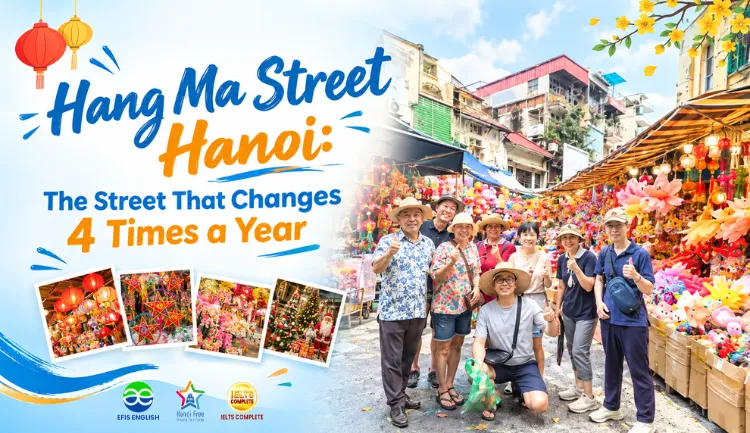
Hang Ma Street Hanoi is a 339-metre strip of the Old Quarter that completely redecorates itself on a festival calendar, and if you time it right it is the most colourful street in Vietnam. This guide explains what the street sells in each season, the exact weeks each “costume” goes up, what things cost, which streets border it, and how to visit without being swallowed by the crowd. Our volunteers walk it every week of the year, so the timing advice below is tested, not guessed.
What is Hang Ma Street Hanoi famous for?
Hang Ma Street Hanoi is famous for selling everything made of paper that Vietnamese families burn, hang or play with during festivals. “Ma” means votive paper, the replica money, houses and clothes burned as offerings to ancestors. Around that permanent trade, the shopfronts swap their stock almost entirely four times a year.
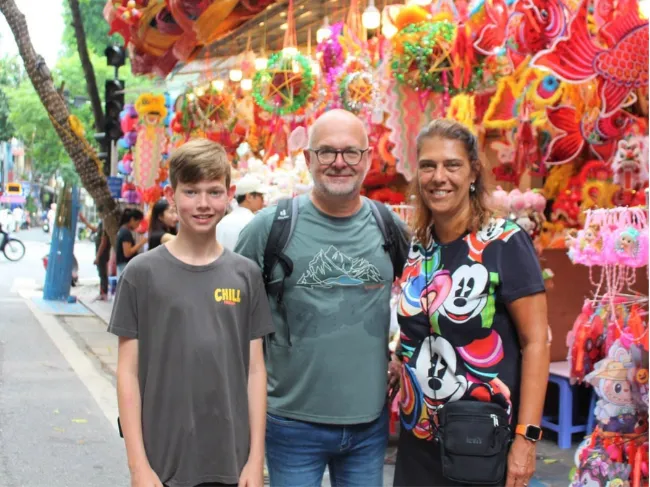
That swap is what makes the street unique. On a random Tuesday in June it is a busy, slightly chaotic paper-goods street that most visitors walk through in five minutes. Three weeks before Mid-Autumn or Tet, the same 339 metres becomes a tunnel of lanterns or a wall of red and gold so dense you cannot see the building facades behind it.
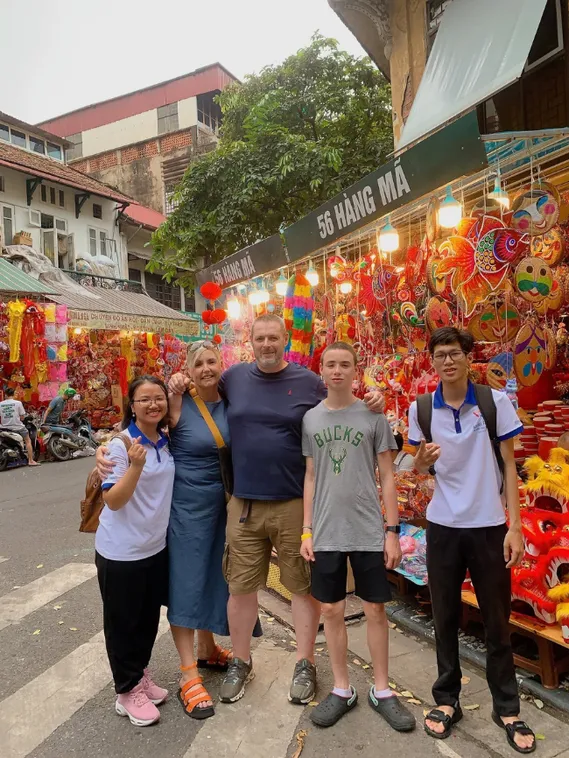
The honest description our guides use: Hang Ma is a festival thermometer. Walk down it and you will know which celebration is coming next without looking at a calendar, because every family in Hanoi shops here for it.
Hang Ma Street Hanoi at a Glance: Length, Borders and Key Facts
Hang Ma Street Hanoi is roughly 339 m long and 8 m wide, running east to west through the northern Old Quarter in Hoan Kiem Ward. Its eastern end meets the Hang Duong, Hang Ngang and Hang Chieu crossroads beside Dong Xuan Market; its western end meets Phung Hung Street and the railway viaduct. Here is everything in one table.
| Detail | Information |
| Vietnamese name | Phố Hàng Mã |
| Length | About 339 m (published figures range 300 to 380 m) |
| Width | About 8 m |
| Direction | East to west |
| East end | Crossroads with Hang Duong, Hang Ngang and Hang Chieu |
| West end | Phung Hung Street and the railway viaduct |
| Administrative area | Hoan Kiem Ward (formerly Hang Ma Ward, Hoan Kiem District) |
| Distance to Dong Xuan Market | About 100 m |
| Distance to Hoan Kiem Lake | About 700 m |
| Core trade | Votive paper and festival decorations |
| Entry fee | Free |
| Typical shop hours | Around 8:00 AM to 10:00 PM, later near festivals |
| Time needed | 20 minutes normally, 60+ minutes in festival weeks |
Which Streets cross or join Hang Ma Street?
Walking from east to west, Hang Ma Street Hanoi meets Hang Duong, Hang Ngang and Hang Chieu at its eastern crossroads, then Hang Ga and Thuoc Bac on the south side, Hang Dong, Hang Ruoi and Hang Cot, then Hang Luoc, before ending at Phung Hung. Several of these side streets absorb the overflow when Hang Ma fills up.
| Joining street | Side | Why it matters |
| Hang Duong / Hang Ngang | East end | The Old Quarter’s main north-south spine, leads to Hoan Kiem Lake |
| Hang Chieu | East end | Leads to O Quan Chuong gate |
| Thuoc Bac | South | Designated motorbike parking during festival markets |
| Hang Ga | South | Quiet route toward Bat Dan and Hang Bo |
| Hang Dong | South | Historically shared a French name with Hang Ma |
| Hang Ruoi | North | Leads toward Hang Luoc |
| Hang Cot | North | Western limit of the festival market zone |
| Hang Luoc | North | Hanoi’s Tet flower market |
| Phung Hung | West end | The railway arches and mural street |
Where does the Name Hang Ma come from?
The name translates simply as “votive paper goods street”, and the trade has not changed since the street was named. The land originally belonged to two villages, Vinh Thai on the eastern stretch and An Phu on the western one, separated by a branch of the To Lich River that was later filled in to create the street.
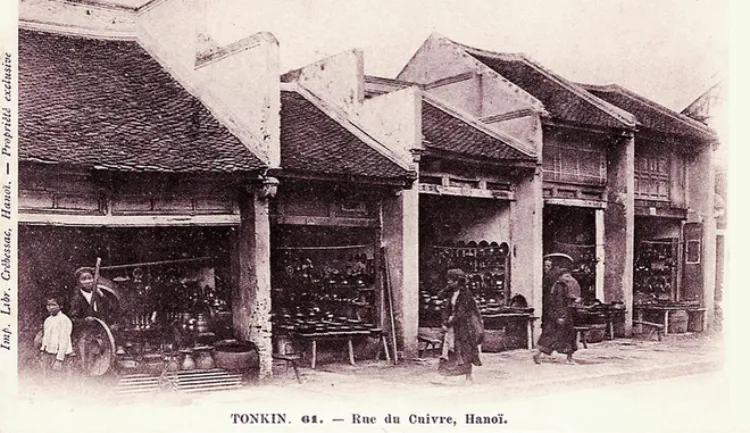
Under French rule the street was grouped with neighbouring Hang Dong under a single name, Rue du Cuivre, “Copper Street”, because the copper trade next door was considered more important. Hanoians ignored it. The paper trade outlasted the French name, which tells you how deeply the street’s identity is tied to what it sells. For the wider story of how guild streets were named, see our guide to the Famous Streets in Hanoi.
How does Hang Ma Street Hanoi change costume through the year?
Hang Ma Street Hanoi changes its stock on a fixed rhythm driven by four festivals, two Vietnamese and two imported. The Vietnamese ones follow the lunar calendar, so their Western dates move by up to three weeks each year; the imported ones are fixed. Shops start stocking roughly three to four weeks before each date.
| Costume | Festival | Stock goes up | Peak weeks | Signature colours |
| 1 | Mid-Autumn (15th day, 8th lunar month) | Mid to late August | 2 weeks before the full moon | Red, gold, rainbow cellophane |
| 2 | Halloween (31 October) | Early October | Last 2 weeks of October | Black, orange, purple |
| 3 | Christmas (25 December) | Mid-November | First 3 weeks of December | Red, green, silver |
| 4 | Tet, Lunar New Year | Early to mid-December | 3 weeks before Tet | Red and gold everywhere |
| Base | Votive paper, all year | Permanent | 7th lunar month and before Tet | Gold, red, printed paper |
The changeovers overlap in practice. By late October you will find Halloween masks on one shopfront and early Christmas trees on the next, and Christmas tinsel often sits beside the first Tet envelopes in mid-December. That overlap is a small bonus: in the weeks between festivals, Hang Ma shows you two costumes at once.
Costume 1: Mid-Autumn Lanterns
Mid-Autumn is the costume Hang Ma Street Hanoi is most famous for, and it is the one Vietnamese families treat as a genuine tradition rather than a shopping trip. The street fills with star lanterns, papier-mâché masks, lion-dance heads and drums for the children’s full-moon festival.
In 2026 the ward organised a formal Traditional Old Quarter Mid-Autumn Market from 11 to 25 September, the 1st to 15th days of the eighth lunar month. It covered the stretch from the Hang Duong crossroads to the Hang Cot crossroads, ran from 7:00 AM to midnight, and the section was closed to cars around the clock with motorbike parking moved to Thuoc Bac Street. Linked events ran at 22 Hang Buom and at the Heritage House at 87 Ma May. Expect a similar format in future years, announced about two weeks before.
The traditional object to look for is the den ong sao, the five-pointed star lantern made from a bamboo frame and coloured cellophane. Plastic battery-powered lanterns now dominate the pavement, but several shops still sell handmade star lanterns, mat na giay boi (papier-mâché masks), den keo quan (the rotating “trotting horse” lantern) and to he, small coloured dough figures. Buy those and you are buying something a Hanoian grandparent would recognise.

Costume 2: Halloween
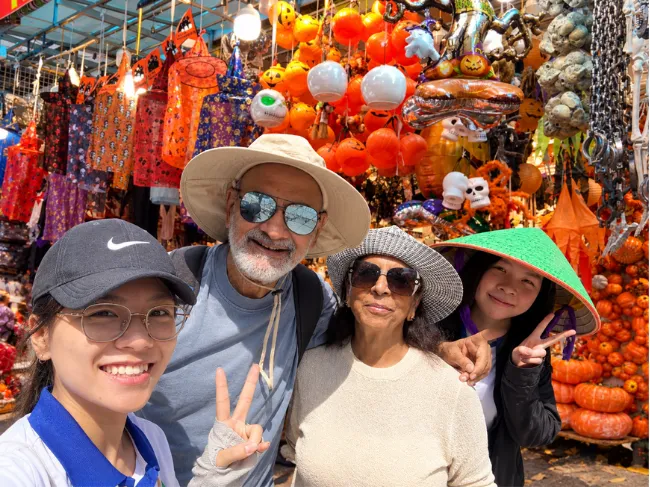
Halloween is the newest costume, and Hang Ma Street Hanoi has adopted it with total enthusiasm. From early October the shopfronts fill with plastic pumpkins, witch hats, skeleton costumes, fake cobwebs and rubber masks.
This is imported culture adopted by young urban Hanoians, mostly for school parties and bars, and it is interesting precisely because it has no traditional roots. There is something quietly funny about a street whose permanent trade is honouring the dead also doing a brisk business in cartoon skeletons. Our guides like pointing that out, and most guests find it delightful rather than jarring.
Costume 3: Christmas
From mid-November, Hang Ma turns red, green and silver: artificial trees, tinsel, baubles, Santa hats and nativity figures. Hanoi’s Catholic community is small but visible, and Christmas has become a broad secular celebration in the city regardless of faith.
Christmas is the most relaxed of the four costumes on Hang Ma Street Hanoi. Crowds are thinner than at Mid-Autumn or Tet, the weather has cooled to the pleasant high teens Celsius, and the stock is bright enough to photograph well. If you are in Hanoi in December and dread crowds, this is your Hang Ma Street Hanoi moment.

Costume 4: Tet, the Lunar New Year
Tet is the biggest costume of the year. From early December, Hang Ma Street Hanoi turns almost entirely red and gold: lucky-money envelopes (li xi), paper couplets, hanging lanterns, gold coin strings, artificial peach and apricot blossoms, and paper decorations shaped like the coming zodiac animal.
The costume spills well beyond Hang Ma. Neighbouring Hang Luoc becomes Hanoi’s traditional Tet flower market, stacked with real peach branches and kumquat trees, and together with Hang Duong and Dong Xuan Market it forms the Old Quarter’s main Tet shopping zone. Tet decorations range from around 10,000 VND for small items to over 500,000 VND for large pieces. The coming Tet (Year of the Goat) falls on 6 February 2027, so the costume will peak through January 2027.
One warning: Hang Ma Street Hanoi is spectacular before Tet and nearly dead during it. Many shops close for several days from New Year’s Eve, and some stay shut for a week.

The everyday costume: Votive Paper and Ghost Month
Under all four festival costumes, Hang Ma Street Hanoi never stops selling its original product: votive paper. This means paper money (including replica US dollars), paper houses, paper cars, paper smartphones, paper clothes and shoes, all burned so ancestors can use them in the afterlife.
Demand peaks at two predictable points. The first is the seventh lunar month, usually falling in August, the “ghost month“ connected to the Vu Lan festival, when families make offerings for wandering souls. The second is the week before Tet, especially around the 23rd day of the twelfth lunar month, when households send off the Kitchen Gods. Walk past on either occasion and you will see paper mansions three storeys high being tied onto motorbikes.
Insider note: our volunteer Minh always tells guests that buying a paper iPhone as a joke souvenir is fine, but do not give one as a gift to a Vietnamese friend. Votive items belong to the dead, and many older Hanoians consider it unlucky to keep them in a living person’s home.
What should you buy on Hang Ma Street Hanoi?
On Hang Ma Street Hanoi, buy the traditional handmade items rather than the plastic imports: bamboo star lanterns, papier-mâché masks, dough figures at Mid-Autumn, and red paper couplets or envelopes at Tet. They cost little more, pack reasonably flat, and carry a real story. Typical prices from the 2026 season:
| Item | Season | Typical price (VND) |
| Small star lantern (den ong sao) | Mid-Autumn | 30,000 to 50,000 |
| Large star lantern | Mid-Autumn | 60,000 to 80,000 |
| Papier-mâché mask (mat na giay boi) | Mid-Autumn | 50,000 to 70,000 |
| Lion-dance head | Mid-Autumn | 200,000 to 800,000 |
| General Mid-Autumn toys | Mid-Autumn | 40,000 to 250,000 |
| Tet decorations | Tet | 10,000 to 500,000+ |
| Lucky-money envelopes, pack | Tet | Low, sold by bundle |
Prices are usually fixed on smaller items and loosely negotiable on larger ones. Pay in cash with small notes; card payment is rare on Hang Ma Street Hanoi, though QR transfers are increasingly common. A papier-mâché mask survives a suitcase surprisingly well if you pack it inside clothes.
When is the Best Time to Visit Hang Ma Street Hanoi?
Visit two to three weeks before a festival, on a weekday, in the morning. That combination gives you full stock, thin crowds and the chance to watch shopkeepers actually building their displays. The final three evenings before Mid-Autumn or Tet are spectacular but genuinely difficult to walk through.
| When | Crowd | What you get |
| Weekday morning, 8 to 11 AM | Low | Full stock, easy photos, shopkeepers willing to chat |
| Weekday evening, 6 to 9 PM | Medium | Lanterns lit, the street at its prettiest |
| Weekend evening in festival weeks | Very high | Atmosphere at maximum, walking at minimum |
| Last 3 days before Mid-Autumn or Tet | Extreme | Crowds spill into Hang Chieu, Hang Ruoi and Thuoc Bac |
| During Tet itself | Very low | Many shops closed |
| Between festivals (e.g. June, early August) | Low | Votive paper only, 5-minute walk |
For photographs, the lantern season is best just after dusk, around 6:30 PM, when the shops switch on their lights but the full evening crowd has not yet arrived. Our volunteers routinely do the opposite of most tourists: they bring guests at 8 AM to watch the displays being unpacked, then return at dusk for the lit version. Seeing both halves of the transformation is the real experience.
How to Get to Hang Ma Street Hanoi
Walk from Hoan Kiem Lake: about 700 m and 10 minutes, heading north up Hang Dao, Hang Ngang and Hang Duong until you reach the crossroads where Hang Ma begins on your left. It is the easiest navigation in the Old Quarter.
| Starting point | Distance | On foot | Notes |
| Hoan Kiem Lake (north end) | 700 m | 10 min | Straight north along the Hang Dao spine |
| Dong Xuan Market | 100 m | 2 min | Enter at the eastern crossroads |
| Phung Hung Mural Street | 300 m | 4 min | Enter from the western end |
| O Quan Chuong gate | 500 m | 7 min | Via Hang Chieu |
| Noi Bai Airport | about 26 km | 40 to 45 min by car | Ask the driver for the Dong Xuan Market end |
During festival markets, cars are banned from the central section and motorbike access is restricted by time slot, so ask Grab to drop you at Dong Xuan Market or on Phung Hung and walk in. City buses stopping at O Quan Chuong leave you about 500 m away.
What Etiquette Applies on Hang Ma Street Hanoi?
On Hang Ma Street Hanoi, treat votive paper with respect, ask before photographing shopkeepers close up, and do not block shopfronts for long photoshoots. Those three habits are enough to be welcomed on a street that sees thousands of visitors a day.
Votive items are religious objects to the families buying them, even when they look playful. Do not pose with paper money as a prop or jokingly wave it around, and do not photograph people who are clearly buying offerings for a funeral or memorial. For the lanterns and decorations, photograph freely; shopkeepers expect it and many will happily switch on a display for you. A quick smile and a gesture toward your camera works better than any phrase.
Space is the other issue. The pavement is narrow and in festival weeks shops extend their stock to the kerb. If you want a long photo session, buy something small first; it changes the shopkeeper’s attitude from tolerating you to helping you.
Short on time? Our volunteer guides build Hang Ma into a hanoi old quarter walking tour and can translate what each festival object is for, which turns a colourful walk into an explanation of how Hanoi families actually celebrate.
Book our free tour guide!

Hanoi Old Quarter Walking Tour
❤❤❤❤❤ (TripAdvisor / GetYourGuide)
Historical Tour – Walking Tour – Small Group
⚑ 3 – 4 hours
✎ Free Tour – Free Cancellation

Hanoi Cultural Exchange
❤❤❤❤❤ (TripAdvisor / GetYourGuide)
Local – Most Popular – Small Group
⚑ 3 – 8 hours
✎ Free Tour – Free Cancellation
What is Near Hang Ma Street Hanoi?
Hang Ma Street Hanoi sits at the northern hinge of the Old Quarter, so four very different stops are within five minutes. Pair it with at least one of them rather than treating the street as a standalone trip.
At the western end, the painted railway arches of Phung Hung Mural Street are a four-minute walk, and one of the murals actually depicts Hang Ma at Mid-Autumn, which makes a neat bookend. Just north, Hang Luoc is worth a detour before Tet for its flower market. At the eastern end, Dong Xuan Market is two minutes away for a cheap meal in its food alley, and Hang Chieu leads to the last surviving city gate.
FAQs About Hang Ma Street Hanoi
Two to three weeks before the 15th day of the eighth lunar month, which falls in September or early October. In 2026 the official Mid-Autumn market ran from 11 to 25 September. Weekday mornings are quietest; the final three evenings before the full moon are the busiest nights of the year on Hang Ma Street.
Hang Ma means “votive paper goods street”. “Hang” means merchandise and “ma” refers to the paper replicas of money, houses and possessions that Vietnamese families burn as offerings to their ancestors. The street has sold these items continuously since it was named, alongside its seasonal festival stock.
Mostly no. Hang Ma Street Hanoi is at its busiest in the three weeks before Tet, but many shops close from New Year’s Eve for several days, and some stay closed for up to a week. Visit before Tet for the red-and-gold costume, not during the holiday itself.
About 339 metres, running east to west from the Hang Duong crossroads next to Dong Xuan Market to Phung Hung Street. You can walk it in five minutes outside festival season. During Mid-Autumn or Tet weeks, allow an hour, because the crowds and the displays slow you to a shuffle.