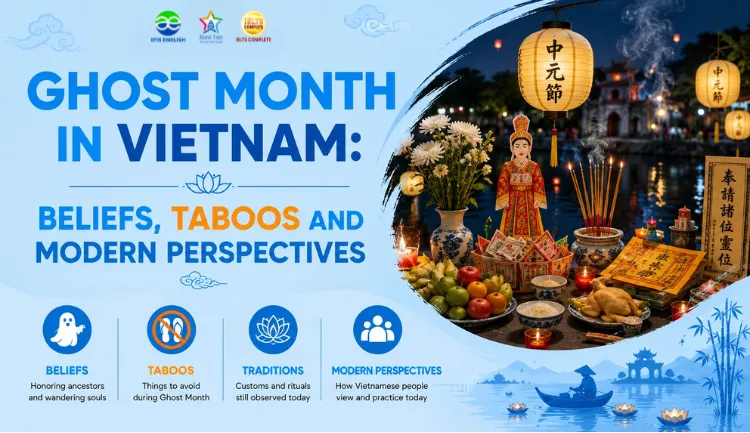
Ghost Month in Vietnam, known locally as “Tháng Cô Hồn”, is the seventh lunar month, when the gates between the living world and the spirit world are believed to open. It is one of the most spiritually significant periods in the Vietnamese calendar, rooted in Buddhist and folk tradition alike. Families use it to honor their own ancestors, feed wandering souls with no descendants, and quietly reflect on the balance between life and death. For visitors, it is also one of the most fascinating windows into how Vietnamese people actually live their beliefs.
What is Ghost Month in Vietnam?
Ghost Month in Vietnam is the 7th month of the lunar calendar, a period when the King of Hell, Diêm Vương, is believed to open the gates of Quỷ Môn Quan and allow spirits to roam the human world. Among these spirits are “cô hồn”, wandering souls with no living descendants to care for them. Vietnamese families respond with a mix of caution and compassion, honoring their own ancestors while also feeding the souls that nobody else remembers.
The month’s most important date is Rằm tháng Bảy, the full moon on the 15th day, which coincides with Vu Lan, the Buddhist festival of filial piety and gratitude toward parents. On this day, households and pagodas alike prepare elaborate offerings, and many Vietnamese people who rarely visit a pagoda the rest of the year will make a point of going on Vu Lan. The saying “cúng cả năm không bằng Rằm tháng Bảy” captures this well: offerings made all year cannot equal what is offered on this single day.

Rituals and practices during Ghost Month in Vietnam
Throughout this period, families follow a mix of rituals aimed at keeping the household in spiritual balance. Each practice serves a slightly different purpose, from honoring relatives to appeasing spirits who belong to no one.
- Ancestor worship: Families prepare trays of food, fruit, flowers, and tea, inviting their own ancestors home for blessings. Our guide to ancestor worship in Vietnam covers the altar rituals behind this in more depth.
- Offerings for wandering souls: On sidewalks and in front of houses, families set out rice, corn, fruit, candy, and small bills for spirits who have no descendants of their own.
- Burning votive papers: Paper money, clothing, and other symbolic goods are burned as gifts for the dead. Our votive papers in Vietnamese culture guide explains the meaning behind this smoke in detail.
- Charity and kindness: Many people donate to those in need or release caged animals, acts believed to build good karma during a spiritually heavy month.
These practices reflect a wider Vietnamese belief in balance between yin and yang, where the living take active responsibility for keeping the unseen world calm and cared for.
Is Ghost Month really unlucky?
In Vietnamese folk belief, yes, the 7th lunar month is considered spiritually risky, though most of that reputation comes from tradition and psychology rather than anything provable. People commonly avoid big decisions during this window and stay more alert than usual. It is best understood as a month of caution, not a month of guaranteed misfortune.
Common folk beliefs include:
- Wandering spirits may cause traffic accidents, so people drive more carefully.
- Businesses often delay big investments, fearing financial loss.
- Staying out late or visiting spiritually sensitive places is thought to weaken one’s health.
- Weddings, contract signings, and house purchases are frequently postponed until the month passes.

Why Do These Ghost Month Beliefs Still Persist Today?
These beliefs persist mainly because of confirmation bias, seasonal timing, and generational habit, not because of any scientific link between the lunar calendar and bad luck. Cultural researchers point to a few overlapping explanations. Understanding them helps put the taboos in context rather than dismissing them outright.
- Psychological effect: People expect something to go wrong, so they notice and remember the negative events that do happen.
- Weather factor: The 7th lunar month usually falls during the rainy season, when accidents and illness naturally increase regardless of the calendar.
- Cultural heritage: The taboos are passed down through generations and absorbed early, long before anyone questions where they came from.
- Modern reinterpretation: Many younger Vietnamese and businesses now treat the month less as something to fear and more as a chance to do good deeds. Food delivery apps and restaurants often run “cúng Rằm” promotions during this period, turning an old belief into a lighthearted seasonal tradition.
When Is Ghost Month in Vietnam? 2026 and 2027 Calendar
It runs for the entire 7th lunar month, which falls between mid-August and mid-September on the Gregorian calendar depending on the year. Because Vietnam follows a lunisolar calendar, the exact dates shift annually, but the structure stays the same: a gate-opening on the 2nd day, a climax on the 15th day, and a gradual gate-closing at month’s end. The table below gives verified dates for both 2026 and 2027, so this guide stays useful whichever year you are reading it.
| Milestone | 2026 (Gregorian) | 2027 (Gregorian) |
| 7th lunar month begins | August 13 | August 2 |
| Gate opening (2nd day) | August 14 | August 3 |
| Rằm tháng Bảy / Vu Lan (15th day, peak) | August 27 (Thursday) | August 16 |
| 7th lunar month ends (gate closing) | September 10 | August 31 |
During the gate-opening window, spirits are believed to be most active, so this is when sidewalk offerings become a common sight across Hanoi and the rest of Vietnam. Vu Lan itself is the single busiest day, with pagodas and temples filling up from early morning. After the 15th day, spiritual activity is thought to taper off gradually, although many families continue to observe caution through the rest of the month.
How to Find Ghost Month Dates in Any Year?
To find Ghost Month dates for any future year, look up the 7th lunar month on a Vietnamese lunar calendar, or simply search for that year’s Vu Lan or Rằm tháng Bảy date, since it always falls on the 15th day. Once you have that date, the month itself runs from roughly two weeks before it to two weeks after. Vietnamese lunar calendar converters and most Vietnamese news outlets publish the coming year’s dates well in advance, usually by the preceding spring.
For travelers planning ahead, it also helps to know that Ghost Month always lands close to Vietnam’s rainy season in the north, so pack accordingly regardless of the exact dates. Our guide to the lunar calendar in Vietnam explains how the wider lunisolar system works, including how leap months occasionally shift a festival by a full lunar cycle.
Things to avoid during Ghost Month in Vietnam
This period comes with a long list of taboos, and while not everyone follows every one of them today, most Vietnamese people still observe at least a few out of habit or respect. Each rule carries its own symbolic logic, usually tied to avoiding contact with wandering spirits or accidentally inviting them closer. Knowing the main ones helps travelers avoid an awkward moment at the dinner table or a confused look from a local host.
Quick-reference table of the most common taboos:
| Taboo | Why It’s Avoided |
| Going out late at night | Spirits are believed strongest around midnight and noon |
| Picking up money or food from the street | It is likely a spirit offering; taking it is seen as stealing from the dead |
| Sticking chopsticks upright in rice | Resembles incense for the deceased, seen as inviting spirits to the table |
| Whistling or calling out at night | Believed to attract or summon wandering spirits |
| Wearing all-white clothing | White is the color of mourning in Vietnam |
| Hanging wind chimes near the bed | The sound is thought to draw spirits into a resting space |
| Big life events (weddings, moving, contracts) | The month is considered spiritually unstable for new beginnings |
Beyond this quick list, several more specific customs are worth knowing in detail.
1. Avoid going out late at night
Midnight and noon are considered yin-heavy hours when spirits are at their strongest, so going out during these windows is thought to raise the risk of an unwanted encounter.
2. Don’t pick up money or food from the street
Coins, rice, or snacks scattered on a sidewalk are almost always an offering to wandering souls. Taking them is considered disrespectful, akin to stealing from the dead.
3. Never stick chopsticks upright in a bowl of rice during ghost month in Vietnam
Two chopsticks standing straight up closely resembles incense sticks placed for the deceased, so doing this at a meal is read as an invitation for spirits to join the table.
4. Don’t whistle, call mames, or take photos at night
Whistling and shouting into empty space are both believed to catch a spirit’s attention. Night photography carries a similar superstition, since a flash is thought to occasionally capture something unintended.
5. Avoid wearing all-white clothes
White is Vietnam’s traditional funeral color, so wearing it head to toe during Ghost Month is thought to draw the wrong kind of attention.
6. Don’t hang wind chimes above the bed
Their sound is pleasant to the living but believed to be equally appealing to wandering spirits, making the bedroom feel like an open invitation.
7. Avoid leaving shoes pointing toward the bed
Shoes aimed at a sleeping person are thought to act as a pathway that guides spirits straight toward them.
8. Don’t dry clothes outdoors at night during ghost month in Vietnam
Clothing left out overnight is believed to attract spirits who may cling to the fabric, carrying bad energy back into the home once worn again.
9. Refrain from sitting near big trees or walls at night
Large trees, old walls, and bamboo groves are traditionally seen as resting spots for wandering spirits, so sitting near them after dark is best avoided.
10. Avoid big life events (Moving, Weddings, Contracts)
A spiritually unstable month is considered a poor time to start a new chapter, which is why many Vietnamese families quietly reschedule big events until after Ghost Month ends.
11. Don’t break dishes or sharpen knives unnecessarily
Broken dishes symbolize discord, and sharp blades are linked to severed ties, so both are avoided to protect household harmony.
12. Avoid cutting hair during ghost month in Vietnam
Hair is traditionally seen as carrying a person’s vital energy, so cutting it during this month is thought to briefly weaken one’s spiritual protection.
13. Don’t eat offerings before incense burns out
The food is considered a gift to ancestors or spirits until the incense burns out, so eating early is seen as taking what isn’t yours yet.
14. Limit lending or borrowing money
Exchanging money at the start of Ghost Month is thought to set an unlucky pattern for the rest of the year, whether you’re the one lending or the one owing.
Whether or not a visitor believes in any of this, these taboos say a great deal about Vietnamese values around respect, caution, and harmony between the living and the dead.
» The Five Elements in Vietnamese Folk Culture
» Lotus flower in Vietnamese culture: Symbol of purity and strength
How Does Ghost Month in Vietnam Compare to Other Asian Ghost Festivals?
Vietnam’s version shares Buddhist and Taoist roots with similar festivals across East and Southeast Asia, but the way each country expresses it looks quite different on the ground. Vietnam leans toward quiet, family-centered ritual rather than public spectacle, which sets it apart from some of its neighbors. The table below highlights the main differences a traveler moving between countries would actually notice.
| Country / Region | Local Name | Core Focus | Signature Practice |
| Vietnam | Tháng Cô Hồn / Vu Lan | Filial piety blended with compassion for wandering souls | Sidewalk offerings of rice, candy, and paper money outside homes |
| China | Zhongyuan Jie | Ancestor worship and appeasing hungry ghosts | Burning joss paper and offerings at crossroads and riversides |
| Taiwan | Ghost Month (Zhongyuan Pudu) | Month-long caution with large public ceremonies | Keelung’s floating lantern releases guiding spirits out to sea |
| Singapore & Malaysia | Hungry Ghost Festival | Community celebration paired with spiritual caution | Getai stage performances, with the front row of seats left empty for spirits |
What makes Vietnam’s version distinct is how tightly it is woven into everyday ancestor worship rather than treated as a separate event. Where Singapore and Malaysia lean into loud, public getai concerts and Taiwan stages large-scale ceremonies in places like Keelung, Vietnam’s version plays out quietly on sidewalks, home altars, and pagoda courtyards. The chopsticks and white-clothing taboos are also more specifically Vietnamese, tied closely to local funeral customs rather than shared regional folklore.
Experiencing Ghost Month in Vietnam as a Traveler in Hanoi
This period is a genuinely rewarding time to be in Hanoi as a traveler, as long as you approach it with curiosity and a bit of respect. Locals themselves treat it as a mix of caution and compassion rather than pure fear, and most businesses run as usual around it. For visitors, the sidewalk offerings and pagoda ceremonies offer one of the clearest, least staged windows into Vietnamese spirituality available at any time of year.
If you’re in Hanoi during Vu Lan Festival, pagodas such as Quan Su Padoga, headquarters of the Vietnam Buddhist Sangha, and Tran Quoc Pagoda on West Lake hold some of the city’s largest Vu Lan ceremonies, drawing crowds from early morning. Arriving before 8am generally means a calmer visit and better photo opportunities before the courtyards fill up. Dress modestly, keep your voice low, and never step over an offering tray left on the ground, even if it looks like it’s simply in your way.

One thing our volunteers often point out to guests is how differently Ghost Month feels once you’re walking through the Old Quarter rather than reading about it. A tray of rice and incense outside a shopfront isn’t decoration, it’s a quiet act of care for someone nobody else remembers, and locals will happily explain the meaning if you ask politely. If a custom like this catches your interest during a visit, it’s exactly the kind of detail our guides love pointing out on a free walking tour through Hanoi’s Old Quarter.
A few practical tips for visiting during this period:
- Visit a local pagoda on Rằm tháng Bảy to see the Vu Lan festival firsthand.
- Never step on or take from offerings placed on sidewalks or house fronts.
- Try the vegetarian dishes many restaurants prepare specially during this month.
- Ask locals about their own family traditions; most are happy to share stories connected to Ghost Month (Tháng Cô Hồn).
Rather than something to fear, it is best seen as a window into how deeply the country holds onto respect for both ancestors and strangers alike, a balance between tradition and the practical realities of modern life.
FAQ about Ghost Month in Vietnam
No, Ghost Month is observed across East and Southeast Asia, including China, Taiwan, Singapore, and Malaysia. Vietnam has its own unique blend of Buddhist and folk practices.
Many young people see it as cultural tradition rather than literal belief. They may still observe certain taboos out of respect for family or community.
Yes, but respectfully. You may observe or join temple ceremonies, but avoid taking food from offerings or disrupting rituals.
From a scientific perspective, no. But for cultural and psychological reasons, many people remain cautious during this time.
Don’t worry, many Vietnamese people believe that sincere apologies, lighting incense, or performing a small offering can restore balance.
By the middle of the 7th lunar month, most Vietnamese families have quietly carried out two duties at once: honoring their own ancestors and feeding the wandering souls nobody else remembers. That balance is the real substance behind Ghost Month in Vietnam, expressed through incense, sidewalk offerings, and a handful of habits passed down for generations rather than through fear alone. Whether you visit during the gate-opening days in mid-August or arrive right on Rằm tháng Bảy itself, understanding these customs turns a simple walk through Hanoi into something far more meaningful. Few periods on the Vietnamese calendar reveal so much about how the living choose to care for the dead, and for the strangers among them.