In Vietnamese folk culture, few philosophical systems are as influential, or as deeply woven into everyday life – as the Five Elements, known traditionally as “Ngũ Hành”. Far more than a symbolic model, the Five Elements in Vietnamese Folk Culture are understood as forces of nature that shape the universe, govern human destiny, and maintain balance between the physical and spiritual worlds.
For centuries, this system guided decisions in healing, architecture, rituals, naming, marriage, agriculture, and even ethics. To understand the Five Elements in Vietnam is to understand a core part of how Vietnamese people perceive harmony and connection.
The origin of the Five Elements philosophy
The concept of the Five Elements originated in ancient Chinese natural philosophy, likely forming during the Zhou Dynasty (around 1046–256 BCE). It became woven into early cosmology and medicine and later became a major foundation for Confucianism, Taoism, Chinese medicine, feng shui, and astrology.
Vietnam adopted the Five Elements through cultural exchanges during the first millennium CE. However, Vietnamese people adapted and localized the theory to fit their own values, agricultural needs, spiritual traditions, and worldview. Over time, the Five Elements became an essential pillar of Vietnamese folk belief, similar to how indigenous communities shape borrowed philosophies to create something uniquely their own.

What are the Five Elements?
The system consists of five dynamic components:
- Metal
- Wood
- Water
- Fire
- Earth
These are not literal materials but symbolic energies, each representing qualities, directions, colors, seasons, organs in the body, and natural patterns. The Vietnamese people believe that everything, the weather, the body, emotions, health, relationships, fortune, and even architecture, is influenced by the balance or imbalance of these five forces.
The two cosmic cycles of the Five Elements in Vietnamese Folk Culture
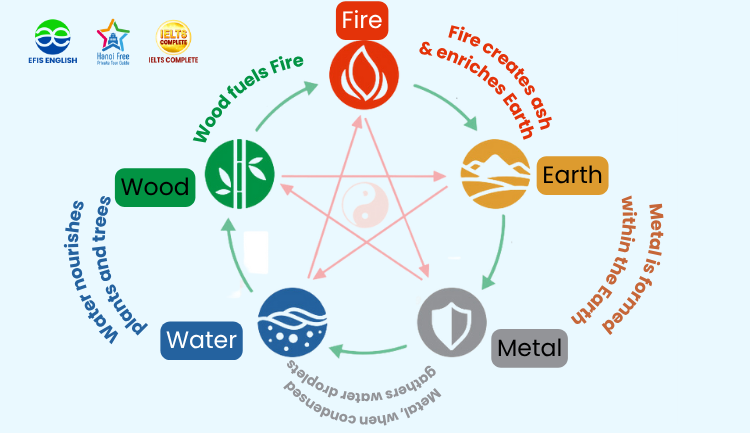
1. The generating cycle (Enhancing Cycle)
This cycle explains how each element nourishes and strengthens the next:
- Wood → Fire: Wood fuels Fire.
- Fire → Earth: Fire creates ash and enriches Earth.
- Earth → Metal: Metal is formed within the Earth.
- Metal → Water: Metal, when condensed, gathers water droplets.
- Water → Wood: Water nourishes plants and trees.
Vietnamese culture views this as the cycle of growth, support, and prosperity. It is used when choosing harmonious colors, meaningful gifts, wedding decisions, or construction materials intended to foster good fortune.
2. The controlling cycle (Balancing Cycle)
To prevent chaos or excess, each element must also restrain another:
- Wood → Earth: Roots break and weaken the Earth.
- Earth → Water: Earth absorbs and blocks Water.
- Water → Fire: Water extinguishes Fire.
- Fire → Metal: Fire melts Metal.
- Metal → Wood: Metal tools cut Wood.
This cycle is not negative, it is necessary. Vietnamese people believe that balance arises only when there is both support and regulation.
The Five Elements and Personal Destiny (The “Life Element”)
In Vietnamese astrology and divination traditions, everyone is born with a dominant life element, connected to their year of birth. This element influences personality traits, emotional tendencies, strengths, and compatible relationships.
Life element profiles
- Metal personalities: Analytical, disciplined, principled, strong-willed. They succeed in leadership, decision-making, and structured environments.
- Wood personalities: Creative, compassionate, growth-oriented. They excel in education, innovation, social fields, and artistic work.
- Water personalities: Adaptable, intuitive, diplomatic. They naturally succeed in communication, psychology, negotiation, and travel.
- Fire personalities: Passionate, charismatic, energetic. They thrive in entertainment, public roles, entrepreneurship, and leadership.
- Earth personalities: Stable, patient, loyal. They make excellent planners, nurturers, builders, and managers.
How to Find Your Personal Element (Bản Mệnh) by Birth Year
Find Your Vietnamese Five Element (Ngũ Hành)
Enter your birth year to see your Bản Mệnh, the traditional element believed to shape your personality, according to Vietnamese folk astrology.
Results appear automatically as soon as you type a valid 4-digit year. Uses your lunar birth year — born in January or early February? Your lunar year may differ, check our Lunar Calendar in Vietnam guide if your birthday falls near Tết.
Your element and its personality profile will appear here.
Your personal element is determined by your lunar birth year, not a shortcut like the last digit of the year. Vietnamese tradition calculates it through Nạp Âm, a system built on the 60-year Can-Chi (stem-branch) cycle, where every pair of consecutive years shares one of 30 poetically named sub-elements. Find your birth year below to see your Bản Mệnh instantly.
A quick note on lunar years: Vietnamese astrology uses the lunar calendar, and Tết (Lunar New Year) usually falls in late January or February. If you were born in early January or before Tết in a given year, your Bản Mệnh actually follows the previous lunar year, not the calendar year on your passport. For the exact cutoff date in your birth year, see our guide to the Lunar Calendar in Vietnam.
| Birth Years | Element | Traditional Name (Nạp Âm) | Meaning |
| 1944, 1945 | Water | Tuyền Trung Thủy | Spring Water |
| 1946, 1947 | Earth | Ốc Thượng Thổ | Rooftop Earth |
| 1948, 1949 | Fire | Tích Lịch Hỏa | Thunder Fire |
| 1950, 1951 | Wood | Tùng Bách Mộc | Pine & Cypress Wood |
| 1952, 1953 | Water | Trường Lưu Thủy | Great Flowing River |
| 1954, 1955 | Metal | Sa Trung Kim | Gold in Sand |
| 1956, 1957 | Fire | Sơn Hạ Hỏa | Fire at the Mountain’s Foot |
| 1958, 1959 | Wood | Bình Địa Mộc | Wood of the Plains |
| 1960, 1961 | Earth | Bích Thượng Thổ | Wall-Top Earth |
| 1962, 1963 | Metal | Kim Bạch Kim | Platinum-like Metal |
| 1964, 1965 | Fire | Phú Đăng Hỏa | Lamp Fire |
| 1966, 1967 | Water | Thiên Hà Thủy | Milky Way Water |
| 1968, 1969 | Earth | Đại Dịch Thổ | Vast Earth |
| 1970, 1971 | Metal | Thoa Xuyến Kim | Jewelry Metal |
| 1972, 1973 | Wood | Tang Đố Mộc | Mulberry Wood |
| 1974, 1975 | Water | Đại Khê Thủy | Great Stream Water |
| 1976, 1977 | Earth | Sa Trung Thổ | Earth in Sand |
| 1978, 1979 | Fire | Thiên Thượng Hỏa | Heaven’s Fire |
| 1980, 1981 | Wood | Thạch Lựu Mộc | Pomegranate Wood |
| 1982, 1983 | Water | Đại Hải Thủy | Great Ocean Water |
| 1984, 1985 | Metal | Hải Trung Kim | Sea Gold |
| 1986, 1987 | Fire | Lư Trung Hỏa | Furnace Fire |
| 1988, 1989 | Wood | Đại Lâm Mộc | Great Forest Wood |
| 1990, 1991 | Earth | Lộ Bàng Thổ | Roadside Earth |
| 1992, 1993 | Metal | Kiếm Phong Kim | Sword-Edge Metal |
| 1994, 1995 | Fire | Sơn Đầu Hỏa | Mountain Fire |
| 1996, 1997 | Water | Giản Hạ Thủy | Stream Water |
| 1998, 1999 | Earth | Thành Đầu Thổ | City Wall Earth |
| 2000, 2001 | Metal | Bạch Lạp Kim | Candle Wax Metal |
| 2002, 2003 | Wood | Dương Liễu Mộc | Willow Wood |
| 2004, 2005 | Water | Tuyền Trung Thủy | Spring Water |
| 2006, 2007 | Earth | Ốc Thượng Thổ | Rooftop Earth |
| 2008, 2009 | Fire | Tích Lịch Hỏa | Thunder Fire |
| 2010, 2011 | Wood | Tùng Bách Mộc | Pine & Cypress Wood |
| 2012, 2013 | Water | Trường Lưu Thủy | Great Flowing River |
| 2014, 2015 | Metal | Sa Trung Kim | Gold in Sand |
| 2016, 2017 | Fire | Sơn Hạ Hỏa | Fire at the Mountain’s Foot |
| 2018, 2019 | Wood | Bình Địa Mộc | Wood of the Plains |
| 2020, 2021 | Earth | Bích Thượng Thổ | Wall-Top Earth |
| 2022, 2023 | Metal | Kim Bạch Kim | Platinum-like Metal |
| 2024, 2025 | Fire | Phú Đăng Hỏa | Lamp Fire |
| 2026, 2027 | Water | Thiên Hà Thủy | Milky Way Water |
| 2028, 2029 | Earth | Đại Dịch Thổ | Vast Earth |
| 2030, 2031 | Metal | Thoa Xuyến Kim | Jewelry Metal |
| 2032, 2033 | Wood | Tang Đố Mộc | Mulberry Wood |
Why 30 names instead of 5? Each of the five core elements is split into six poetic variations that add nuance. Sa Trung Kim (“Gold in Sand”) suggests hidden potential that needs patience to refine, while Kiếm Phong Kim (“Sword-Edge Metal”) suggests sharp, ready-made strength. Both are “Metal”, but Vietnamese elders will often tell you they express that Metal energy differently, this is part of why two people born 12 years apart can share a zodiac animal but “feel” different, elementally.
Quick Compatibility Cheat-Sheet
Every element has one element that supports it, one it supports in return, and two it must actively balance. This table condenses the generating and controlling cycles from earlier in this guide into a single, practical reference you can apply to your own Bản Mệnh, whether you’re checking a partner’s compatibility or picking a lucky color.
| Your Element | Supports You | You Support | Balance Carefully With |
| Metal (Kim) | Earth | Water | Fire and Wood |
| Wood (Mộc) | Water | Fire | Metal and Earth |
| Water (Thủy) | Metal | Wood | Earth and Fire |
| Fire (Hỏa) | Wood | Earth | Water and Metal |
| Earth (Thổ) | Fire | Metal | Wood and Water |
“Balance carefully with” doesn’t mean incompatible, Vietnamese couples with clashing elements marry successfully all the time. It simply means families traditionally pay closer attention to color choices, timing, or small rituals to keep that relationship harmonious.
Why Vietnamese people care about elemental compatibility ?
When planning major life events, Vietnamese families often consider elemental harmony for:
- marriage compatibility
- choosing business partners
- naming a newborn
- selecting house colors or structural layout
- choosing auspicious dates
- purchasing jewelry that strengthens or balances their element
This is not seen as superstition, but as harmonizing human energy with natural forces.
Vietnamese Cosmology 101: Decode Vietnam’s Ancient Worldview
Vietnamese Folk Religion: A Living World You Can’t Unsee
The Five Elements in architecture and Home Design
Traditional Vietnamese homes were built according to elemental harmony, and many modern households still follow similar principles consciously or unconsciously.
Color symbolism aligned with the elements:
- Metal → White, Gold, Silver
- Wood → Green, Teal
- Water → Black, Dark Blue
- Fire → Red, Orange
- Earth → Yellow, Brown
Homes, shops, and temples often combine these colors to create balanced energy.
Placement and direction guided by the elements
Feng shui influences Vietnamese architecture strongly:
- Water features (aquariums, fountains) often placed in the north for career luck
- Wood elements (plants, wooden furniture) in the east
- Fire elements (lights, stoves, colors) in the south
- Earth elements (ceramics, clay items) in the center
- Metal elements (decor, white tones) in the west
The altar – the spiritual heart of the home
Many Vietnamese homes place ancestor altars in areas considered elementally stable and auspicious. Because the altar represents spiritual continuity, it must not conflict with the household’s elemental energy.
Elemental balance creates an environment believed to be:
- harmonious
- protective
- emotionally grounding
- spiritually uplifting
See the Five Elements Come Alive in Hanoi’s Old Quarter
You do not need a temple or a fortune teller to see the Five Elements in action, Hanoi’s Old Quarter is essentially a working museum of Metal, Wood, Water, Fire and Earth if you know where to look. For over 600 years, the district’s 36 guild streets were named after the exact material each guild worked with, and many still carry that material’s elemental identity today.
Walking these streets in order, Metal to Wood to Water to Fire to Earth, roughly retraces the generating cycle explained earlier in this guide, though that route is more coincidence of geography than ancient design. Still, it’s a genuinely fun way to make an abstract philosophy click, and it’s exactly the kind of detail our volunteer guides point out on the Hanoi Old Quarter Walking Tour, free and led by local student volunteers who grew up a few streets from Hang Bac.
Book our free tour guide!

Hanoi Old Quarter Walking Tour
❤❤❤❤❤ (TripAdvisor / GetYourGuide)
Historical Tour – Walking Tour – Small Group
⚑ 3 – 4 hours
✎ Free Tour – Free Cancellation

Hanoi French Quarter Walking Tour
❤❤❤❤❤ (TripAdvisor / GetYourGuide)
Historical Tour – Walking Tour – Small Group
⚑ 3 – 8 hours
✎ Free Tour – Free Cancellation
The Five Elements in Traditional Medicine
Traditional Vietnamese medicine, influenced by East Asian systems, relies deeply on the Five Elements.
Each element corresponds to an organ and emotion:
- Wood → Liver → Anger
- Fire → Heart → Joy
- Earth → Spleen → Worry
- Metal → Lungs → Grief
- Water → Kidneys → Fear
Illness arises when one element is deficient or excessive. Healing involves restoring balance through:
- herbs
- acupuncture
- diet
- breathing techniques
- massage
- energy work
For example:
- A person with excessive “Fire” may experience insomnia, anxiety, or heat-related issues, treated with cooling foods and herbs.
- Someone with weak “Water” may feel exhausted or fearful, treated with nourishing soups, kidney-strengthening remedies, and rest.
The Five Elements in Festivities and Rituals
Vietnamese festivals frequently include symbolic representations of the Five Elements.
Lunar New Year (Tết)
Families prepare a five-fruit tray, where each fruit color corresponds to an element, symbolizing prosperity.
Ancestor worship
Offerings typically include:
- incense (Fire)
- fresh water (Water)
- fruit (Earth)
- flowers or plants (Wood)
- ceremonial objects (Metal)
Together they create a spiritually balanced offering.
Ghost Month rituals
People avoid certain actions (like moving house or major investments) to avoid disrupting elemental harmony.
Weddings and important ceremonies
Color palettes, ritual items, and even pairing decisions consider elemental compatibility to promote future stability.
» Ancestor Worship Vietnam: The soul of Vietnamese culture
» Tet Holiday: The Heart of Vietnamese Culture and Tradition
» Ghost Month in Vietnam: Beliefs, taboos, and modern perspectives
The Five Elements in Arts, Cuisine, and Aesthetics
Vietnamese culture blends elemental symbolism into beauty, creativity, and daily enjoyment.
Cuisine and the five flavors
Traditional cooking aims to harmonize:
- salty (Water)
- sweet (Earth)
- bitter (Fire)
- sour (Wood)
- spicy (Metal)
This balance symbolizes internal harmony and good health.
Folk paintings
Artists use the five elemental colors to express philosophical ideas, spirituality, and cultural identity.
Martial arts
Vietnamese traditional martial arts incorporate movements reflecting the nature of each element – fluid like Water, grounded like Earth, explosive like Fire, and so on.
Why the Five Elements in Vietnamese Folk Culture still matter today
Even in modern Vietnam, the Five Elements remain relevant because they provide:
- a framework for interpreting relationships
- a psychological tool for decision-making
- a cultural link to ancestors
- a philosophy of balance and harmony
- a way to integrate spirituality into everyday life
From choosing lucky days to designing homes and celebrating festivals, elemental understanding continues to guide Vietnamese identity.
FAQ About the Five Elements in Vietnamese Folk Culture
The Five Elements – Wood, Fire, Earth, Metal, and Water – are a traditional system of natural energies believed to govern the universe. They guide harmony in rituals, architecture, medicine, and daily life.
The philosophy originated in ancient Chinese cosmology more than 2,000 years ago and later merged into Vietnamese folk beliefs. Vietnam adapted the concept culturally to fit local spirituality, agriculture, and social values.
No. They are not physical substances but dynamic energies representing growth, transformation, interaction, and balance in nature and human life.
They appear in choosing home directions, altar placement, interior colors, wedding compatibility, naming newborns, cooking flavors, and health practices. The goal is always balance between energies.
Each element corresponds to organs and emotions: Liver (Wood), Heart (Fire), Spleen (Earth), Lungs (Metal), Kidneys (Water). Imbalance can cause emotional or physical issues, treated through herbs, diet, and traditional medicine.
Because elemental compatibility is believed to influence harmony, prosperity, and long-term stability. Families often consult the elements to ensure a balanced partnership.
Yes – sometimes spiritually, sometimes symbolically. Even young people apply the system casually for home decoration, lucky colors, choosing dates, or understanding personality profiles.
The Five Elements in Vietnamese Folk Culture are not an old superstition, they are a living worldview. By shaping rituals, medicine, architecture, ethics, celebrations, and daily choices, this philosophy continues to help Vietnamese people navigate life with a sense of connection, grounding, and cosmic harmony.
To understand the Five Elements is to understand the elegant, symbolic, and spiritual heart of Vietnamese culture.
Curious to explore Vietnam’s spiritual traditions like the Five Elements, ancestor worship, or feng shui in real life?
Join a free walking tour with Hanoi Free Private Tour Guide Club, where passionate local student guides bring cultural stories to life through temples, ancient houses, and hidden corners of the Old Quarter. Book your free tour today and experience Vietnam’s living traditions through the eyes of a local!