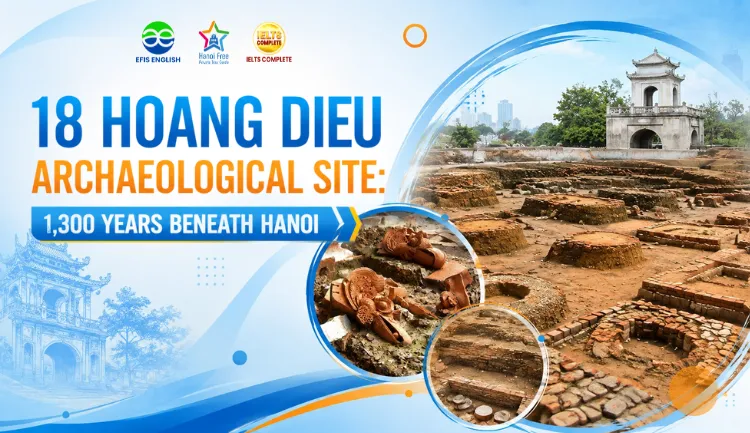
Right beneath the lawns behind Hanoi’s National Assembly, the 18 Hoang Dieu Archaeological Site keeps thirteen centuries of royal history sealed in the soil. This is the spot where, in the winter of 2002, construction workers preparing the ground for a new parliament building stumbled onto the buried skeleton of an entire royal capital. What followed was Vietnam’s largest excavation ever undertaken, and it forced historians to rewrite what they thought they knew about the Thang Long Imperial Citadel.
For our volunteer guides at Hanoi Free Private Tour Guide, the 18 Hoang Dieu Archaeological Site is one of the most rewarding stops on a Ba Dinh walking tour, because nothing else in the city lets a visitor stand on top of nine different centuries at once. Most first-time visitors expect a museum and instead find themselves walking on raised platforms above the actual dig. In this guide, we will walk you through what was found, why it matters, and how to experience it for yourself.
What is the 18 Hoang Dieu Archaeological Site?
The 18 Hoang Dieu Archaeological Site is an open-air excavation in central Hanoi where archaeologists uncovered stacked layers of palace foundations, wells, and royal artifacts spanning multiple dynasties. It sits inside Ba Dinh District, just west of the Kinh Thien Palace platform, and forms the archaeological half of the wider Imperial Citadel of Thang Long complex. Unlike a museum with objects behind glass, this is the actual ground the royal court once walked on, still holding the physical proof of how each dynasty built directly on top of the one before it.
The excavation covers roughly 4.53 hectares of the original dig, though the protected heritage zone recognized by UNESCO extends further. Archaeologists organized the find into four zones labeled A, B, C, and D, each revealing a different slice of the citadel’s layout. Walking between them today feels less like touring ruins and more like reading a cross-section of Hanoi’s entire history, one soil layer at a time.
Why was the 18 Hoang Dieu Archaeological Site Discovered?
The 18 Hoang Dieu Archaeological Site was uncovered by accident in December 2002, when the government began groundwork for a new National Assembly building on Hoang Dieu Street. Within weeks, the construction crew’s shovels were replaced by archaeologists’ brushes, as it became clear the plot sat directly on top of the old Forbidden City of Thang Long. The scale of what emerged was so significant that the parliament project itself had to be redesigned around the ruins.
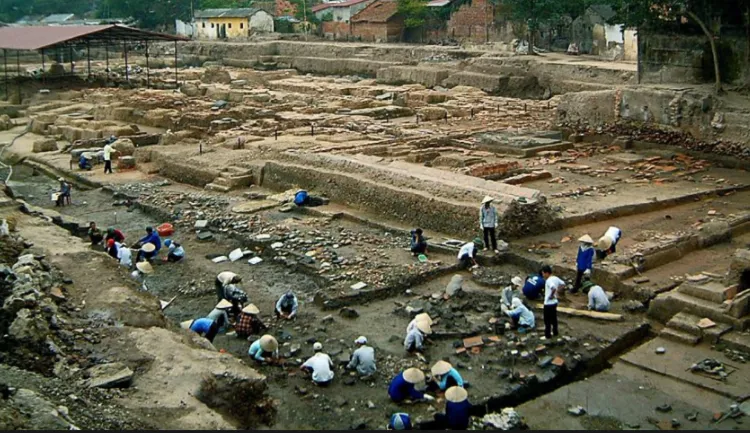
The Vietnam Institute of Archaeology led the dig, eventually documenting 168 individual relic traces across roughly 33,000 square meters by late 2009. That tally includes 95 building foundation traces, 16 boundary wall foundations, 24 wells, and 33 drainage culverts, along with the remains of ponds, a Le dynasty era canal, and even a lacquered wooden boat with its oar and rudder still intact. It is, quite literally, the buried town plan of the old royal capital.
The Four Excavation Zones at 18 Hoang Dieu
Each of the four excavation zones at the 18 Hoang Dieu Archaeological Site tells a different part of the story, from grand multi-room palace halls to delicate garden pavilions. Zone A sits closest to Hoang Dieu Street and holds the clearest architectural footprint, while the deeper pits in Zone D stack several dynasties directly on top of each other. The table below breaks down what each zone contributed to the overall picture.
| Zone | Location Within the Site | Key Discovery | Historical Period Highlighted |
| Zone A | North of the site, along Hoang Dieu Street | A multi-room hall over 70 meters long, marked by 40 gravel-packed column-base pits set in ten rows | Ly and Tran dynasties |
| Zone B | West of Zone A | Eleven clusters of foundations, believed to be hexagonal garden pavilions running 82 meters north to south | Ly and Tran dynasties |
| Zone C | Central excavation area | Overlapping foundation layers, including an octagonal structure some scholars link to Buddhist ritual use | Multiple dynasties |
| Zone D | Southern pits, D4 to D6 | A seven-compartment palace foundation plus gold leaf and inscribed roof tiles naming Kim Quang Palace | Ly, Tran, and Le dynasties |
If you only have time for a quick loop, our volunteers usually recommend starting at Zone A, since its column layout is the easiest for a first-time visitor to read at a glance. From there, the walking tour naturally flows toward Zone D, where the inscribed tiles make the most compelling photo stop. It is exactly this kind of sequencing that a free guided tour with our club can help you get right on your first attempt.
How did Ly Dynasty builders engineer such massive Palaces?
Ly dynasty builders solved Hanoi’s soft, waterlogged delta soil by packing river gravel and clay into deep pits under every column base, a technique strong enough to carry multi-story wooden halls with heavy tiled roofs. Excavators found these gravel piles driven between 1.5 and 3 meters deep, mixed with broken tile and pottery shards for extra compaction, a method also seen at brick towers like Chuong Son and Pho Minh from the same era. This single innovation is why archaeologists consider the 18 Hoang Dieu Archaeological Site proof of an advanced, homegrown engineering tradition rather than a simple copy of foreign palace design. In pit B16, this technique held up the foundation of a three-story, four-roof tower covering roughly 1,000 square meters, the single largest and most significant structure identified at the site so far.
The drainage network below these palaces at the 18 Hoang Dieu Archaeological Site shows the same obsessive precision, and remarkably, it was built without a trace of mortar or binding paste. Archaeologists uncovered channels lined with specially fired trapezoid-shaped bricks on the floor and angled parallelogram-shaped bricks along the walls, a design precise enough that the interlocking shapes alone kept each 17-centimeter-wide culvert watertight for centuries. Paired with the wells, drainage culverts, and lotus pond traces mentioned earlier, this network shows a royal capital that planned its plumbing with almost the same care as its palaces. It is a detail most visitors walk straight past, but our guides like to point out the bricks up close, since the craftsmanship is honestly hard to believe once you have seen it.
What Treasures were found at 18 Hoang Dieu?
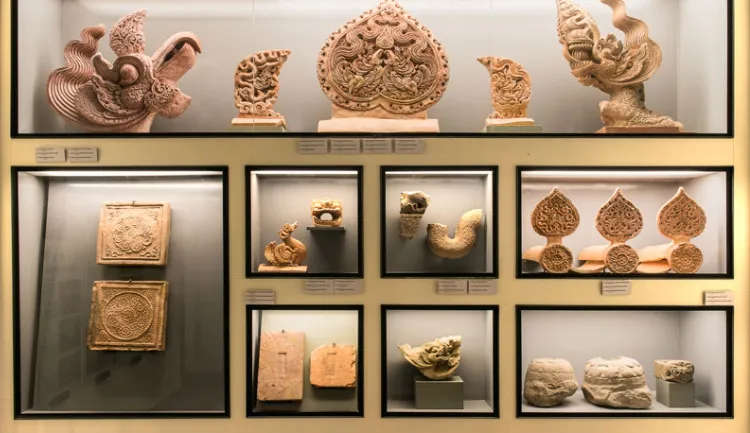
The treasures found at the 18 Hoang Dieu Archaeological Site range from a gold leaf fragment stamped with a Ly dynasty dragon to roof tiles inscribed with the names of long-vanished palaces. Among the standout pieces are tile fragments reading “Hoang Mon thu dan giam tao” from the Tran dynasty and “Kim Quang dien” from the Le dynasty, both confirming that a building called Hoang Mon and a hall called Kim Quang Palace once stood on this exact ground. Archaeologists also recovered blue and yellow glazed roof tiles decorated with five-clawed dragons, a motif reserved strictly for royal use.
One of our longtime volunteer guides likes to pause visitors in front of a preserved well from the Tran dynasty, dated to the 13th or 14th century, because it still holds groundwater more than 700 years after it was dug. It is a small detail, but it tends to land harder than any information panel: a well that outlived six dynasties and is still technically doing its job. Traces of a lotus pond, identified through preserved leaves and roots buried in the mud, round out the picture of a citadel that was landscaped as carefully as it was fortified.

What do the Buddhist Motifs at 18 Hoang Dieu Reveal?
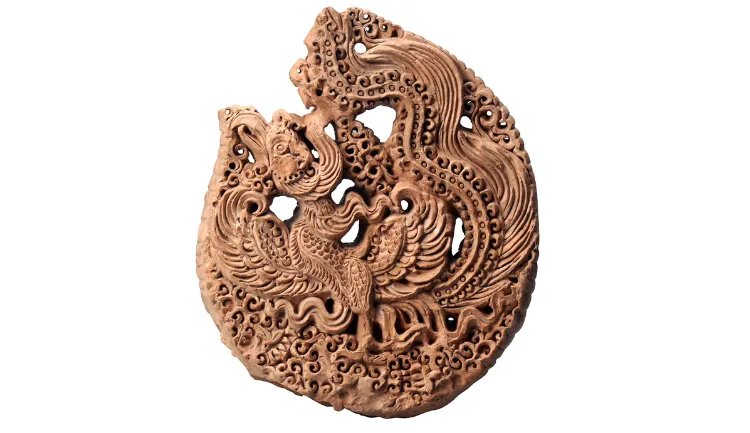
The Buddhist motifs at the 18 Hoang Dieu Archaeological Site show that Buddhism functioned almost as a state religion inside the Ly and Tran royal court, not just in the pagodas outside its walls. The clearest proof is the “La De Chim Phuong“; a roof ornament shaped like a Bodhi leaf, the tree under which the Buddha reached enlightenment, carved on both faces with a pair of phoenixes and unearthed in pit A20. The piece was formally recognized as a National Treasure of Vietnam in 2021, and its craftsmanship is considered among the finest examples of Ly-dynasty decorative art ever recovered. Lotus motifs turn up just as often on the Ly-dynasty ceramics found nearby, carved or glazed onto bowls and pedestal bases, a quiet reminder that the same symbol sacred to Buddhist temples was just as present in daily palace life.
How do the Layers at 18 Hoang Dieu Reveal 1,300 Years of History?
The layers at the 18 Hoang Dieu Archaeological Site reveal 1,300 years of continuous history because each dynasty built its palaces directly on the ruins of the last, stacking evidence like the rings of a tree. Archaeologists can read this vertical timeline from the Dai La period under Chinese governor Cao Bien through to the final Nguyen dynasty additions near the surface. Few archaeological sites anywhere in Southeast Asia preserve such an unbroken sequence in a single dig.
| Period | Approximate Dates | What Was Found |
| Dai La | 7th to 9th century | Earliest citadel foundations under Tang-era Chinese rule |
| Dinh and Early Le | 10th century | Transitional layers marking Vietnamese independence |
| Ly dynasty | 1009 to 1225 | Palace halls, gold leaf ornaments, drainage systems |
| Tran dynasty | 1226 to 1400 | Garden pavilions, the still-functioning well, inscribed tiles |
| Le dynasty (early and restored) | 1428 to 1789 | Kim Quang Palace remains, glazed dragon-motif roof tiles |
| Nguyen dynasty | 1802 to 1945 | Faint surface-level traces near the top layer |
This stacked chronology is exactly why the 18 Hoang Dieu Archaeological Site pairs so naturally with the rest of the Imperial Citadel of Thang Long, where the Kinh Thien Palace foundation and the Doan Mon Gate carry the same story forward above ground. One half of the story sits underground, and the other stands in open air just a short walk away. Seeing both halves in one visit is really the only way the timeline clicks into place.
Visiting the 18 Hoang Dieu Archaeological Site
You can visit the 18 Hoang Dieu Archaeological Site through the main heritage gate at 19C Hoang Dieu Street in Ba Dinh District, the same entrance used for the wider Thang Long Imperial Citadel complex. A standard adult ticket costs around 30,000 VND, with free entry for children under 15, and the 18 Hoang Dieu Archaeological Site is typically open daily except Monday. Because opening hours and access to individual excavation pits can shift for conservation work, it is worth checking current details before you go, or simply joining a guide who already knows the day’s layout.
Plan for at least 90 minutes if you want to see the excavation zones alongside Doan Mon Gate, the Kinh Thien Palace platform, and the wartime command house D67. Mornings are cooler and give softer light for photos, and the months from October to April are generally the most comfortable for walking the open courtyards. Comfortable shoes matter more than most visitors expect, since the route covers gravel paths, raised walkways, and grassy stretches between each zone.

Is there a Museum Hidden Beneath the National Assembly?
Yes, a separate archaeological exhibition sits inside the basement of the National Assembly building itself, just a short walk from the open-air 18 Hoang Dieu Archaeological Site, and it is arguably the most underrated stop in the entire area. Spread across roughly 3,700 square meters on two basement levels, one themed “Pre-Thang Long” and the other “Thang Long”, the display uses 3D projection and lighting to recreate a Ly-dynasty palace wall at its true height of 2.72 meters. A thick glass walkway lets visitors walk directly above a preserved section of the original dig, so you are quite literally standing over the same soil described earlier in this guide.
Unlike the walk-up ticket for the main citadel, access to this underground museum is normally reserved for organized groups who register in advance through the National Assembly Office, sometimes with a formal letter of introduction. This makes it a wonderful bonus for visitors who plan ahead, but not something you can simply show up to on the day. If this level of detail interests you, it is worth asking a local guide to check current access before you build your itinerary around it.

Why the 18 Hoang Dieu Archaeological Site matters for UNESCO Heritage
The 18 Hoang Dieu Archaeological Site matters for UNESCO heritage because it supplied the physical, underground evidence needed to prove the citadel’s thirteen centuries of continuous use. When UNESCO inscribed the Central Sector of the Imperial Citadel of Thang Long as a World Heritage Site in 2010, this excavation was central to the case, since surface ruins alone could not have demonstrated such an unbroken timeline. The recognized core zone covers 18.395 hectares combined with the older citadel remains, backed by a 108-hectare buffer area.
Local and international scholars have called the find one of the most significant archaeological discoveries in Vietnamese history, and it is easy to see why once you have walked the zones yourself. It elevated Thang Long from a well-documented capital in old texts to a physically verified one beneath modern Hanoi. That distinction, dug up rather than merely written down, is what continues to draw historians and curious travelers back to Hoang Dieu Street.

FAQs about 18 Hoang Dieu Archaeological Site
Yes, the site is open to independent visitors through the shared entrance for the Imperial Citadel of Thang Long at 19C Hoang Dieu Street. A single ticket covers the excavation zones along with the above-ground relics like Doan Mon Gate and the Kinh Thien Palace foundation. No advance booking is required for general entry, though joining a scheduled guided walk is worth arranging ahead of time.
The site sits in Ba Dinh District, a short taxi, ride-hail, or bus ride from Hoan Kiem Lake or the Old Quarter. Bus route 22 stops close to the main gate, and the location is walkable from nearby landmarks like Ho Chi Minh Mausoleum and the One Pillar Pagoda. Most visitors combine all three stops into a single half-day loop around Ba Dinh Square.
The 18 Hoang Dieu Archaeological Site is the underground excavation area, while the wider Imperial Citadel of Thang Long refers to the above-ground relics like Doan Mon Gate, the flag tower, and the Kinh Thien Palace platform. Together they form one UNESCO-listed heritage complex, with Hoang Dieu supplying the buried evidence behind the story told above ground. Visitors typically see both sections on the same ticket and the same walking loop.
Most visitors need 45 minutes to an hour for the excavation zones alone, or closer to two hours if combining it with the rest of the citadel complex. Joining a guided walk usually makes this more efficient, since a guide can prioritize the zones and artifacts that match your specific interests. Rushing through in under 30 minutes tends to leave visitors confused about which layer belongs to which dynasty.
Book our free tour guide!

Hanoi Old Quarter Walking Tour
❤❤❤❤❤ (TripAdvisor / GetYourGuide)
Historical Tour – Walking Tour – Small Group
⚑ 3 – 4 hours
✎ Free Tour – Free Cancellation

Hanoi City Tour
❤❤❤❤❤ (TripAdvisor / GetYourGuide)
Most Popular – Walking Tour – Small Group
⚑ 3 – 8 hours
✎ Free Tour – Free Cancellation