The One Pillar Pagoda (Chùa Một Cột) has stood as Hanoi’s most iconic symbol for nearly 1,000 years. Built in 1049 during the Lý Dynasty, this extraordinary Buddhist pagoda rises from a lotus pond on a single stone pillar and is officially certified as Asia’s most unique architectural pagoda. If you’re planning a visit to the Ho Chi Minh Complex in Ba Dinh District, this guide covers everything you need to know.
One Pillar Pagoda: Essential Visitor Information
Before diving into the history and symbolism, here are the practical facts every visitor needs.
| Detail | Information |
| Official Name | Diên Hựu Tự (延祐寺) / Liên Hoa Đài |
| Vietnamese Name | Chùa Một Cột |
| Address | Ông Ích Khiêm Street, Ngọc Hà, Ba Đình, Hanoi |
| Opening Hours | 7:00 AM – 6:00 PM, daily |
| Entrance Fee | Free for Vietnamese / 25,000 VND (~1 USD) for foreigners |
| Nearest Landmarks | Ho Chi Minh Mausoleum, Ba Dinh Square, Presidential Palace |
| Getting There | Bus lines 09ACT, 09A, 18 (stop: 15A Lê Hồng Phong, 200m walk); Grab/taxi available |
| Dress Code | Modest attire required (cover shoulders and knees) |
| Photography | Permitted on the grounds |
| Best Time to Visit | Early morning (7–9 AM) for crowds and light |
| National Recognition | National Historic & Architectural Relic (1962) |
| International Recognition | Asia Book of Records: Most Unique Architectural Pagoda (2012) |
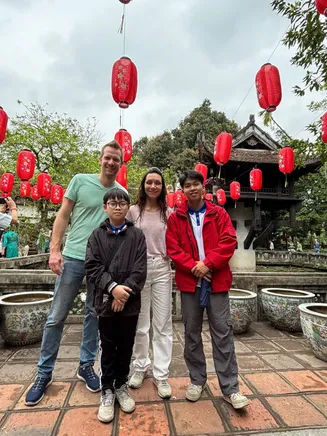
What is the One Pillar Pagoda and Why is It so Famous?
The One Pillar Pagoda is a 975-year-old Buddhist temple built on a single stone pillar rising from a square lotus pond in central Hanoi. It is famous for two reasons: its extraordinary architecture, which has no parallel in Asia, and its deep spiritual significance as a place of prayer for fertility, health, and enlightenment.
In 2006, the Vietnam Records Organization recognized it as Vietnam’s most architecturally unique pagoda. Then in October 2012, the Asia Book of Records officially certified it as “The Most Unique Architectural Pagoda in Asia”. These aren’t just honorary titles; they reflect a genuine architectural achievement that has endured wars, reconstruction, and nearly ten centuries of history. For any traveler visiting Hanoi’s Ba Dinh District, skipping this site would be a serious mistake.
The Legend Behind the One Pillar Pagoda
The One Pillar Pagoda was born from a dream. Emperor Lý Thái Tông had ruled without an heir for years, and his nightly prayers at Buddhist temples went unanswered. Then came the dream: the Bodhisattva Avalokiteshvara (Quan Âm Bồ Tát), the Goddess of Mercy, appeared to him seated on a radiant lotus flower and handed him a baby boy.
On the advice of a monk named Thiền Tuệ, the emperor married a young peasant woman shortly after. She gave birth to a son, and the grateful emperor kept his vow. In 1049, he ordered the construction of a pagoda designed in the exact shape of his dream: a lotus flower rising from the water, supported by a single pillar representing the lotus stem. This is not folklore decoration; historical records from the Lý Dynasty confirm the 1049 construction date, and the original Linh Chiêu Pond that surrounds the pagoda was expanded in 1105 by Emperor Lý Nhân Tông.
How Was the One Pillar Pagoda Designed and Built?
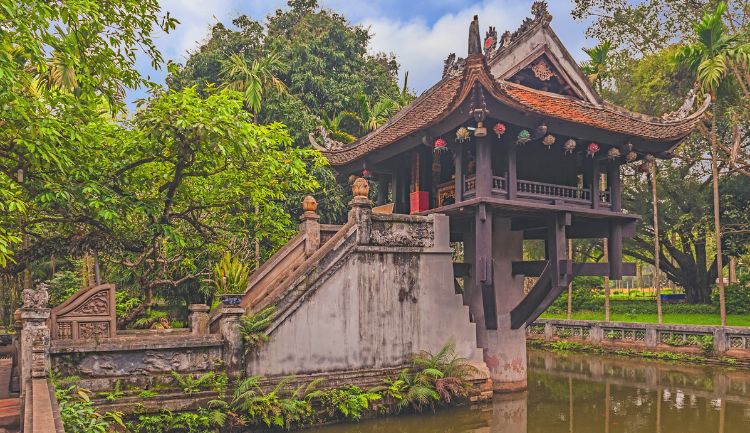
The One Pillar Pagoda achieves something architecturally astonishing: a full wooden temple supported entirely by one stone pillar, approximately 1.25 meters in diameter and 4 meters tall, rising from the center of the square Linh Chiêu Pond. The wooden shrine on top measures roughly 3 square meters, making it one of the smallest yet most recognizable religious structures in Southeast Asia.
Every element of the design carries meaning. The structure intentionally mirrors a lotus flower emerging from muddy water, one of Buddhism’s most powerful metaphors for spiritual purity overcoming worldly suffering. The roof tiles are laid in a traditional “double skill” dragon-scale pattern, with four upturned eaves curved like sword blades pointing skyward. At the roof’s peak, two carved dragons face a central moon, a design motif symbolizing yin and yang balance in Vietnamese spiritual architecture. The dragons represent yang; the moon, yin; together they form the number three, symbolizing fertility, which is precisely why so many couples come here to pray.
To enter the shrine at Liên Hoa Đài, visitors climb 13 stone steps, each approximately 1.4 meters wide, flanked by brick walls that still carry the original Lý Dynasty style. On the temple grounds, you’ll also find a large Bodhi tree, a personal gift from the President of India to President Hồ Chí Minh during a visit in February 1958.
Insider tip from our guides at Hanoi Free Private Tour Guide: On the first and fifteenth days of each lunar month, the pagoda holds a ceremonial incense-burning and cleansing ritual that very few tourists know about. If your travel dates align, arriving early on these days gives you a rare chance to witness a living Buddhist tradition that has barely changed in centuries.

The One Pillar Pagoda’s Destruction and Reconstruction
The One Pillar Pagoda was deliberately destroyed in 1954. As French colonial forces withdrew from Hanoi following their defeat in the First Indochina War, they dynamited the pagoda, leaving only the stone pillar and scattered wooden beams. It was an act that shocked Vietnamese society deeply, as the pagoda had stood for over 900 years.
The response was swift. In 1955, the Ministry of Culture of the Democratic Republic of Vietnam commissioned architect Nguyễn Bá Lăng to lead the reconstruction, working from historical records, photographs, and drawings to stay true to the original Lý Dynasty form with some Nguyễn Dynasty stylistic refinements. By 1955, the pagoda was restored to its current appearance, and in 1962, the entire complex was officially designated a National Historic and Architectural Relic. This is the structure you see today, a faithful reconstruction that has stood for over 70 years and continues to serve as an active place of worship.
What to Expect When Visiting the One Pillar Pagoda?
Visiting the One Pillar Pagoda takes roughly 20 to 40 minutes, though most travelers combine it with a larger tour of the Ho Chi Minh Complex, which can fill a half-day. The site has a genuinely peaceful atmosphere, despite being one of Hanoi’s most visited landmarks.
Here is what you will experience on arrival. The main approach leads through the Tam Quan Gate (three-entrance gate) of Diên Hựu Pagoda, a broader complex that surrounds the iconic single-pillar structure. The Linh Chiêu Pond reflects the pagoda beautifully, particularly in the soft light of early morning. Lotus flowers bloom in the pond depending on the season, typically May through September, creating some of the most photographed scenes in all of Hanoi.
You can climb the 13 stone steps to stand at the entrance of the upper shrine, though you cannot enter the interior. Locals come here consistently to burn incense and pray, particularly couples hoping for children, a tradition unbroken since the Lý Dynasty. Respectful visitors are welcome to observe. Remove your shoes before stepping onto the stairway platform, keep voices low, and avoid pointing at the altar. The pagoda takes ten minutes to see and a lot longer to understand, which is why our guides explain it in context during a private Hanoi city tour.
The One Pillar Pagoda Within the Ho Chi Minh Complex
The One Pillar Pagoda sits inside the Ho Chi Minh Complex in Ba Dinh District, which makes it incredibly easy to combine with a full morning of historical sightseeing. The complex is one of Hanoi’s most significant political and cultural zones, and the pagoda adds a spiritual dimension to what is otherwise a civic and historical tour.
| Site | Distance from One Pillar Pagoda | Notes |
| Ho Chi Minh Mausoleum | ~200 m | Requires separate visit schedule (Tue–Thu, Sat–Sun, AM only) |
| Presidential Palace | ~300 m | Ho Chi Minh’s former office and stilt house |
| Ba Dinh Square | ~350 m | Site of Vietnam’s Declaration of Independence (1945) |
| Ho Chi Minh Museum | ~150 m | Modern museum tracing Ho Chi Minh’s life |
| Bộ Lãnh Đạo Bunker | ~400 m | Underground wartime command center |
Note on visiting the Mausoleum: The Ho Chi Minh Mausoleum operates on a restricted schedule (Tuesday to Thursday and Saturday to Sunday, 7:30 to 10:30/11:00 AM). Plan your One Pillar Pagoda visit around this schedule if you want to see both on the same morning.
Why Do People Come to the One Pillar Pagoda to Pray?
People visit the One Pillar Pagoda primarily to pray for fertility, health, and good fortune, following a tradition tied directly to the founding legend of the pagoda. Because Emperor Lý Thái Tông built it in gratitude for a son born after divine intervention, the pagoda became associated with blessings for couples struggling with infertility. This belief has been sustained for nearly 1,000 years.
The Goddess of Mercy, Quan Âm Bồ Tát, is enshrined at the heart of Liên Hoa Đài. In Vietnamese Buddhist belief, she responds to sincere prayers from those in need, and fertility is among the most common requests. On the first and fifteenth days of each lunar month, the management board holds formal prayer ceremonies that attract large numbers of local worshippers. Many foreign visitors are moved by the sincerity of devotion they witness here, far removed from the transactional spirituality sometimes felt at more commercialized sites.
Cultural Heritage and International Recognition
The One Pillar Pagoda has earned its place in the official records of Vietnamese and Asian heritage through documented recognition at multiple levels. These are not honorary plaques; they reflect a genuine and enduring cultural legacy.
In 1962, the full architectural complex, including the Diên Hựu Pagoda, Linh Chiêu Pond, Tam Quan Gate, and surrounding grounds, was designated a National Historic and Architectural Relic by the Vietnamese government. In 2006, the Vietnam Records Organization named it the most architecturally unique pagoda in Vietnam. In October 2012, the Asia Book of Records certified it as Asia’s Most Unique Architectural Pagoda at a ceremony in India. Today it is also associated with the broader Thăng Long Imperial Citadel area, a UNESCO World Heritage Site, as part of Hanoi’s layered feudal and spiritual landscape.
The pagoda appears in Vietnamese textbooks, on stamps, in architectural journals, and in miniature form across souvenir shops throughout the country. Few structures in Vietnam carry both the historical weight and the visual immediacy of this lotus rising from water.
FAQs: One Pillar Pagoda
Vietnamese citizens visit the One Pillar Pagoda for free. Foreign tourists are charged an entrance fee of 25,000 VND per person (approximately 1 USD). The site is open daily from 7:00 AM to 6:00 PM.
The One Pillar Pagoda is built from wood, supported by a single large stone pillar approximately 1.25 meters in diameter and 4 meters tall. The stone pillar rises from the center of a square lotus pond (Linh Chiêu Pond). All joints in the wooden structure were designed without nails, using traditional Vietnamese interlocking woodwork techniques.
The single pillar is architectural symbolism, not structural limitation. The entire pagoda is designed to resemble a lotus flower rising from muddy water on its stem, one of Buddhism’s central metaphors for spiritual purity. The single pillar represents the lotus stem; the wooden shrine above represents the bloom. Emperor Lý Thái Tông ordered this specific design to honor a divine dream in 1049.
A standalone visit to the One Pillar Pagoda takes about 20 to 40 minutes. Most visitors combine it with the Ho Chi Minh Mausoleum, Presidential Palace, Ho Chi Minh Museum, and Ba Dinh Square in a half-day tour of the Ba Dinh District.
The One Pillar Pagoda distills nearly 1,000 years of Vietnamese Buddhism, architectural ingenuity, and royal devotion into a structure barely 3 square meters in size. What makes it remarkable is not its scale but its endurance: through French destruction, reconstruction, and the relentless pace of modern Hanoi, this lotus-shaped shrine has continued its function as a living place of prayer and cultural identity. Recognized by both Vietnamese national authorities and the Asia Book of Records, it belongs at the top of any Hanoi itinerary. Combine your visit with the Ho Chi Minh Complex next door, arrive early, and if you want the full story told by someone who grew up knowing it, bring a local guide.