
Ao Dai Vietnam is the flowing silk tunic that turns any street in Hanoi into a runway, and the first time I watched a bride glide down Hang Gai Street wearing one, I finally understood why locals call it “the soul wrapped in silk”. This article walks you through the ao dai’s real history, what its colors and cuts actually mean, and exactly where in Hanoi you can see, try, or buy one for yourself. By the end, you will know how to spot authentic craftsmanship and wear the dress the way Vietnamese people actually do.
What is Ao Dai Vietnam?
Ao Dai Vietnam is the country’s national costume: a long tunic with two flowing panels, worn over wide-legged silk trousers. The name itself simply means “long shirt” in Vietnamese, though there is nothing simple about how much meaning locals pack into it. Traditionally the tunic has a high mandarin collar, fitted bodice, and side slits that begin at the waist and run down to the ankle, letting the fabric move with every step.
Both men and women once wore ao dai, but today it is worn mostly by women for formal occasions, school days, and important holidays. Men still wear a heavier, boxier version, usually dark brocade, for weddings and ancestral ceremonies. What makes the ao dai so distinct is how it balances modesty and elegance at once: it covers the arms and legs completely, yet the fitted cut and side slits reveal the shape of the body in a way few other traditional dresses in Asia attempt. Grandmothers, students, and diplomats’ wives can all wear the same basic pattern and look entirely different in it.

The History of Ao Dai Vietnam: From Ao Ngu Than to today’s silhouette
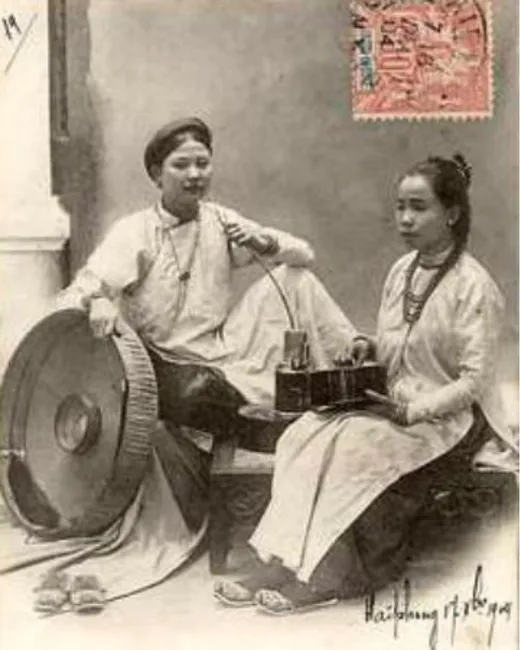
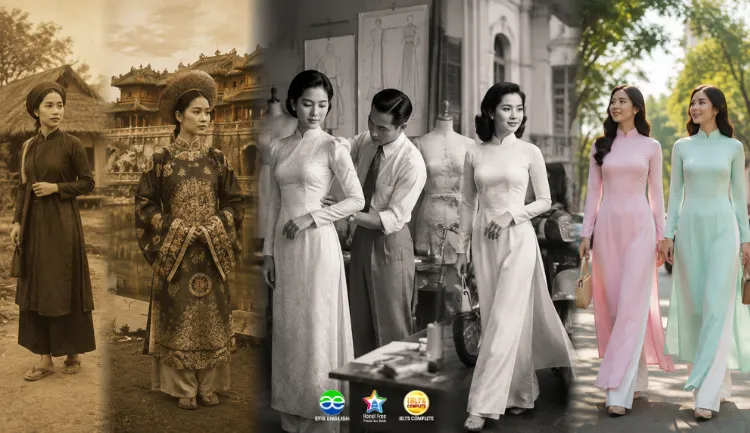
The history of ao dai in Vietnam stretches back more than three centuries and is really the story of three cities, not one: Hue, where the design was first codified, Hanoi, where it was reinvented, and Saigon, where it was perfected into the fitted shape worn today. Its most distant known ancestor is the ao giao linh, a cross-collar robe with Chinese-influenced tailoring worn in the 17th and 18th centuries. Rural women in the north and center later simplified this into the ao tu than, a looser four-panel dress worn over a yếm and a plain skirt, practical enough for farm work while still symbolically tying the wearer to their two sets of parents through its four outer panels.
In 1744, Lord Nguyen Phuc Khoat, ruling from Phu Xuan, the citadel that is now the city of Hue, mandated a five-panel gown called ao ngu than for his court. The design borrowed elements from Cham dress out of respect for the region’s indigenous population, and it used a straight collar and fitted torso rather than the looser cut of earlier robes. That five-button robe became the formal dress of the Hue imperial court, and under Emperor Minh Mang it later spread as official attire from the north to the south, making it the direct grandparent of the modern ao dai and the reason Hue’s own cultural authorities still credit Nguyen Phuc Khoat with turning the ao dai into a true national costume.
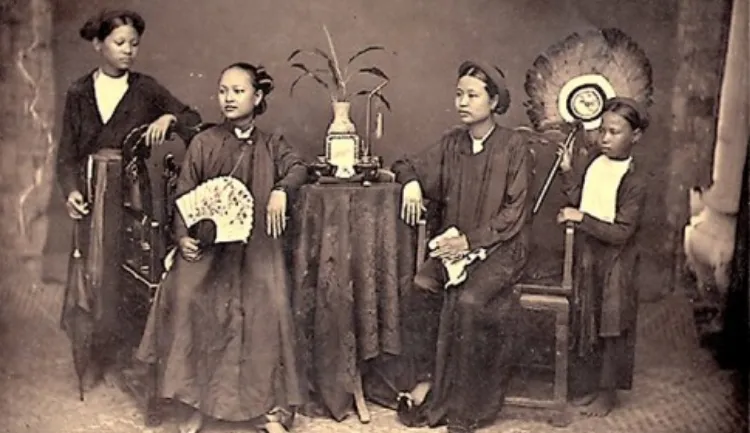
The fitted shape we recognize today was not born in a palace but in a 1930s Hanoi art studio. Designer Nguyen Cat Tuong, known by his French name Le Mur, restyled the ao ngu than with a heart-shaped collar, puffed shoulders, and a single seamless front panel influenced by French couture, a look tied to the founding of the Ecole des Beaux-Arts de l’Indochine in Hanoi. Conservative critics condemned it at first, and only a handful of artists dared wear it in public. Four years later, painter Le Pho toned the design down, removing the puffed sleeves and fitting it closer to the body, and this calmer version is what carried the ao dai through the next three decades largely unchanged.

Politics interrupted the ao dai’s rise more than once. In 1947, Ho Chi Minh encouraged Vietnamese women to favor practical clothing suited to wartime work, which pushed the ao dai out of daily life and into formal occasions only. After national reunification in 1975, the dress was treated for a period as a symbol of pre-revolutionary excess and largely disappeared from public life, only returning to Vietnamese schools and offices in the late 1980s once the Doi Moi economic reforms reopened the country to the wider world.
While Hanoi was reshaping the collar and shoulders, Saigon was reshaping the fit. Once Western-style bras reached Vietnam in the 1950s, tailors could finally cut the ao dai closer to the body without the wrinkling that had bothered wearers for years, and tailor Dung of the Dakao district refined this further with a raglan sleeve seam running diagonally from collar to underarm. In the early 1960s, Tran Le Xuan, better known abroad as Madame Nhu, popularized a boat-neck version that dropped the traditional stand-up collar entirely and drew sharp criticism for breaking with custom. By the late 1960s a knee-length “mini ao dai”, paired with wider trousers and influenced by youth fashion of the era, became a common sight on Saigon’s streets before the dress settled back into the long, high-collared silhouette most people recognize today.

Ao Dai Vietnam’s story is still being written in an official sense. In August 2024, Vietnam’s Ministry of Culture, Sports and Tourism recognized the traditional knowledge of tailoring and wearing Hue’s ao dai as a national intangible cultural heritage, and a formal dossier is now being prepared to nominate it for UNESCO’s Representative List of the Intangible Cultural Heritage of Humanity. It is a fitting next chapter for a garment that began as a royal court’s dress code in the same city three centuries ago.
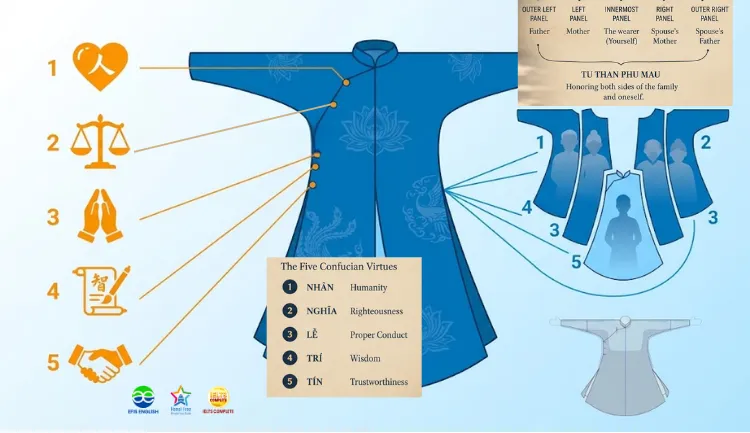
The five panels and five buttons on a traditional ao ngu than were never just a tailoring choice, they carry a specific moral message passed down for generations. According to the story most Vietnamese elders still tell, the four outer panels stand for Tu than phu mau, meaning the wearer’s own parents and the parents of their spouse, while the fifth and innermost panel represents the wearer themselves, physically tying every generation into one piece of cloth. The five buttons running down the front are linked to ngu thuong, the five Confucian virtues: nhan (humanity), nghia (righteousness), le (proper conduct), tri (wisdom), and tin (trustworthiness). Fastening the robe from top to bottom each morning was traditionally treated as a small, physical reminder to live by those five values, which is part of why older Vietnamese still speak about the ngu than with so much reverence.
Why does the Ao Dai matter so much in Vietnamese Culture?
The ao dai matters because it functions as a wearable symbol of Vietnamese identity, discipline, and family pride, not just a piece of clothing. It appears on school uniforms, national airline staff, diplomats at international summits, and brides on their wedding day, which is rare for a single garment to cover so many contexts. Wearing it well is considered a small act of cultural respect, and Vietnamese families often keep a mother’s or grandmother’s ao dai as an heirloom rather than passing it down for reuse.
One of our longtime volunteer guides still keeps her grandmother’s wedding ao dai from the 1960s folded in cedar paper at home, and she brings a photo of it on tours whenever guests ask about local wedding customs. She says the fabric has faded from deep red to a soft rust color, but the five-button closure and the hand-embroidered phoenix on the collar are still perfectly intact. Stories like this are common in Hanoi, where an ao dai often carries more family history than any photo album.
» Cultural Symbols of Vietnam: A Local’s Complete Guide
» Vietnam’s Bronze Drum: Ancient Voice of Dong Son
How has the Ao Dai changed over time?
Ao Dai Vietnam has changed through four clearly identifiable eras, each shifting the fit, sleeve style, or intended wearer while keeping the same basic silhouette. The table below breaks down how the dress evolved from a royal court requirement into the everyday and ceremonial garment worn across Vietnam today. Reading it top to bottom, you can trace the ao dai’s move from a strict court dress code to the flexible, personal style choice it has become.
| Era | Style Name | Key Features | Typical Wearer |
| 1744, Nguyen Lords | Ao Ngu Than (Five-Panel) | Five panels, high collar, loose fit, five fabric-covered buttons | Royal court, noble families |
| 1930s, Hanoi | Ao Dai Le Mur | Fitted waist, puffed sleeves, single front panel, French influence | Fashionable urban women |
| 1950s to 1960s, Saigon | Ao Dai Raglan | Raglan sleeve seam, smoother fit, brighter fabrics | Working and society women |
| Today | Ao Dai Cach Tan (Modern Fusion) | Shorter hem, mixed fabrics, looser or cropped cuts | Young Vietnamese, tourists |
Each version reflects the fashion and politics of its decade as much as personal taste. The 1930s redesign, for instance, coincided with broader debates in Hanoi about women’s roles in a modernizing society, while today’s cach tan versions borrow freely from streetwear to appeal to a younger generation. Even so, every version keeps the same core recognition: two long panels, a high collar or a modern variation on it, and trousers underneath.
The most recent shift, ao dai cach tan, has also been the most divisive. Instead of the traditional stand-up collar, tailors now offer boat necks and round necks that feel less restrictive, and the hemline has crept up from ankle-length to somewhere around the knee for easier movement. Pairing it with pleated skirts or wide-legged culottes instead of classic silk trousers caused a real backlash a few years ago, with several well-known designers arguing publicly that the combination should not be called ao dai at all. Despite that criticism, cach tan versions are now the most common style seen on Hanoi’s streets in the weeks leading up to Tet, mainly because they are easier to move in and cheaper to buy ready-made.
What are the Main Types of Ao Dai and When should you wear one?
Ao Dai Vietnam comes in several recognized types, distinguished mainly by color, fabric, and the occasion they are made for. Knowing the difference helps first-time visitors avoid an awkward mismatch, such as wearing a bright wedding-style ao dai to a formal business event, or worse, to a temple. The table below covers six versions you are most likely to encounter while traveling around Hanoi, ranging from the most solemn to the most playful.
| Type | Color or Fabric | Typical Occasion | Where You Might See It in Hanoi |
| Ao Dai Trang (White) | Plain white silk or polyester | School uniform, Teachers’ Day | Outside high schools in the Old Quarter and near Hoan Kiem Lake |
| Wedding Ao Dai | Red or gold brocade, often embroidered | Weddings, engagement ceremonies | Family celebrations, photo shoots at the Temple of Literature |
| Tet Ao Dai | Bright red, yellow, or floral prints | Lunar New Year (Tet) | Old Quarter streets and flower markets in late January or February |
| Temple or Worship Ao Dai | Muted blue, brown, or grey, minimal pattern | Visiting a pagoda, ancestral rites | Ngoc Son Temple, Quan Su Pagoda, family altars |
| Funeral Ao Dai | Plain black or white, no pattern | Funerals, mourning periods | Worn quietly within the family, not typically seen by tourists |
| Ao Dai Cach Tan | Mixed fabrics, cropped or looser cuts | Casual outings, café photos | Hoan Kiem Lake promenade, Long Bien Bridge, Train Street |
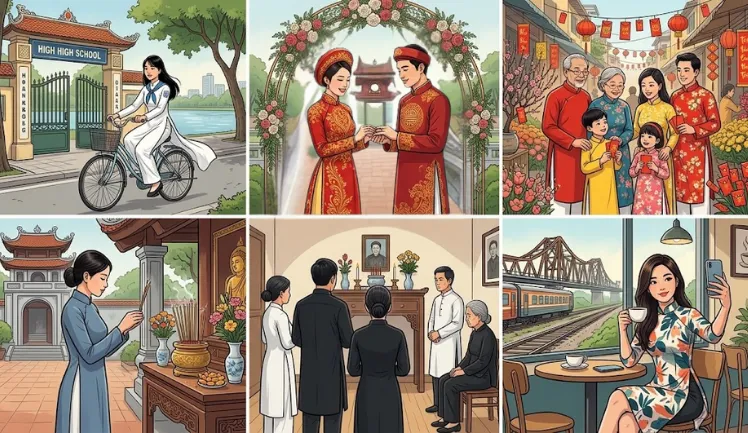
The white ao dai carries emotional weight far beyond its plain color, since generations of Vietnamese associate it with Monday assemblies and the first nervous day of a new school term. Poets and photographers have spent decades chasing the same image: a line of schoolgirls cycling past Hoan Kiem Lake with their white ao dai fluttering behind them as the wind presses the fabric flat against the bicycle frame. That picture appears so often in Vietnamese literature and film that many visitors half-recognize it before they even land in Hanoi.
Visitors sometimes assume any ao dai works for any occasion, but Vietnamese hosts do notice the difference. A bright red wedding-style ao dai worn to a quiet pagoda, where locals favor muted tones and minimal patterning, can look out of place next to worshippers dressed more simply. The same logic applies at funerals, where only plain black or white is considered appropriate. It only takes a quick question to your tailor or guide to make sure the style and color match the day’s plans.
Where can you see, try, or buy an Ao Dai in Hanoi?
Hanoi’s Old Quarter is the easiest place in the country to experience Ao Dai Vietnam up close, whether you want to see it, rent it, or have one commissioned, with Hang Gai Street standing out as the city’s unofficial silk and tailoring hub. Family-run shops along this street have dressed generations of local brides and can usually turn around a custom-fitted ao dai within 24 to 48 hours, depending on the fabric and embroidery you choose. The Vietnam Women’s Museum near Hoan Kiem Lake also keeps a rotating exhibit of ao dai from different decades if you would rather study the craftsmanship before buying.
On our free walking tours, guides often stop at a small, unmarked tailor shop near Hang Gai that has been in the same family for three generations, mostly because guests enjoy watching the measuring and pinning process up close. If you are short on time, several rental studios near Hoan Kiem Lake let you borrow a ready-made ao dai for a few hours of photos, which is a popular option for travelers who want the experience without committing to a custom order. Either route gives you a far more personal souvenir than anything sold in a typical tourist shop.
Book our free tour guide!

Hanoi Old Quarter Walking Tour
❤❤❤❤❤ (TripAdvisor / GetYourGuide)
Historical Tour – Walking Tour – Small Group
⚑ 3 – 4 hours
✎ Free Tour – Free Cancellation

Hanoi Street Food Tour
❤❤❤❤❤ (TripAdvisor / GetYourGuide)
Food & Drink – Walking Tour – Small Group
⚑ 3 – 4 hours
✎ Free Tour – Free Cancellation
How does bespoke Ao Dai tailoring actually work?
Bespoke Ao Dai Vietnam tailoring in Hanoi usually takes two visits rather than one, since a proper fit depends on far more than your general dress size. A skilled tailor typically takes upward of 20 individual measurements, covering the bust, waist, hips, shoulder width, and both the front and back torso length, because the fitted bodice leaves almost no room to hide an inaccurate cut. After the first fitting, most shops ask you to come back one to two days later so they can pin and adjust the half-finished garment directly on your body before the final stitching. “We can sew a plain shirt in an hour, but an ao dai that actually fits takes patience”; one veteran tailor near Hang Gai Street told our guides, “the whole dress lives or dies by the two inches around the waist.”
If you are buying an ao dai as a gift and do not have the recipient’s exact measurements, it is worth skipping the fully custom route. A ready-to-wear ao dai cach tan, with its looser cut and forgiving hem, is far more likely to fit a stranger than a fitted traditional style, or you can simply buy a length of silk and let the recipient have it tailored back home. Fabric choice matters here too, since raw silk (lua to tam) drapes beautifully and feels cool in Hanoi’s humidity but wrinkles easily and needs careful hand-washing, while polyester or brocade blends hold their shape, machine-wash without complaint, and cost noticeably less.

How do you wear an Ao Dai the right way?
Wearing an ao dai correctly comes down to fit, posture, and a few simple styling choices rather than any complicated ritual. The tunic should sit close through the bodice without pulling at the buttons, and the trousers underneath should skim the floor rather than bunch up around the ankles. Most Vietnamese women wear their hair up or in a simple low style so it does not compete with the high collar.
Flat sandals or low heels work better than sneakers, which tend to clash with the formality of the silhouette. Pairing the outfit with a Non La (conical hat) is common for photos in rural or lakeside settings, though it is optional in the city. If you are unsure about fit or styling, most tailoring shops in Hanoi will happily adjust the outfit on the spot, since a well-fitted ao dai is central to how the whole look reads.

FAQs About Ao Dai Vietnam
“Ao dai” translates roughly to “long shirt” or “long tunic” in Vietnamese, referring to the length of the top panel that extends past the hips. Older five-panel versions were called ao ngu than for the same reason, since “dai” simply describes length rather than one specific cut.
Yes, foreigners are welcome and even encouraged to wear ao dai, especially for photos, weddings, or cultural events, and most tailors in Hanoi are used to fitting visitors of all body types. Many shops also keep a small stock of pre-made sizes on hand for same-day tourist requests when there is no time for a full custom order.
Prices generally range from around 40 to 150 US dollars depending on fabric and embroidery, with silk and hand-embroidered designs sitting at the higher end. Rush orders finished within 24 hours usually carry a small surcharge on top of the base price.
No, men also wear ao dai, typically a heavier, boxier version in dark brocade, for weddings, funerals, and ancestral worship ceremonies. For the most formal occasions, the male ao dai is usually paired with a matching turban-style hat called khan dong.