The deep, resonant boom of Vietnam’s bronze drum, known locally as the Trong Dong, once echoed across misty hills and flooded rice paddies long before a single word of the country’s history was written down. To me, that sound still feels alive every time I stand in front of one in Hanoi. This article walks you through what Vietnam’s bronze drum actually is, how the Trong Dong was made more than two thousand years ago, what its intricate carvings mean, and why it still stands today as one of Vietnam’s most treasured cultural symbols.
What is Vietnam’s Bronze Drum?
Vietnam’s bronze drum, called the Trong Dong in Vietnamese, is a large, flat topped ritual object cast by the ancient Lac Viet people during the country’s Bronze Age. It was never simply a musical instrument; it doubled as a ceremonial centerpiece, a farming calendar, and a mark of a leader’s authority, all in one cast bronze object. Its surface tells a story on its own, carrying us straight into a civilization that existed well before written records of Vietnamese history began.
Each drum is shaped like a short, wide cylinder with a slightly bulging middle and a flat circular face called the tympanum. Bold, radiating patterns spiral out from a central sunburst motif, surrounded by rings of carved birds, boats, houses, and human figures. Archaeologists and historians consider these drums some of the finest surviving evidence of skill and symbolic thinking in early Southeast Asia. Standing beside one in a museum hall, it is easy to sense why generations of Vietnamese have treated it as a source of pride rather than just an old artifact.

History and Origins of Vietnam’s Bronze Drum
The name most commonly used for this drum, Trong Dong, traces back to a single accidental discovery. In 1924, a fisherman digging along the bank of the Ma River near Dong Son village in Thanh Hoa province unearthed a cluster of bronze objects, including drums, that would eventually give an entire Bronze Age culture its name: the Dong Son culture.
News of the find reached the École française d’Extrême-Orient in Hanoi, which sent a French customs official named Louis Pajot to investigate the site further. Pajot’s follow-up excavation uncovered numerous graves and additional bronze artifacts, and it was this more systematic work that led Western archaeology to formally recognize and name the Dong Son culture. That single riverbank discovery, and the excavation that followed it, reshaped how scholars understood the origins of Vietnam’s bronze drum tradition.
An even earlier and more famous example, however, had already surfaced decades before. The Ngoc Lu drum was found in 1893 in Ha Nam province, southeast of Hanoi, and dates to roughly the third to second century BCE. Vietnamese oral tradition links this era to the Hung Kings and the early state of Van Lang, though archaeologists place the culture more broadly within Southeast Asia’s Bronze Age. Similar drums have also turned up in Indonesia, Thailand, and Timor-Leste, which tells us these objects, and the trade networks that carried them, reached far beyond Vietnam’s borders.

How was Vietnam’s Bronze Drum Made?
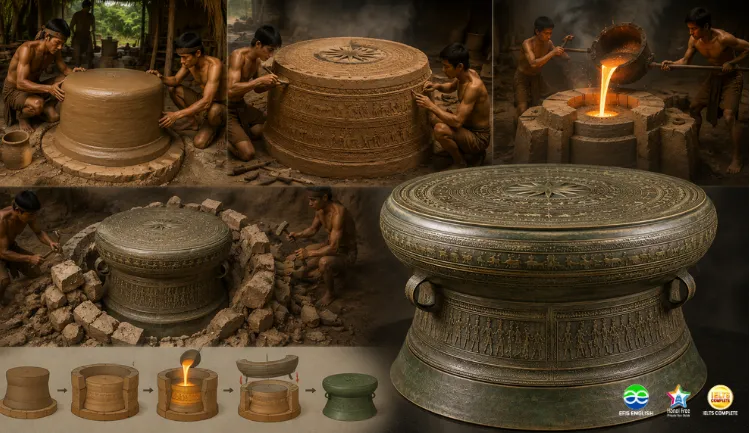
Ancient artisans cast Vietnam’s bronze drum using a mold based technique, working with an alloy of copper, tin, and lead to achieve the right strength and tone. Casting a single, seamless piece of this size without modern tools or machinery was an extraordinary technical achievement for its time.
Craftsmen first built a clay core in the shape of the drum, then wrapped it in a decorated outer mold carved with the intended patterns before pouring molten bronze between the layers. Once cooled, the mold was broken away to reveal the finished drum, meaning every mold, and every drum, was essentially unique. This level of metallurgical precision, achieved thousands of years ago, is one of the main reasons historians rank Dong Son bronze casting among the most advanced in early Southeast Asia.
What do the Symbols on the Trong Dong Mean?
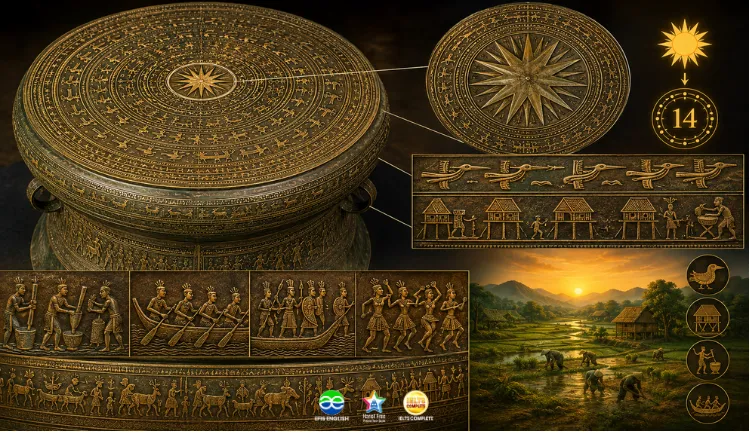
The carvings on the Trong Dong, Vietnam’s bronze drum, are not decoration for its own sake. They form a visual record of how the Lac Viet people saw their world, and possibly even measured it. At the center of almost every tympanum sits a many pointed star or sun motif, believed to represent sun worship and the agricultural cycles the community depended on for survival.
The number of rays was likely not random either. On the Ngoc Lu drum, the central star has fourteen points, and many researchers believe the ray count, together with the surrounding concentric rings, worked as an early agricultural calendar, tracking the sun, seasons, and rice growing cycles for a farming society with no written script. Seen this way, the drum face becomes less like an ornament and more like a working record of the heavens, the land, and the people caught between them.
That human presence is itself worth pausing on. Unlike many ancient cultures that carved oversized gods at the center of their sacred art, Dong Son artisans placed ordinary people front and center instead, including farmers pounding rice, warriors rowing war boats, and dancers in festival dress. This choice reflects a practical, community focused worldview that valued human labor and collective strength as much as any unseen deity. Moving outward from the sun, concentric rings also show flying birds with long beaks, often identified as the sacred Lac bird, alongside houses raised on stilts and musicians keeping time, together painting a picture of a farming society deeply tied to nature, ancestor worship, and communal ceremony.
Major Types of Vietnam’s Bronze Drum: The Heger Classification
Vietnam’s bronze drum belongs to what archaeologists call Heger Type I, the oldest and most refined of four bronze drum types classified by the Austrian scholar Franz Heger in 1902. Later drum styles found elsewhere in Southeast Asia and southern China, made by different peoples over the following centuries, fall under Heger Types II through IV and are generally considered less intricate and less closely tied to the original Lac Viet tradition.
Vietnamese scholars further divided Heger Type I drums into rough chronological groups, commonly labeled A, B, and C. Group A, which includes both Ngoc Lu and Hoang Ha, represents the earliest and most elaborately decorated drums, rich with narrative scenes of people and animals. Group C drums, generally cast later, are the ones most often decorated with small toad or frog figures perched along the tympanum’s rim, a detail visitors sometimes mistakenly picture on every Trong Dong, including Ngoc Lu, even though it does not appear there.
| Drum Name | Discovery | Notable Feature |
| Ngoc Lu | Found in 1893 in Ha Nam province | Richest known scenes; Vietnam’s first recognized National Treasure (2012); Heger Type I, Group A |
| Hoang Ha | Found in 1937 in Hoang Ha village, Phu Xuyen district, then Ha Dong province (now part of Hanoi) | Considered the finest Dong Son drum after Ngoc Lu, with closely comparable size, layout, and craftsmanship; Heger Type I, Group A |
| Dong Son | Found in 1924 on the Ma River, Thanh Hoa province | Gave its name to the entire Bronze Age culture and drum style |
| Song Da | Found in the Da River region | Smaller in scale, with waterbirds dominating the tympanum |
| Co Loa | Found near the ancient Co Loa Citadel, Dong Anh, Hanoi | Linked in local legend to the Au Lac kingdom of An Duong Vuong |
This variety shows that Vietnam’s bronze drum was never a single fixed design, but an evolving craft tradition practiced across generations and regions of ancient Vietnam.
Why Does Vietnam’s Bronze Drum Matter to Vietnamese Culture?
Vietnam’s bronze drum matters because it stands as physical proof that a sophisticated, organized civilization existed in Vietnam long before centuries of Chinese rule and long before European contact. Beyond ceremony and farming, the drum also functioned as a symbol of a chieftain’s authority and as a military instrument, its deep boom used to rally warriors and coordinate troops in battle. For many Vietnamese people, it represents independence, craftsmanship, and identity rolled into one object.
That symbolic weight became painfully clear during the Han dynasty’s suppression of the Trung Sisters’ uprising in the first century CE. According to Chinese historical records, the general Ma Vien confiscated bronze drums from the defeated Lac Viet and melted them down to cast bronze horses and pillars, a calculated attempt to erase a potent symbol of Vietnamese self rule. The fact that an occupying power felt the need to destroy these drums, rather than simply ignore them, only confirms how deeply they were tied to Vietnamese sovereignty, and how many still survive and are still revered today speaks to a culture that was never fully assimilated.
One of our club’s longtime volunteer guides likes to ask visitors to count the rays on the sun at the center of the drum before revealing that scholars believe the exact number was never random, but tied to an ancient farming calendar. Guests are usually surprised that a detail this small carried such practical weight for a community that depended entirely on the rhythm of the seasons. Moments like that, shared face to face in front of the real object, tend to stay with visitors far longer than a caption on a museum wall ever could, which is exactly the kind of connection our free walking tours aim to create.
Where to See Vietnam’s Bronze Drum in Hanoi
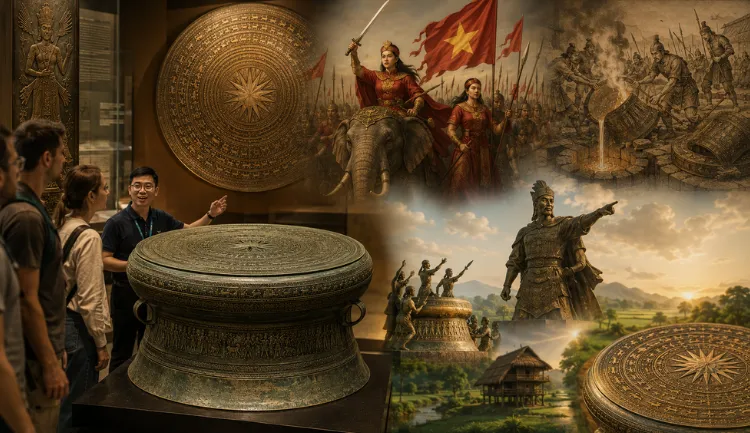
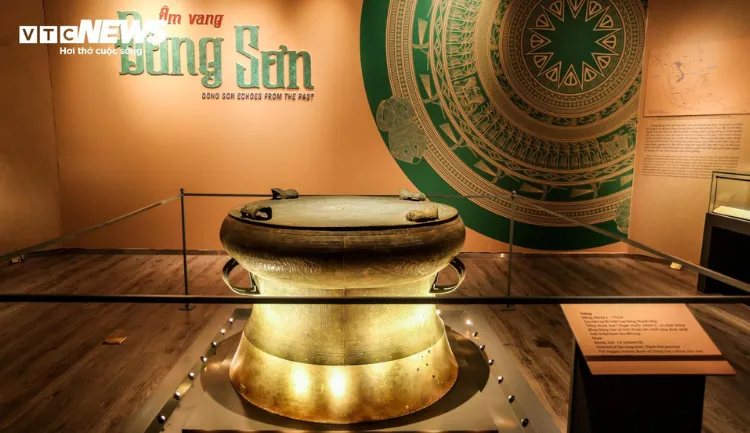
The best place in Hanoi to see an authentic example of Vietnam’s bronze drum is the Vietnam National Museum of History, located at 1 Trang Tien Street in Hoan Kiem District. The museum sits just behind the Hanoi Opera House and within easy walking distance of Hoan Kiem Lake, making it simple to combine with a stroll through the Old Quarter.
The museum typically opens from 8:00 am to 12:00 pm and 1:30 pm to 5:00 pm, though it is worth confirming current hours before visiting since these can shift around holidays. Inside, you will find original Dong Son era bronze drums displayed alongside artifacts spanning Vietnam’s prehistoric period through the Nguyen Dynasty. Seeing one of these drums up close, with its patterns catching the light, gives a much stronger sense of scale and craftsmanship than any photograph can offer.
Trong Dong Among Vietnam’s Other Cultural Symbols
Vietnam’s bronze drum does not stand alone as a marker of national identity. It belongs to a wider family of cultural symbols that includes the ao dai, the non la conical hat, and the hoa sen lotus flower, each carrying its own story about Vietnamese values and daily life. If you would like to explore how these symbols connect to one another, our full guide to the Cultural Symbols of Vietnam brings them together in one place.
Understanding the Trong Dong alongside these other symbols gives a fuller picture of how Vietnamese culture has expressed identity across centuries, from clothing and headwear to sacred ritual objects. It also shows why a single museum visit rarely tells the whole story on its own.
Frequently Asked Questions About Vietnam's Bronze Drum
Most examples of Vietnam’s bronze drum date back roughly 2,000 to 2,500 years, placing them within the Bronze Age Dong Son culture, with the famous Ngoc Lu drum dated to around the third to second century BCE.
The discovery that gave the culture its name happened in 1924, when a fisherman found bronze objects on the bank of the Ma River near Dong Son village in Thanh Hoa province, a find that French archaeologist Louis Pajot excavated further that same year.
The central sunburst represents sun worship and the agricultural cycles that ancient Vietnamese farming communities depended on, and many researchers believe its number of rays doubled as part of an early farming calendar.
Yes, an original Dong Son era drum is on permanent display at the Vietnam National Museum of History at 1 Trang Tien Street, within walking distance of Hoan Kiem Lake and the Old Quarter.