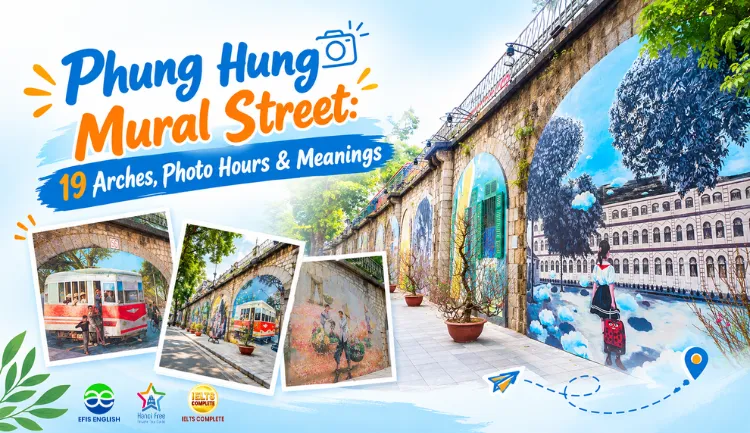
Phung Hung Mural Street is a 200-metre open-air gallery painted onto the stone arches of a 1902 French railway viaduct on the western edge of Hanoi’s Old Quarter. This guide gives you the street’s exact dimensions and borders, the story of the arches beneath the paint, what every mural is actually depicting, and the hours our volunteers use when they want a photograph with nobody in it. It is free, it never closes, and most visitors spend twenty minutes here when they should spend forty.
What is Phung Hung Mural Street, exactly?
Phung Hung Mural Street is a public art project that turned a neglected strip of railway arches into a free street gallery recalling twentieth-century Hanoi. It is not a separate street with its own name; it is a 200-metre section of Phung Hung Street, a 1,244 m road that most visitors walk past without noticing. The murals occupy the arch wall along that section only.
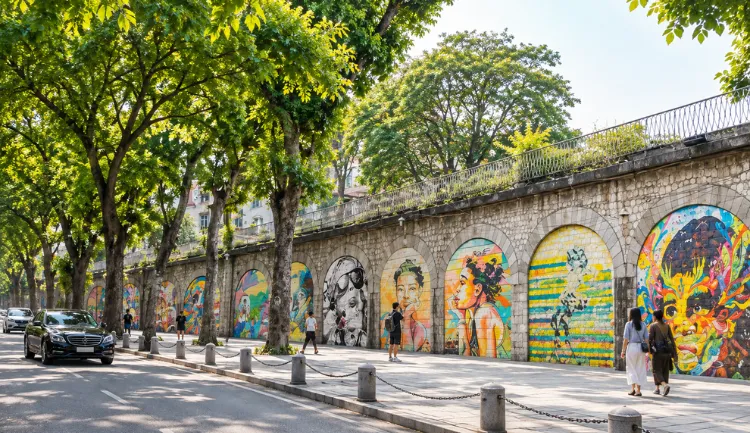
The project was launched in June 2017 and took seven months to complete, opening to the public in February 2018. It was delivered by the then Hoan Kiem District People’s Committee together with the Korea Foundation and UN-Habitat, timed to mark 25 years of diplomatic relations between Vietnam and South Korea. The curator was Hanoi artist Nguyen The Son, who assembled a mixed team of Vietnamese and Korean painters.
What the art replaced matters as much as the art itself. Before 2017 this stretch of arch wall was a motorbike parking lot and an informal dumping ground, dark and unwalkable after sunset. Our volunteers who grew up nearby describe it as the block you crossed the road to avoid. That context is the reason locals treat the murals with a slightly protective affection that surprises first-time visitors.
Phung Hung Mural Street at a Glance: Length, Borders and Key Facts
The mural section measures about 200 m between the Le Van Linh junction and Hang Cot street, sitting on the eastern arch wall of Phung Hung Street in Hoan Kiem Ward. The full street is 1,244 m long and runs north to south. Everything you need in one table.
| Detail | Information |
| Vietnamese name | Phố bích họa Phùng Hưng |
| Full street length | 1,244 m |
| Mural section length | Approximately 200 m |
| Mural section runs from | Le Van Linh junction to Hang Cot street |
| Number of murals | 19 large works (published counts range 17 to 20) |
| Arches in the mural section | Approximately 25 |
| Total arches on the viaduct | 131, from Phung Hung to Long Bien station |
| Opened | February 2018 |
| Built by | Vietnamese and Korean artists, curated by Nguyen The Son |
| Funded by | Hoan Kiem District, Korea Foundation, UN-Habitat |
| Medium | Paint and golden acrylic on wood panels, mounted onto the arches |
| Stated lifespan of panels | 5 to 10 years |
| Entry fee | Free |
| Opening hours | 24 hours, outdoors, unfenced |
| Administrative area | Hoan Kiem Ward, Hanoi (formerly Hoan Kiem District) |
| Time needed | 30 to 45 minutes |
| Nearest landmark | Hang Luoc flower market, 2 minutes |
Where does Phung Hung Street start and end?
Phung Hung Street runs 1,244 m from Phan Dinh Phung Street in the north to Hang Bong Street in the south. The murals are at the northern end, so if you arrive from Hoan Kiem Lake you will walk most of the street before you reach any paint.
The street has an unusual double character along its length. On its western side it runs directly alongside the railway line, which is why the viaduct dominates the view. On its eastern side it feeds into the Old Quarter through a series of much smaller streets. Historically this line was a canal circling the Thang Long Imperial Citadel, which is why the street is so straight in a district where nothing else is.
Which streets border Phung Hung Mural Street?
Working from north to south, Phung Hung Street meets Phan Dinh Phung, the Hang Luoc and Hang Cot junction, Le Van Linh, Hang Ma, Hang Vai, Bat Dan, Cua Dong, Nguyen Van To, Ngo Tram, and finally the Ha Trung and Tran Phu crossroads. The mural section sits inside the Hang Cot to Le Van Linh portion at the top of that list.
| Adjoining street | Position | Why it matters to you |
| Phan Dinh Phung | North end | Hanoi’s most photogenic boulevard, 5 min walk |
| Hang Cot | North edge of murals | Ceramic mural panel at this junction |
| Hang Luoc | North, via Hang Cot | Flower market, spectacular before Tet |
| Le Van Linh | South edge of murals | Where the painted section stops |
| Hang Ma | East, mid-street | Festival paper street, 3 min walk |
| Hang Vai, Bat Dan | East | Quiet residential Old Quarter blocks |
| Cua Dong | East, mid-street | Where the arched viaduct section begins |
| Ha Trung, Tran Phu | South end | Toward Hanoi railway station |
That density is the real argument for coming here. Phung Hung Mural Street is not a destination you travel to; it is a hinge between the Old Quarter and Ba Dinh, and four genuinely good streets sit within a five-minute walk of the paint.
The 131 Stone Arches Beneath Phung Hung Mural Street
The wall behind the murals belongs to a French railway viaduct built between 1900 and 1902, opened alongside Long Bien Bridge. It carries 131 stone arches from Phung Hung Street along Gam Cau to Long Bien station. The murals use only about 25 of them.
The engineering is worth two minutes of your attention. Each arch encloses roughly 16 square metres, is built of rubble stone, and stands between 2 and 6 m high depending on the ground level. The railway line from Hanoi station through Phung Hung and Gam Cau to Long Bien station runs about 1,300 m, of which the low stretch from Tran Phu to Cua Dong is solid masonry and the raised arch stretch from Cua Dong to Long Bien station runs close to 850 m. That is why the arches only start partway along the street.
Most of the arches are sealed. The current breakdown, as surveyed by the city, is stark.
| Arch status | Count |
| Open for pedestrian and vehicle traffic | 6 |
| Sealed with two layers of wall | 97 |
| Sealed with four layers of wall | 21 |
| Left in original condition | 7 |
Hanoi has been trying to reopen them since 2017. A pilot in 2020 punched through five arches, numbers 79 to 83, connecting Hang Cot to Hang Giay. The wider scheme stalled for years, and as of 2026 the ward is preparing a detailed 1:500 urban design plan proposing five uses for the reopened arches: handicrafts, community arts, food, a traditional market, and a public park tied to conserving Long Bien station. A separate landscaping project along 1.8 km of the line, adding planting and safety fencing, was scheduled through to April 2026.
Insider note: one of our guides, Linh, always stops guests at arch 79 rather than at the murals, because you can stand inside a sealed arch that was opened and feel the wall thickness with your hand. It makes the 131 number physical instead of abstract.
What does each Mural on Phung Hung Mural Street mean?
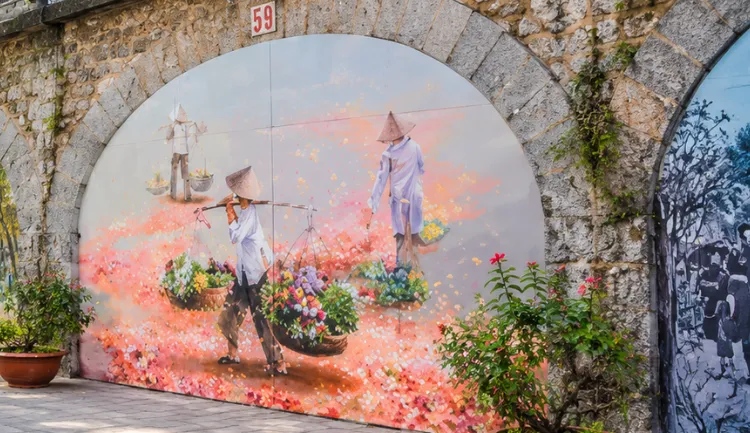
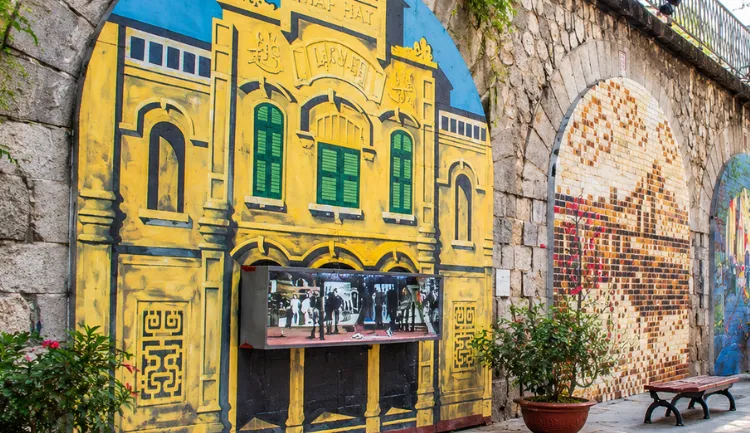
Almost every mural on Phung Hung Mural Street depicts a specific piece of twentieth-century Hanoi that has since disappeared, not generic Vietnamese imagery. If you know what you are looking at, the street reads as a timeline rather than a photo backdrop. Here are the works most visitors ask about.
| Mural | What it shows | Why Hanoians react to it |
| The Public Water Tap | A queue at a communal standpipe | The defining image of the bao cap subsidy era, when households shared street taps |
| The State Department Store | The old Trang Tien general store | Ration-book shopping, empty shelves, a generation’s childhood errand |
| The Clanging Tram | Hanoi’s electric tram | Ran until 1990, and the sound is still a nostalgia trigger |
| The Street Vendor | A woman with a shoulder pole | The one scene on the wall you can still see live, thirty metres away |
| The Calligrapher | An old scholar writing Tet characters | Links to the calligraphy stalls that appear each Lunar New Year |
| Hang Ma at Mid-Autumn | Lanterns and masks | Hang Ma is a three-minute walk east, so it doubles as a signpost |
| The Old Motorbike | A vintage bike, repainted gold | Phung Hung was once Hanoi’s motorbike-selling street |
| Kim Vang Giot Le | A 3D interactive piece by Duong Manh Quyet | Built with depth so you can step into the frame |
| Long Bien Bridge | The bridge, by Korean artist Jang Su Ik | An outsider’s view of Hanoi’s most photographed structure |
| A Street Coloured by Flowers | By Korean artist Oh Ye Seul | Softer, brighter palette than the Vietnamese works |
| Ao Dai on the Old Street | By Korean artist Choi Lak Won | The Korean team’s reading of Vietnamese dress |
The Vietnamese Murals Versus the Korean Murals
The two national teams produced visibly different work, and once you notice it you cannot unsee it. The Vietnamese artists painted memory: rationing, trams, taps, specific vanished institutions rendered in muted period colour. The Korean artists painted impression: brighter, looser, more romantic, reading Hanoi the way a visitor does.
Neither approach is better and the contrast is the point of a bilateral art project. If you walk the strip from Le Van Linh toward Hang Cot, the tonal shift between clusters is the easiest way to tell which team made what without reading a single label. It is also the single most useful thing a guide can point out here, and it takes ten seconds.
The 2024 Addition on Arches 61 to 64
Four newer works were added in early 2024 on arches 61 to 64 to connect the two original clusters, which had been separated by a blank stretch. Curator Nguyen The Son used a different technique: photographs printed on do paper (traditional poonah paper), mounted onto the stone, with mirror-polished stainless steel elements added.
They look nothing like the 2018 panels and some visitors assume they are unfinished. They are not. The reflective steel is deliberate, catching the street and the passing motorbikes so the artwork includes whatever is happening in front of it that second. It is the most contemporary thing on the wall.
When are the Best Photo Hours at Phung Hung Mural Street?
Arrive between 6:30 and 8:30 AM. The murals sit in the shadow of the viaduct for most of the day, so light quality barely changes; what changes dramatically is how many people are standing in front of your frame. By 10 AM on a weekend, every arch has a photoshoot in it.
| Time slot | Crowd level | What you get |
| 6:30 to 8:30 AM | Very low | Empty arches, soft light, locals exercising |
| 8:30 to 10:00 AM | Low to moderate | Still workable on weekdays |
| 10:00 AM to 4:00 PM | High on weekends | Wedding and graduation shoots occupy whole arches |
| 4:00 to 6:00 PM | Moderate | Warmer light, families arriving |
| After 7:00 PM | Low | Poorly lit, not worth it for photos |
Three practical points our volunteers repeat. Overcast days are good days here, because flat light suits painted panels far better than harsh sun. Tet and Mid-Autumn weeks are the worst possible timing if you want clean photographs, since the whole street fills with ao dai shoots. And the ceramic mural panel at the Phung Hung and Hang Cot junction is a separate artwork from the 2018 project, part of Hanoi’s ceramic mosaic road, so do not be confused when the style changes abruptly at the north end.
If you would rather have somebody explain the bao cap references while you shoot, our hanoi old quarter walking tour starts early enough to reach the arches before the crowds.

How do you get to Phung Hung Mural Street?
Walk. From Hoan Kiem Lake it is roughly 1.3 km and about 15 to 18 minutes on foot, heading north through the Old Quarter via Hang Ngang and Hang Duong, then west along Hang Ma. From Dong Xuan Market it is under 500 m.
| Starting point | Distance | On foot | Notes |
| Hoan Kiem Lake (north end) | 1.3 km | 15 to 18 min | Go via Hang Ma for the best route |
| Dong Xuan Market | 450 m | 6 min | Exit west along Hang Chieu, then Hang Luoc |
| Hang Ma Street | 300 m | 3 min | Walk west to the railway wall |
| O Quan Chuong gate | 700 m | 9 min | Via Hang Chieu and Hang Luoc |
| Hanoi Railway Station | 1.2 km | 15 min | Straight up Phung Hung the whole way |
| Noi Bai Airport | 26 km | 40 to 45 min by car | Grab is the simplest option |
Grab and taxis can drop you at the Phung Hung and Hang Cot junction without difficulty. Motorbike parking exists along the wall but is informal, so agree a price before you hand over the key. There is no ticket office, no entrance and no staff, which occasionally confuses visitors who expect a gallery.
What to Combine With Phung Hung Mural Street in One Walk
Treat the murals as the first stop of a morning, not a standalone trip. Everything worth seeing here sits within a ten-minute walk, and the natural sequence runs from the arches into the Old Quarter or out toward Ba Dinh. Thirty minutes at the wall plus two of the stops below makes a genuinely good half day.
| Stop | Walk time | Best paired because |
| Hang Ma Street | 3 min | Festival paper, same era as the murals depict |
| Hang Luoc flower market | 2 min | Spectacular in the two weeks before Tet |
| Hang Cot and Hang Chieu | 5 min | Leads to O Quan Chuong gate |
| Phan Dinh Phung Street | 5 min | Tamarind trees and villas, best at the same early hour |
| Long Bien Bridge | 12 min | The bridge the viaduct was built to reach |
| Dong Xuan Market | 6 min | Breakfast in the food alley afterwards |
For the wider picture of how this street fits alongside the other nineteen worth walking, see our guide to the Famous Streets in Hanoi.
What Should You Know Before Visiting Phung Hung Mural Street?
Three things, and the first is the one nobody tells you. The murals are painted on wood panels mounted onto the arches, not on the stone, which is why they crack, peel and fade on a predictable cycle and why their stated lifespan is only 5 to 10 years.
- Condition varies and repairs are periodic
The works degraded badly by 2022, were restored over two weeks in December that year and reopened on 6 January 2023, then were refreshed again before Tet in early 2024. Expect some panels to look tired. If you arrive and a section is fenced for maintenance, that is normal and usually short.
- This is not Train Street
Visitors constantly conflate the two because both involve railway lines in the Old Quarter. The track-side cafés with restricted access are a different location. Here the railway runs high above you on the viaduct and there is no safety issue at all, but do not climb the wall or the embankment to reach the line.
- It is a working street, not a set
Residents live behind those shopfronts and the pavement is narrow. Stepping into the road to get a wider frame is how people get clipped by motorbikes, so back up onto the pavement opposite instead.

FAQs About Phung Hung Mural Street
Yes. Phung Hung Mural Street is a public street with no entrance fee, no ticket office and no opening hours. It is outdoors and unfenced, so you can walk it at any time of day or night, although after dark the lighting is poor and the murals are hard to see properly.
The figure used by the city and the original project is 19 large murals, spread across roughly 25 arches. Published counts vary between 17 and 20 because some works were damaged and removed over the years, and four newer pieces were added on arches 61 to 64 in 2024. Counting on site rarely produces exactly 19.
Thirty to forty-five minutes is realistic. The painted section is only about 200 m, so walking it takes four minutes, but the murals reward stopping at each one. Budget longer if you are photographing, and add ten minutes for the ceramic panel at the Hang Cot junction.
Between 6:30 and 8:30 AM. The wall stays shaded under the viaduct for most of the day, so the deciding factor is crowds rather than light. Weekday mornings are emptiest, overcast days give the most even colour, and weekend afternoons are the hardest time to get a clean shot.
The famous streets in Hanoi reward company. A name on a shopfront becomes a 400-year-old family story once somebody can translate it, and the difference between a good bowl of pho and a tourist-priced one is usually a single sentence in Vietnamese. That is the whole idea behind our club.