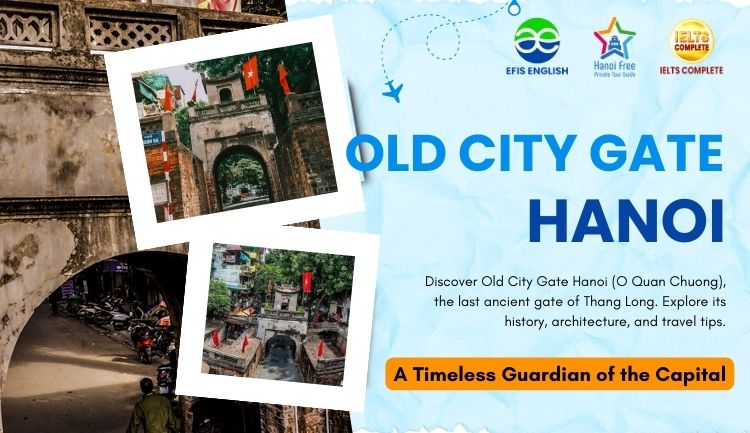
In the heart of the bustling Old Quarter stands a powerful reminder of Vietnam’s past – the old city gate Hanoi, known locally as O Quan Chuong. While modern traffic flows endlessly around it, this ancient gate remains a silent witness to centuries of transformation. It is the last surviving gateway of the old Thang Long Citadel and one of the most meaningful historical landmarks in Hanoi.
For foreign travelers seeking more than sightseeing, O Quan Chuong offers something deeper. It is not simply an architectural relic. It is a preserved fragment of memory, courage, and identity. Visiting this site allows you to step into the layered history of Hanoi, a capital that has endured wars, colonial rule, and rapid modernization.
Where is the Old City Gate Hanoi located?
O Quan Chuong is located on Thanh Ha Street in Hoan Kiem District, at the intersection of Hang Chieu and Dao Duy Tu streets. The gate marks the eastern edge of the Old Quarter, only about 80 meters from the Red River. This strategic position once made it a crucial defensive and commercial entrance to the ancient capital.
Today, the location creates a powerful contrast. Ancient brick walls stand beside lively streets filled with scooters, food vendors, and travelers. Many visitors describe the gate as a doorway connecting past and present. It is one of the most accessible historical landmarks in Hanoi and easily included in any Old Quarter walking itinerary.
From Dong Ha Mon to O Quan Chuong: A history of Resilience
The old city gate Hanoi was originally built in 1749 during the reign of King Le Hien Tong. At that time, it was called Dong Ha Mon because it stood in the Dong Ha ward and opened toward the eastern side of the citadel. It was one of several gates protecting the capital of Thang Long.
Over time, the structure underwent restoration during the Nguyen Dynasty, particularly in 1804 and 1817 under Emperor Gia Long. These renovations helped preserve the gate’s stability and allowed it to withstand the test of time.
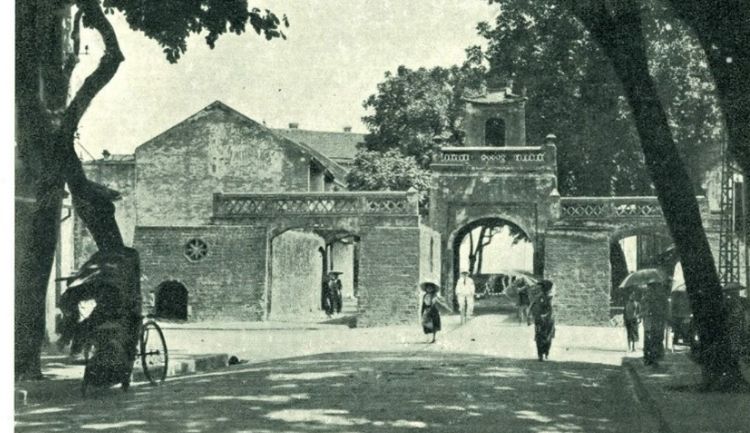
The name “O Quan Chuong” emerged after a dramatic historical event in 1873. During the first French attack on Hanoi, a Vietnamese military commander, known as a Chưởng cơ, and his soldiers fought bravely at this gate. They resisted until the end. According to local accounts, the commander was captured and executed, and his body was displayed near the Red River. Deeply moved by his sacrifice, local residents renamed the gate O Quan Chuong in his honor.
The gate thus became more than a physical structure. It became a symbol of defiance and patriotism. Even after the French demolished most of Hanoi’s ancient gates for urban planning, O Quan Chuong survived thanks to strong resistance from local citizens, especially residents of Hang Chieu and Thanh Ha wards.
Architectural features of the Old City Gate Hanoi
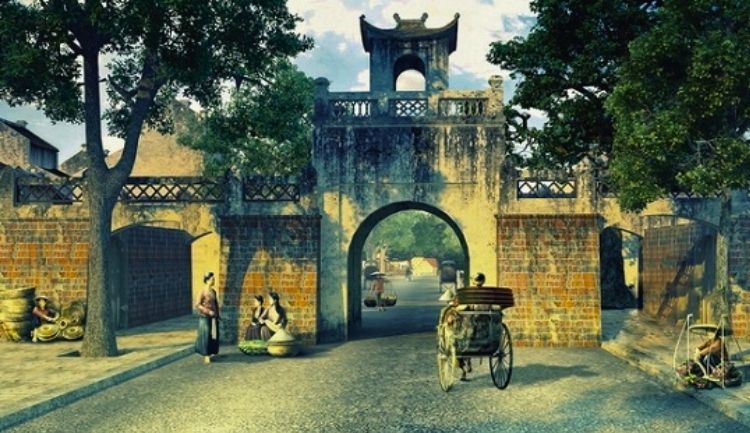
Architecturally, O Quan Chuong represents the traditional “vọng lâu” style of Vietnamese military gateways from the Nguyen period. The structure consists of two main levels and retains much of its original character.
The ground level features three arched entrances. The central arch stands about three meters high and is the main passageway. On both sides are two smaller arches, each around 2.5 meters high and 1.65 meters wide. These arches once controlled movement in and out of the city. The materials used include large ancient bricks and blue stone, similar to those found in important sites like the Temple of Literature.

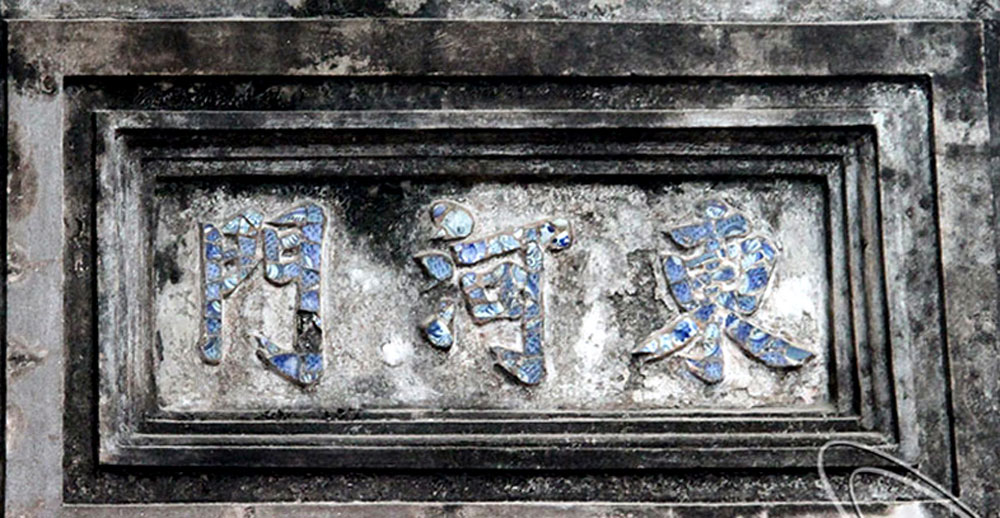
Above the main arch, a rectangular panel displays the three Chinese characters “Đông Hà Môn” in blue porcelain. This original name remains visible as a historical signature from the past.
The second level forms a watchtower with four curved roofs that gently slope toward the center. Decorative details include geometric patterns such as hexagons and floral motifs typical of feudal architecture. A narrow staircase on both sides leads to the upper level, where guards once observed approaching activity from the river and surrounding roads.

Inside the upper chamber is a small altar dedicated to the fallen commander and soldiers who defended Hanoi in 1873. This spiritual element reinforces the gate’s role not only as a military structure but also as a memorial site.
Symbol of resistance in 1873 and 1946
The Stone Stele of 1881: A message of integrity
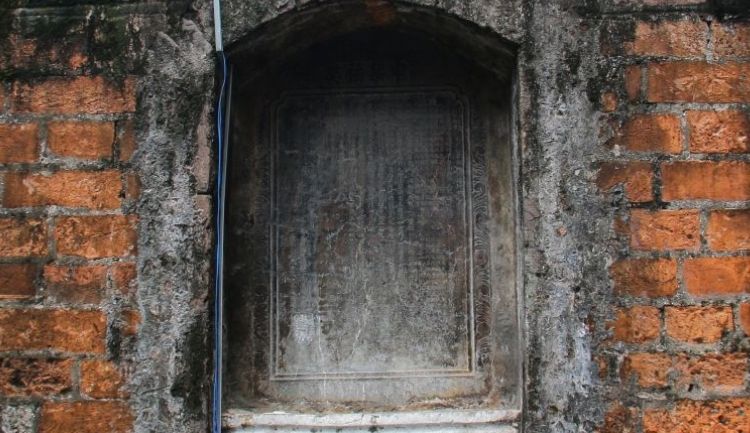
One of the most fascinating historical details at O Quan Chuong is a stone stele installed in 1881. Positioned on the left wall of the main entrance, this tablet carries an inscription known as the “Lệnh cấm trừ tệ.”
The inscription was ordered by Governor Hoang Dieu and Provincial Chief Hoang Van Xuong. It prohibited soldiers guarding the gate from harassing civilians, especially funeral processions passing through. This small but powerful document reflects an administration concerned with justice and compassion. It also shows that the gate was deeply connected to daily community life, not only military defense.
For history enthusiasts, this stele adds another layer of meaning to the old city gate Hanoi, highlighting values of morality and governance in Vietnamese society.
The historical importance of O Quan Chuong extends beyond the 19th century. During the nationwide resistance in 1946, the gate once again became a defensive position when Vietnamese forces confronted returning French troops. Makeshift barricades and trenches were built nearby.
Some marks from bullets and explosions remain visible today. They serve as quiet reminders of Hanoi’s turbulent 20th century and its enduring spirit.
As the only surviving gate of the ancient Thang Long defensive system, O Quan Chuong stands as a material symbol of collective memory. It reflects the connection between urban defense architecture and the lived experiences of the people of Hanoi.
What to expect when visiting today ?
Today, the old city gate Hanoi is classified as a national historical and architectural monument. It is open to the public at all times, and visitors can walk directly through the arches.
You can expect a vibrant urban environment surrounding the gate. Street vendors sell snacks nearby, photographers capture the contrast between tradition and modern life, and local residents pass through daily as they have for generations.
The gate is especially photogenic in the early morning, when sunlight gently illuminates the brick façade. Late afternoon also offers beautiful lighting. Although the site is small, its atmosphere is powerful.
Because the gate sits at a busy intersection, traffic flows continuously around it. The constant movement only emphasizes how the monument endures despite modern change. O Quan Chuong is the last of the old gates still standing, and seeing it at the end of a hanoi old quarter walking tour gives you a sense of where the city once ended.

Why you should visit the Old City Gate Hanoi?
Visiting O Quan Chuong offers more than historical knowledge. It allows travelers to witness the last physical trace of Hanoi’s ancient city walls. It embodies resilience, memory, and the spirit of a capital that has survived centuries of upheaval.
For photographers, it provides a striking visual contrast between old brick and modern chaos. For historians, it tells a story of defense, sacrifice, and civic responsibility. For curious travelers, it offers a quiet moment of reflection amid the vibrant Old Quarter.
It is not grand in size, but it is immense in meaning.
Travel advice for visiting O Quan Chuong
When visiting the old city gate Hanoi, wear comfortable shoes as the surrounding streets are best explored on foot. Visit early in the morning to avoid heavy traffic and capture better photographs. Stay alert when crossing roads, as scooters move constantly through the intersection.
Respect the monument as a historical site. Avoid climbing on fragile surfaces and help preserve the structure for future generations.
Consider combining your visit with a walking tour of the Old Quarter to understand the broader historical context of the area.
Nearby attractions around O Quan Chuong
Exploring the area around the old city gate Hanoi reveals even more cultural richness. Just 200 meters away stands Dong Xuan Market, one of Hanoi’s largest traditional markets. Here you can discover local textiles, souvenirs, and authentic street food.
Hang Chieu Street, directly beside the gate, was once famous for reed mats and handicrafts. Today it retains its local flavor and artisan spirit. A short walk leads to Hang Duong Street, known for preserved fruits and sweet delicacies, and Hang Buom Street, lively with restaurants and nightlife.
Bach Ma Temple, one of the Four Sacred Temples of ancient Thang Long, lies about 500 meters away. Ma May Ancient House, located nearby, offers a glimpse into traditional tube-house architecture and family life in the 19th century.
Together, these sites create a meaningful cultural route within the Old Quarter.
Experience O Quan Chuong with Hanoi Free Private Tour Guide Club
To truly understand the stories behind O Quan Chuong, exploring with a local guide makes a profound difference. The Hanoi Free Private Tour Guide Club is a volunteer organization made up of young and dynamic individuals who are passionate about Hanoi’s cultural and historical heritage.
They believe that these beautiful values must be preserved through Vietnamese generations and shared with international friends visiting Vietnam. Their guided tours offer in-depth explanations, hidden historical details, and meaningful storytelling that transforms a simple visit into a memorable cultural experience.
Walking with them, you will not only see the old city gate Hanoi – you will understand why it still matters.
👉 Book your free local guide at: https://hanoifreeprivatetourguide.com
Discover Hanoi through the eyes of those who cherish its past and proudly carry its legacy into the future.
Book our free tour guide!

Hanoi Old Quarter Walking Tour
❤❤❤❤❤ (TripAdvisor / GetYourGuide)
Historical Tour – Walking Tour – Small Group
⚑ 3 – 4 hours
✎ Free Tour – Free Cancellation

Hanoi Cultural Exchange
❤❤❤❤❤ (TripAdvisor / GetYourGuide)
Local – Most Popular – Small Group
⚑ 3 – 8 hours
✎ Free Tour – Free Cancellation
______________________________________
HANOI FREE PRIVATE TOUR GUIDE
✤ Website: Hanoi Free Private Tour Guide
✤ Adress: 158 Chua Lang, Dong Da, Hanoi
✤ Hotline: (+84) 97 63 69 796
✤ Mail: hanoifreeprivatetourguide@gmail.com
✤ English Course: Efis English
Read more
✧ First Footing Tradition: Welcoming Luck at Lunar New Year
✧ Red Envelope Tradition at the Lunar New Year – Lì Xì Tết