
Hoa Lo Prison is one of the most emotionally gripping places you will ever set foot in anywhere in Southeast Asia. Built by French colonialists in 1896, this infamous Hanoi landmark held Vietnamese revolutionary fighters, and later, American POWs during the Vietnam War, who grimly nicknamed it the “Hanoi Hilton”. Today, it operates as a museum and stands as the most thought-provoking stop on any visit to Hanoi’s French Quarter.
What exactly Is Hoa Lo Prison and Why does It matter?
Hoa Lo Prison is a former colonial detention facility turned national museum, and it is one of the most significant historical landmarks in Hanoi. Originally built by French authorities to crush Vietnam’s independence movement, it later served as a POW facility during the Vietnam War, giving it a layered history unlike almost any other site in Southeast Asia.
The name “Hoa Lo” carries a poetic irony. The name originates from the fact that the prison was built on the land of Phụ Khanh village, a renowned handicraft village in Hanoi that specialized in pottery products, including earthen stoves, “Hoa Lo” literally translating to “fiery furnace” or “stove”. The French flattened this artisan community to build their most formidable prison in all of Indochina. That contrast between the warmth of a craft village and the brutality of what replaced it tells you everything you need to know about the colonial era in Vietnam.
Hoa Lo Prison sits squarely within the Hanoi French Quarter, and no visit to that neighborhood is complete without understanding what happened inside these walls. The museum is located at 1 Hoa Lo Street, on the edge of Hanoi’s French Quarter, a short stroll from Hoan Kiem Lake, placing it within easy reach of other iconic French Quarter landmarks like the Hanoi Opera House and Trang Tien Plaza.
A Two-Chapter History: From “Hell on Earth” to “Hanoi Hilton”
Hoa Lo Prison’s history unfolds in two dramatically different chapters, separated by Vietnam’s independence in 1954. Understanding both is essential to making sense of what you see inside the museum.
Chapter 1: The French Colonial Era (1896-1954)
The French began constructing Hoa Lo Prison in 1896. The complex originally spanned over 12,000 square meters and was among the largest and most notorious colonial prisons in Indochina. Inside, prisoners faced severe conditions including overcrowded cells, minimal food, and chains that bound them day and night. The authorities formally named it Maison Centrale (Central Prison), and the imposing yellow sign bearing that French inscription still greets you above the main entrance today.
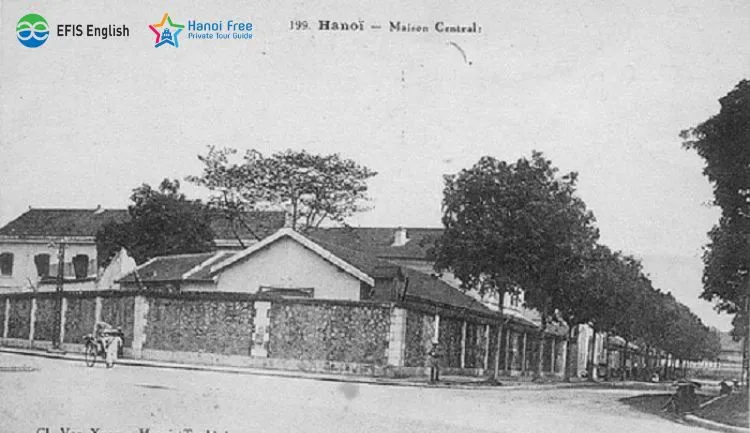
The French designed the prison to hold about 450 inmates, but during the height of the anti-colonial movement, it often held more than 2,000 people. Prisoners endured brutal conditions, including overcrowding, poor sanitation, and harsh punishments. Yet remarkably, these conditions did not break the revolutionary spirit. The prison became an unlikely crucible of resistance, where imprisoned leaders organized, educated, and inspired one another behind bars.
Its four-meter-high granite walls, topped with broken glass and electric wire, created a sense of complete isolation. Inside, narrow brick corridors, iron-barred windows, and tiny cells emphasized the system’s brutality and the prisoners’ suffering. Despite its horrors, many of the leaders who later shaped modern Vietnam passed through these cells.
Chapter 2: The “Hanoi Hilton” Era (1964-1973)
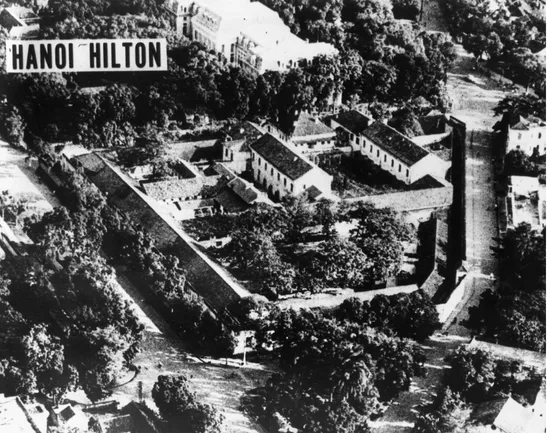
From 1964 to 1973, the North Vietnamese government used Hoa Lo Prison to detain downed American pilots. American POWs humorously nicknamed the place “Hanoi Hilton“; including John McCain, who later became a U.S. Senator, and Douglas Peterson, the first U.S. Ambassador to Vietnam.
The irony of the nickname was razor-sharp. These men were confined in a place designed for suffering and called it after one of the world’s most luxurious hotel brands, as a darkly humorous act of defiance. Most of the original prison complex was demolished in 1993, and what was left was turned into today’s museum. Today, only an area of about 2,434 square meters of Hoa Lo Prison remains, preserved as a historical site for visitors.
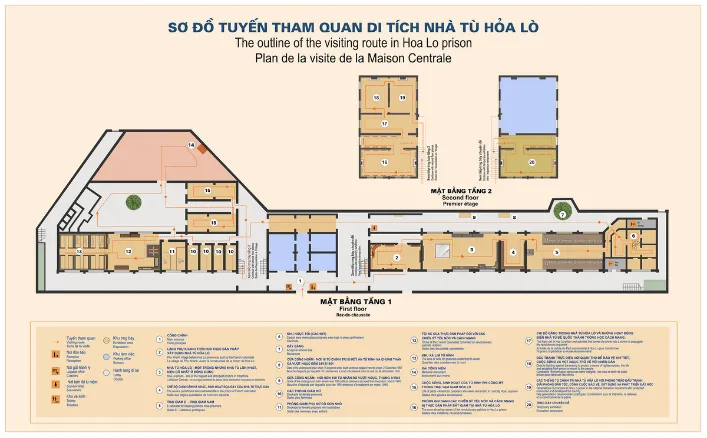
What Will You See Inside? The Key Exhibits at Hoa Lo Prison Museum
The Hoa Lo Prison museum is divided into two main exhibition zones: the French colonial era and the American POW period. Each section delivers a distinct emotional experience, and together they paint a comprehensive picture of Vietnam’s struggle for self-determination across two vastly different conflicts.
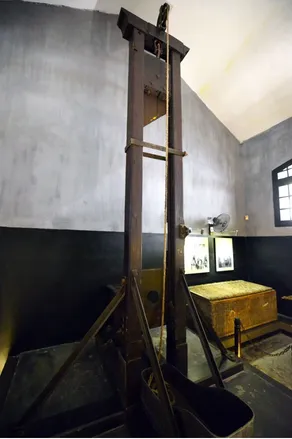
The Guillotine Room
Nothing inside the museum hits quite as hard as this room. The guillotine displayed at Hoa Lo Prison is an original artifact, one of two brought to Hanoi by the French in the late 19th century. Standing at 4 meters tall, it features two wooden pillars supporting the blade, which was held in place by a latch. Even with the blade now rusted and still, standing in front of these devices leaves most visitors speechless. It is undeniable physical evidence of the colonial justice system.
The Cachot (Dark Cells)
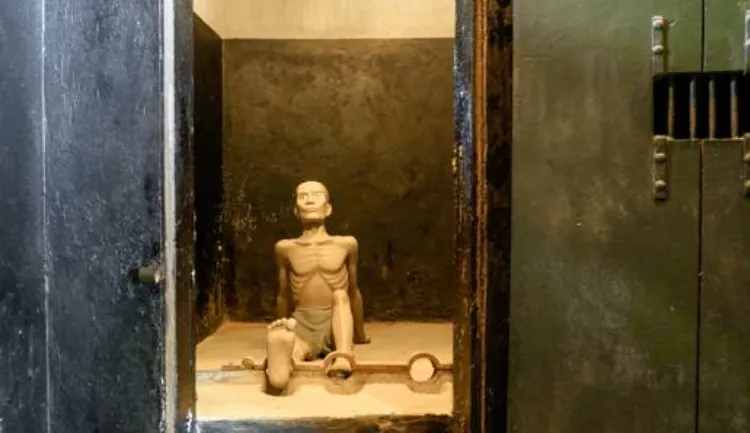
The Cachot at Hoa Lo Prison was used to punish inmates who violated prison rules. Each cell was only 4m², making it a cramped and oppressive space often referred to as the “Hell of Hell.” Prisoners were isolated in these dark, narrow cells, shackled at night, and forced to eat, sleep, and relieve themselves in the same confined area. Our club volunteers who have guided hundreds of visitors through this room often say it is the single spot where guests fall completely silent.
The John McCain Exhibit
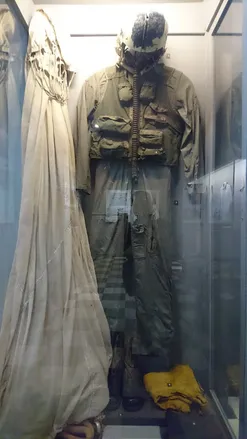
This section documents the experiences of American POWs with particular focus on future U.S. Senator John McCain. The most famous exhibit is McCain’s actual flight suit and parachute from when he was shot down. The section also includes reconstructed cells showing beds and tables, photos of prisoners playing sports and celebrating holidays, and exhibits emphasizing the North Vietnamese narrative of humane treatment. It is worth approaching this section with an open and inquiring mind, as the museum’s framing of POW treatment differs significantly from American POW accounts, offering a thought-provoking study in competing historical narratives.
The Main Cell Blocks and Revolutionary Exhibits
The largest section of the museum documents the Vietnamese revolutionary experience under French rule. Personal belongings, shackles, tools of torture, and preserved cells line the corridors. Since 2019, Hoa Lo Prison has implemented an automated narration system to serve tourists. After purchasing a ticket, visitors can rent a walkie-talkie with headphones to listen to narrations and quotes from individuals who were once held in Hoa Lo Prison. The audio guide is highly recommended, as it transforms the experience from a visual tour into something far more personal and immersive.

Practical Visitor Information: Tickets, Hours & Getting There
Here is everything you need to plan a smooth visit to Hoa Lo Prison:
| Detail | Information |
| Address | 1 Hoa Lo Street, Hoan Kiem District, Hanoi |
| Opening Hours | Daily, 8:00 AM to 5:00 PM |
| Adult Ticket | ~50,000 VND (~$2 USD) |
| Student / Elderly / Disabled | 50% discount (with valid ID) |
| Children under 15 | Free (Vietnamese veterans also free) |
| Audio Guide Rental | ~50,000 VND/person |
| Recommended Visit Time | 1.5 to 2 hours |
| Night Tour (Sacred Night) | Fri, Sat, Sun from 7:00 PM, ~90 min, ~300,000 VND/person |
| Nearest Landmark | Hoan Kiem Lake (10-15 min walk) |
| From Old Quarter | 10-15 minute walk |
| By Grab/Taxi | ~20,000-40,000 VND from the Old Quarter |
| Public Bus Lines | 02, 09, 32, 34, 38 (stop near the prison) |
Insider tip: The museum can feel heavy and emotionally draining. Visit in the morning when you have full energy and a clear head. It is recommended to allocate 1.5 to 2 hours. Due to the large amount of information and heavy atmosphere, a quick visit is not advisable.
Should You Do the Night Tour? “Sacred Night” Explained
The “Sacred Night” night tour is worth doing if you want a deeper, more theatrical experience, but the daytime visit already covers the essential history. The two experiences feel very different in tone and scope.
The night tour runs on Friday, Saturday, and Sunday, starting from 7:00 PM and lasting 90 minutes. The main focus is on highlighting the experience of the Vietnamese revolutionaries incarcerated during the French Colonial Era. At the beginning of the tour, each visitor is given their own pair of headphones, allowing them to hear the guide’s instructions and be immersed in their own personal journey.
The night tour is more emotionally intense than the day visit, and the theatrical elements genuinely enhance understanding of prisoner suffering. However, it is heavy and not appropriate for young children or those seeking light entertainment. Notably, the night tour focuses entirely on the Vietnamese revolutionary period and does not cover the American POW section, so if that chapter of the story is important to you, the daytime visit is the better choice.
Participants also receive unique souvenirs such as tea, jelly, or cakes made from the leaves of the last remaining almond tree in the prison yard. That small, unexpected touch of warmth at the end of an emotionally demanding 90-minute program stays with most visitors long after they have left.

How is Hoa Lo Prison Located Within the Hanoi French Quarter?
Hoa Lo Prison sits on the western edge of the Hanoi French Quarter, making it the perfect anchor for a half-day historical walk through this storied neighborhood. Its location connects it naturally to a cluster of architectural and cultural landmarks.
Located at 1 Hoa Lo Street, Hoan Kiem District, it is within walking distance of Hoan Kiem Lake and the Hanoi Opera House. From the prison’s front gate, you can walk east toward the iconic Trang Tien Street, a wide Parisian-style boulevard lined with elegant French-colonial buildings, continue to the Opera House, and eventually arrive at Hoan Kiem Lake. This is one of Hanoi’s finest and most educational walking routes. SJourney
Combining Hoa Lo Prison with a broader French Quarter exploration means you experience French colonial influence from two completely different angles: its architectural grandeur along the tree-lined boulevards, and the brutal human cost of that same colonial power inside these walls. The contrast is something you genuinely feel, not just understand intellectually.
How to Make the Most of Your Visit: Insider Tips
To get the most out of Hoa Lo Prison, pace yourself, rent the audio guide, and approach both narratives with curiosity rather than pre-formed conclusions.
Here are the practical tips our experienced guides recommend:
- Go early: The museum opens at 8:00 AM. Beat the midday heat and the tour group crowds by arriving in the first hour.
- Rent the audio guide: At roughly 50,000 VND, this is one of the best-value upgrades you can make. The audio guide is well-produced, not just reading the information boards, but also includes oral recordings from survivors and background sounds.
- Linger at the key exhibits: Do not rush past the guillotine display, the Cachot cells, and the POW section. These are the most information-dense stops, and the emotional weight deserves time.
- Read the exhibits critically: Both the French colonial section and the American POW section present history from a North Vietnamese government perspective. This is valuable and legitimate, but it is worth noting where accounts diverge from Western historical records. History is always told by someone.
- Dress respectfully: This is a place of national mourning and historical memory for Vietnamese people. Shoulders and knees covered, and a quiet demeanor, are both appropriate and appreciated.
- Pair it with the French Quarter: After your visit, walk toward the Hanoi Opera House and Hoan Kiem Lake. The 15-minute walk delivers some of Hanoi’s most beautiful French colonial streetscapes as a gentle decompression after an intense museum experience.

FAQs: What Visitors Most Often Ask About Hoa Lo Prison
Hoa Lo Prison is nicknamed the “Hanoi Hilton”. American POWs humorously gave it this name, including John McCain and Douglas Peterson. The sardonic nickname was a darkly humorous reference to the Hilton hotel chain, contrasting sharply with the prison’s brutal conditions.
Hoa Lo Prison is open daily from 8:00 AM to 5:00 PM. The entrance fee is 30,000 VND per person, with a 50% discount available for students with valid identification, senior citizens, and individuals with disabilities. Admission is free for Vietnamese veterans and children under 15 years old. Note that some sources cite 50,000 VND for the adult ticket, so verify at the gate; prices are subject to periodic adjustment.
The night tour is impressive but intense. It is not essential, the day visit covers most of the same material. It is best suited for visitors with extra time and a specific interest in the Vietnamese revolutionary period, as it does not cover the American POW section. The night tour costs approximately 300,000 VND per person and runs Friday to Sunday starting at 7:00 PM.
A thorough, meaningful visit takes 1.5 to 2 hours. Rushing through in 30-40 minutes means missing the full weight of the exhibits. If you add the audio guide and take time to read the panels carefully, two hours is the right benchmark.

Why Hoa Lo Prison Belongs on Every Hanoi Itinerary
Hoa Lo Prison is not a comfortable place to visit, and that is precisely why it belongs on your Hanoi itinerary. It confronts you with two chapters of history that shaped modern Vietnam: a century of colonial oppression, and a decade of wartime captivity that echoed around the world. The guillotines, the dark cells, the ironic POW displays, and the stories of ordinary Vietnamese people who refused to be broken inside these walls deliver a depth of understanding that no guidebook, film, or documentary can fully replicate. Walking out through those iron gates, back into the sunlight of the French Quarter’s wide tree-lined boulevards, you carry with you something real: a genuine sense of what this country endured, and why its people carry such quiet, fierce pride.