
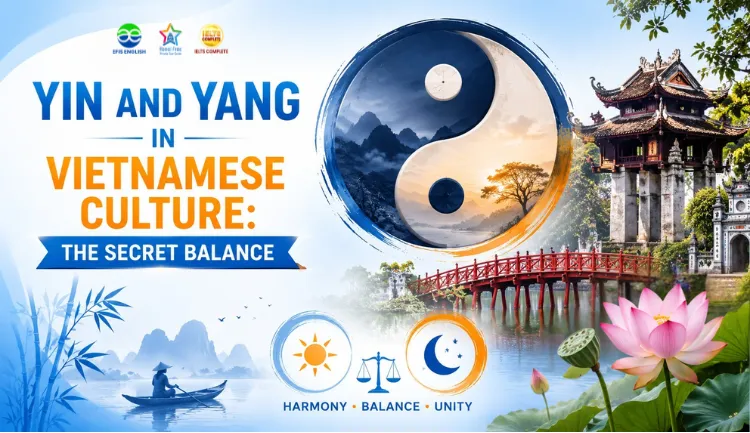
Yin and Yang in Vietnamese culture is not a museum relic. It is the reason your bowl of pho arrives with a plate of raw herbs, why a grandmother in the Old Quarter still throws two coins before a big decision, and why a house gets built on one kind of land while a grave gets chosen on another. This article breaks down what Yin and Yang, known locally as Am Duong, actually means to Vietnamese people day to day, not just as a philosophical idea but as a living habit. We will walk through its roots, its role in food, medicine, architecture, and ritual, and where a visitor can still see it working in Hanoi right now.
What is Yin and Yang in Vietnamese Culture?
Yin and Yang in Vietnamese culture is the belief that everything in life exists as a pair of opposite forces that need each other to function, rather than compete to win. Am (Yin) is cool, dark, soft, slow, and associated with the moon, water, and the feminine, while Duong (Yang) is warm, bright, hard, fast, and associated with the sun, fire, and the masculine. Neither side is “good” or “bad” on its own. In Vietnamese thinking, sickness, bad luck, or a failed harvest usually means the two forces have fallen out of balance, not that one force has defeated the other.
What makes this idea practical rather than abstract is that a small piece of the opposite is always hidden inside each force. A little Duong lives inside every Am, and a little Am lives inside every Duong, which is why a purely “hot” or purely “cold” state is considered unhealthy in Vietnamese folk logic. You will hear this instinct described with the phrase “co am co duong” (there is Yin, there is Yang), used the way an English speaker might say “every cloud has a silver lining.” It is less a rule you memorize and more a lens locals apply automatically, from picking a soup to picking a wedding date.
| Aspect | Am (Yin) | Duong (Yang) |
| Nature | Cool, dark, soft, passive | Warm, bright, hard, active |
| Symbol | Moon, water, earth | Sun, fire, sky |
| Food examples | Leafy greens, cucumber, seafood, mung bean | Ginger, garlic, chili, red meat |
| Medicine (Dong Y) | Cold, deficient, interior symptoms | Hot, excess, exterior symptoms |
| Land / Feng Shui | Duong Trach graves (Am Trach, land for the dead) | Homes and buildings (Duong Trach, land for the living) |
| Roof tile shape | Curves downward | Curves upward |
| Wedding symbol | Betel leaf (climbing, soft) | Areca nut (tall, upright) |
Where does Yin and Yang in Vietnamese Culture come from?
This philosophy comes from two sources layered on top of each other: a native Vietnamese cosmology built around the shapes of the circle and the square, and roughly two thousand years of exchange with Chinese Taoist philosophy. Our companion guide, Vietnamese Cosmology 101, covers the full worldview these ideas sit inside, including the Five Elements and the folk spirit world. Here, we are zooming in on just the Yin-Yang half of that picture, because it deserves its own deep dive.
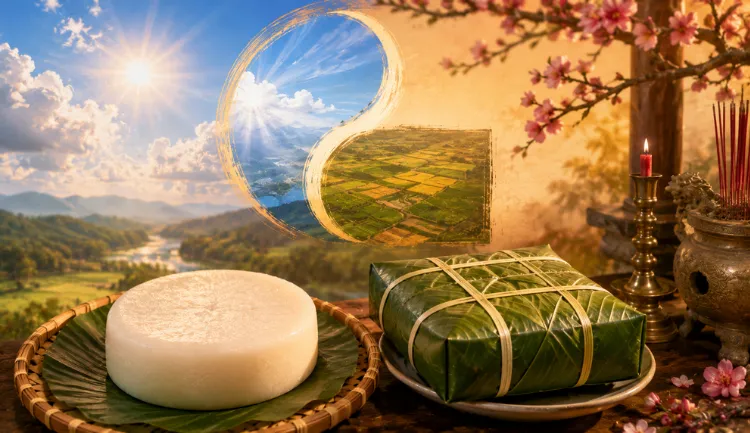
Long before the Chinese Taiji symbol (the familiar black-and-white swirl) reached Vietnam, locals already expressed a version of Yin and Yang through the belief that the sky is round and the earth is square, a phrase still spoken today as “troi tron dat vuong”. You can taste this idea every Tet holiday. The square banh chung cake represents the earth and the Am principle, while the round banh giay cake represents the sky and the Duong principle. According to the old legend, Prince Lang Lieu, the eighteenth son of a Hung King, invented both cakes from plain rice to win his father’s throne, proving that humble, balanced offerings mattered more than exotic ones. That single dish on a Hanoi altar is arguably the most visible piece of native Yin-Yang symbolism in the entire country.
How is Vietnamese Yin and Yang Different From the Chinese Version?
Vietnamese Yin and Yang shares its basic engine with Chinese Taoism but runs on a different set of native stories and rituals layered on top. Where Chinese tradition leans on the Taiji circle and the I Ching for divination, Vietnamese folk practice leans on square-and-round food symbolism, ancestor coin tossing, and a strong rural belief system that predates any contact with China. The result feels less like an imported philosophy and more like a homegrown habit that happened to find a compatible vocabulary once Taoist ideas arrived.
Our volunteer guides like to point out that guests often expect a “Chinese” answer when they ask about the Yin-Yang symbol on a temple roof in the Old Quarter, and are surprised to learn the square-round duality in banh chung has nothing to do with China at all. That small correction tends to be the moment a tour guest stops seeing Vietnamese culture as a footnote to its neighbor and starts seeing it as its own tradition. It is a detail we enjoy sharing on our walking tours precisely because it rarely makes it into guidebooks.
How does Yin and Yang Balance show up in Vietnamese Food?
Yin and Yang balance shows up in Vietnamese food through the constant pairing of cooling (Am) and warming (Duong) ingredients in the same dish, the same meal, and even the same season. Cooling foods include leafy greens, cucumber, seafood, and mung beans, while warming foods include ginger, garlic, chili, and red meat. A bowl of seafood, considered cooling, is almost never served without ginger or chili to offset it, and a sour soup like canh chua is a popular hot-day dish precisely because its tang and freshness cool the body down.
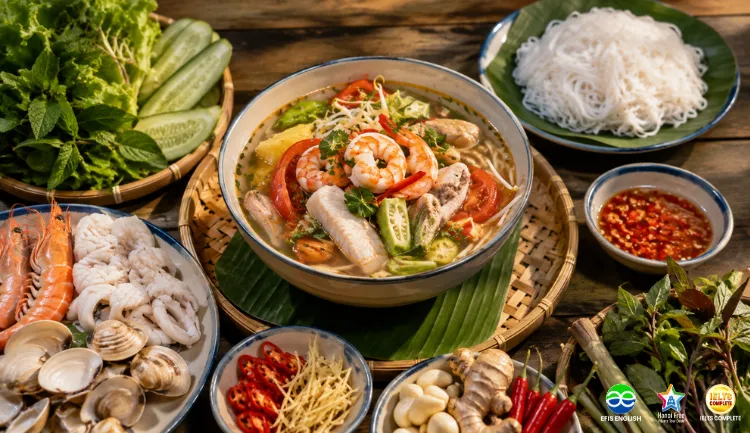
This balancing act happens on three levels at once: inside a single dish, between the food and your body’s current state, and between the meal and the season outside. A humid, sticky Hanoi summer calls for cooling herbs and light broths, while a damp Hanoi winter calls for warming spices like ginger and star anise. Vietnamese grandmothers rarely explain this with the words “Yin and Yang”, they just say a dish feels “too hot” or “too cold” for the weather, which is Am Duong theory working quietly in the background of every kitchen in the country.
What Role does Yin and Yang play in Vietnamese Traditional Medicine?
Yin and Yang is the oldest and most central theory inside Dong Y, Vietnam’s traditional medicine system, where illness is diagnosed as an imbalance rather than an invading germ alone. Practitioners sort symptoms into three paired categories: cold versus hot, interior versus exterior, and deficiency versus excess. A patient with cold, weak, interior symptoms is treated with warming Duong remedies, while a patient with hot, excess, exterior symptoms is treated with cooling Am remedies.
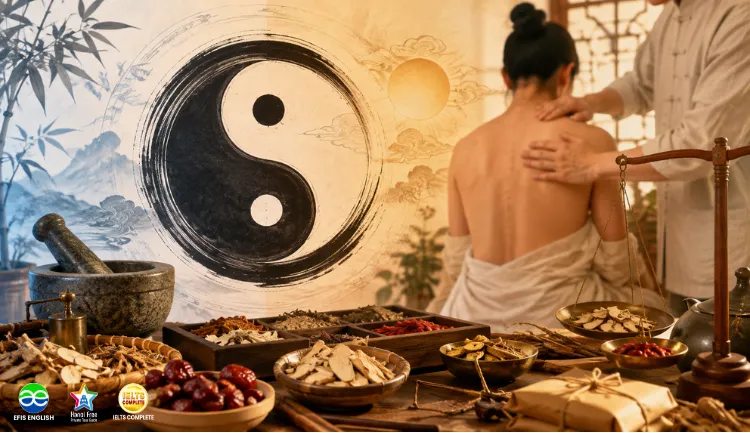
A Dong Y practitioner reads this balance through the tongue and the pulse rather than a blood test. Red spots on the tip of the tongue point toward a Duong-type condition, while a pale, swollen tongue with tooth marks points toward an Am-type weakness. This is also why many older Hanoians still avoid iced drinks after a fever or recommend ginger tea for a cold stomach, folk habits that trace directly back to balancing Am and Duong rather than to any single vitamin or medicine.
Yin and Yang in Vietnamese Architecture and Feng Shui
Yin and Yang in Vietnamese architecture governs where homes are built, where graves are placed, and even how roof tiles are shaped, through the practice known as Phong Thuy, or feng shui. Vietnamese feng shui splits land into two very specific categories: Duong Trach, land for the living, and Am Trach, land for the dead. Traditionally, families believed a well-placed grave (Am Trach) protected the fortune of future generations even more directly than a well-placed house (Duong Trach), so choosing burial ground was treated with extraordinary care, right down to the exact day and hour of interment.
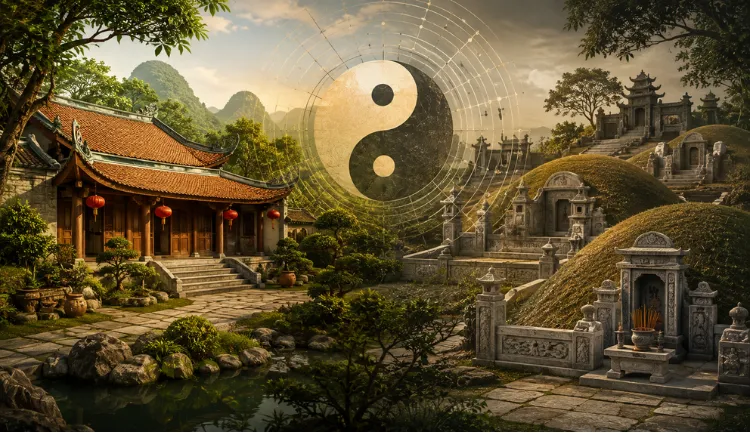
You can see this Yin-Yang logic overhead as well as underfoot. Traditional roof tiles across northern Vietnam, including many communal houses and temples around Hanoi, use an interlocking pattern of curved tiles nicknamed “ngoi am duong”, or Yin-Yang tiles, where one tile arches upward (Duong) and the neighboring tile curves downward (Am) to lock together. Beyond looking beautiful, the design channels rainwater efficiently off steep tropical roofs, a rare case where the philosophy and the engineering solve the same problem at once.
Yin and Yang in Vietnamese Weddings and Everyday Rituals
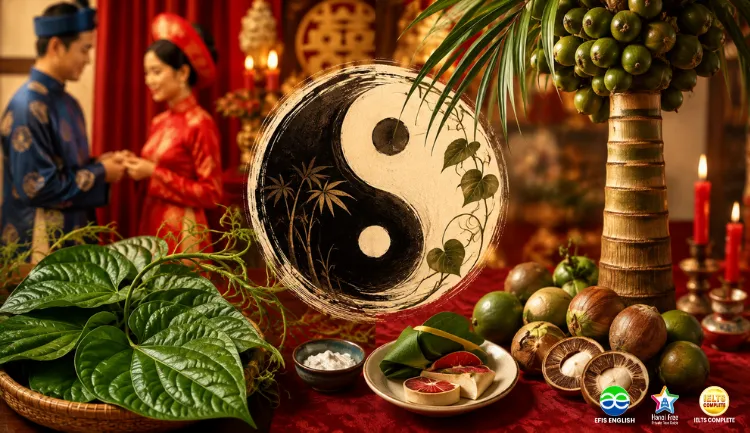
Yin and Yang in Vietnamese weddings and everyday rituals shows up most clearly in the betel leaf and areca nut, a pairing so tied to marriage that “matters of betel and areca” is still a Vietnamese phrase for getting married. The soft, climbing betel leaf represents Am while the tall, upright areca palm represents Duong, and folklore says the two plants grew from a devoted brother and sister-in-law who could not bear to be apart even in death. Chewed together with a pinch of lime, the mixture turns blood red, a color Vietnamese couples still read as a sign of a well-balanced, long-lasting union.
Balance also shows up at the temple, where visitors can try “xin dai am duong”, a small divination ritual using two coins or two curved wooden pieces. You toss them together and ask your ancestors or a deity a yes-or-no question. One piece landing face up and one face down (one Am, one Duong) is read as a clear “yes”, while two matching faces means the answer is unclear and you should ask again. You can still see visitors trying this at temples around Hoan Kiem Lake, including Ngoc Son Temple, and it is one of the small rituals our student guides love pointing out because it turns an abstract philosophy into something a guest can actually do with their own hands.
If following the thread from a Tet cake to a temple coin toss already has you curious about the rest of Vietnam’s spiritual world, our free walking tours are built exactly for that kind of curiosity, and a guide can shape the route around whichever piece of this story you want to see for yourself.
Where can you see Yin and Yang in Vietnamese Culture around Hanoi?
You can see this balance most directly at Hanoi’s older temples, communal houses, and lake-side landmarks, where the symbolism was built into the site rather than added for tourists. Ngoc Son Temple on Hoan Kiem Lake blends Taoist, Confucian, and Buddhist elements in one small complex, and its shrine to the giant lake turtle ties directly back to the water-and-land duality at the heart of Yin-Yang thinking. The nearby Turtle Tower and the Temple of Literature both show the same square-and-round architectural instinct found in banh chung and banh giay, just rendered in stone instead of rice.
Old Quarter communal houses and Hanoi’s older pagoda roofs are also worth a slow look upward, since many still use the interlocking Yin-Yang roof tiles described earlier. One of our volunteer guides remembers a guest who had walked past a Hanoi communal house roof a dozen times without noticing the alternating curved tiles, until it was pointed out mid-tour, and the guest spent the rest of the walk finding the same pattern on every roof afterward. That shift, from walking past a detail to actively hunting for it, is usually the moment a guest stops sightseeing and starts genuinely reading the city.

FAQs About Yin and Yang in Vietnamese Culture
It is both. Vietnam absorbed Yin-Yang theory from Chinese Taoism, but layered it onto native beliefs like the round-sky, square-earth cosmology seen in banh chung and banh giay, giving Vietnamese Yin and Yang a distinct local flavor.
It is called Am Duong, and while the classic black-and-white Taiji circle is recognized in Vietnam, the more distinctly local symbol is the square-and-round pairing seen in Tet cakes and traditional architecture.
Mostly through food and habit rather than formal ritual, pairing cooling ingredients like ginger with warming ones like seafood, dressing for the season, and consulting a Dong Y practitioner or an almanac when something feels persistently “off.”
Yes. Trying “xin dai am duong” coin divination at a temple like Ngoc Son, eating a properly balanced Vietnamese meal, or simply looking up at a communal house roof are all ways to see this philosophy in action rather than just reading about it.



I appreciate you sharing this blog post. Thanks Again. Cool.