Lantern light spills across Hang Ma Street every autumn as the Mid-Autumn Festival in Vietnam turns Hanoi’s Old Quarter into a glowing maze of colour, drums, and the smell of fresh mooncakes. This guide walks you through everything a traveler needs to know about Tet Trung Thu, Vietnam’s beloved harvest celebration, from its ancient roots and 2026 date to the parades, legends, and treats that define it. Whether you’re planning a family trip or simply curious about Vietnamese culture, here is how to experience the festival like a local.
What is the Mid-Autumn Festival in Vietnam?
The Mid-Autumn Festival in Vietnam, called Tet Trung Thu in Vietnamese, is a traditional celebration held on the 15th day of the 8th lunar month, when the year’s fullest and brightest moon rises over the country. It began thousands of years ago among rice-farming communities, who used the point in the calendar when the harvest was in and the fields were quiet to give thanks for a good year and rest before the next planting season. The custom of gathering outdoors to admire the full moon and share food traveled south from China over centuries of contact, then took on a distinctly Vietnamese character as it blended with local folklore.
Today, Vietnamese people call it the “Children’s Festival”, or Tet Thieu Nhi, because the entire celebration revolves around young ones. Kids parade through the streets carrying handmade lanterns, hear the legend of Chu Cuoi, a man said to live on the moon beneath a banyan tree, and receive gifts of toys and sweets from parents and grandparents. Adults take part too, but the joy on a child’s face carrying their first lantern is really what the night is about. In Vietnamese culture, the full moon also symbolizes family unity, so relatives who live apart often make a point of gathering together for the occasion.
» Vietnamese Traditional Holidays: The Complete Calendar for Travelers
» Vietnamese Cosmology 101: Decode Vietnam’s Ancient Worldview
What are the Legends behind Tet Trung Thu?
Vietnam’s Mid-Autumn Festival draws on three intertwined legends: the Chinese story of Hang Nga and Hau Nghe, the tale of Tang emperor Duong Minh Hoang’s journey to the moon palace, and Vietnam’s own legend of Chu Cuoi and the banyan tree. Together they explain why Vietnamese families gaze at the moon, set out offerings to it, and picture human figures living on its surface.
In the oldest version of the story, Hau Nghe was a skilled archer who shot down nine of ten suns scorching the earth, saving humanity. As a reward, he received a pill of immortality, but his wife Hang Nga drank it herself to keep it safe and floated up to the moon, where she has lived ever since, separated from her husband. Hau Nghe is said to have set out fruit and cakes on the night of the full moon so his wife could see and share in the offering from afar, a gesture many consider the origin of moon worship and mooncakes. A separate legend has Tang emperor Duong Minh Hoang carried to the moon palace by a Taoist priest, where he watched celestial dances he later brought back to his royal court.
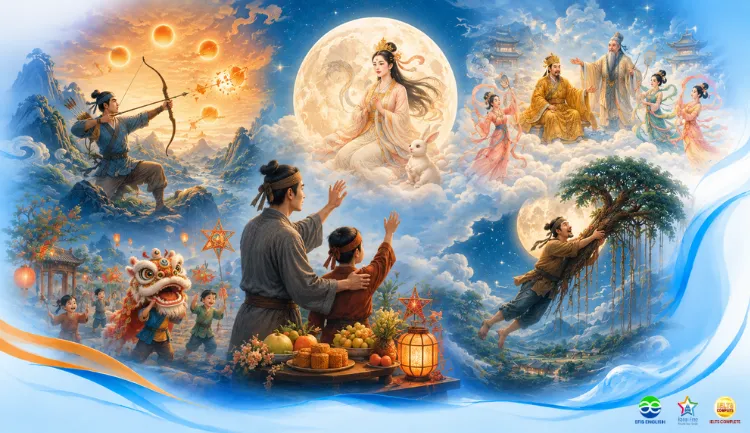
Vietnam adds its own hero to the sky. Chu Cuoi was a woodcutter who once used a magical banyan tree to bring the dead back to life. When the tree began floating skyward after being watered with impure water, Chu Cuoi grabbed hold of it out of instinct and was carried up to the moon, where Vietnamese children still say you can see his silhouette beneath the tree on the brightest night of the eighth month.
When is the Mid-Autumn Festival in Vietnam in 2026?
In 2026, the Mid-Autumn Festival in Vietnam falls on Friday, September 25, the 15th day of the 8th lunar month. Because Tet Trung Thu follows the lunar calendar, the Gregorian date shifts every year, so it’s worth double-checking before you book flights. Unlike Tet (Lunar New Year), this is not a public holiday in Vietnam, which means shops, offices, and transport all run on their normal schedule.
That’s actually good news for travelers: you can enjoy the celebrations without the citywide slowdown that comes with Tet. Hanoi typically begins decorating its streets two to three weeks ahead of the festival, so visitors arriving anytime from early September through the end of the month will still catch the lantern displays even if they miss the exact full moon night.
Mid-Autumn Festival Dates, 2025 to 2028
| Year | Gregorian Date | Lunar Date |
| 2025 | October 6 | 15th day, 8th lunar month |
| 2026 | September 25 | 15th day, 8th lunar month |
| 2027 | September 15 | 15th day, 8th lunar month |
| 2028 | October 3 | 15th day, 8th lunar month |
What happens in Hanoi’s Neighborhoods during the Mid-Autumn Festival?
In residential wards across Hanoi, local community groups organize their own pha co nights in the days before the festival, where children gather to receive gifts, carry lanterns, and share a fruit tray under the moon. These neighborhood celebrations are where Tet Trung Thu is felt most intimately, often more so than on the crowded main streets.
Each residential block, or To Dan Pho, typically sets up its own small courtyard event organized by local volunteers, the women’s union, or the youth union. Families prepare a Mam Co, a tray arranged with seasonal fruit, mooncakes, and sometimes a dragon or rabbit sculpted from pomelo peel and jelly, which is set out to admire under the full moon before everyone shares it together, a custom known as pha co. Community leaders and local businesses often chip in to hand out small gifts such as candy, toys, and lanterns to every child at the gathering, and some neighborhoods extend the same generosity to underprivileged children brought in from the outskirts of the city.
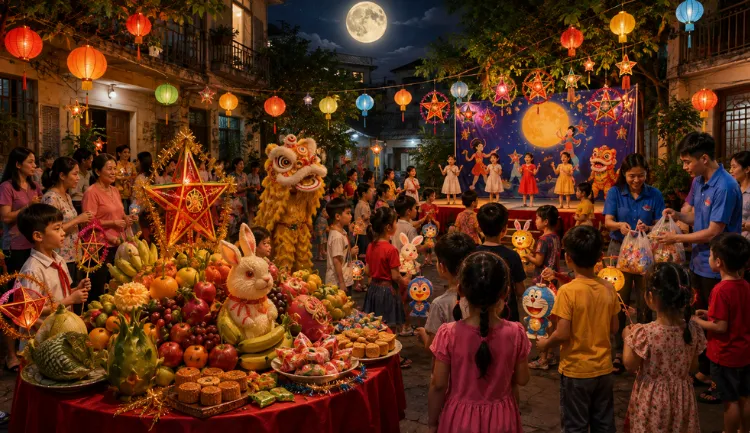
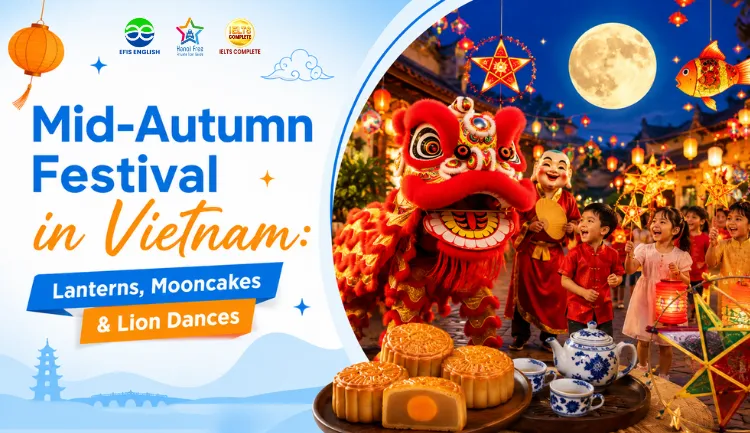
Lanterns are the heart of the evening. Shops sell battery-lit toys shaped like everything from cartoon characters to rockets, but the Den Ong Sao, a red five-pointed star lantern built from bamboo and cellophane paper around a small candle, remains the most iconic and instantly recognizable shape. Children walk in a small procession around the block carrying their lanterns while singing well-known Trung Thu songs, the most famous being “Chiec Den Ong Sao”, and many neighborhoods set up a small stage where kids take turns performing songs, dances, or short skits for their families and neighbors. For a traveler staying in a residential area of Hanoi rather than the tourist center, stepping outside on the evening of the festival is often enough to stumble into one of these community gatherings.

Why do Lion Dance Troupes Parade the Streets During Tet Trung Thu?
Lion dance troupes move through Hanoi’s streets and alleys in the days around the festival because the dance is believed to drive away bad luck and bring prosperity to every home it visits, with drumbeats announcing its arrival long before the lion itself appears.
Known as Mua Lan in Vietnamese, the dance features two performers working a papier-mache lion head and long fabric body, moving to the rhythm of drums and cymbals as they weave through streets, shopfronts, and apartment courtyards. What makes the Vietnamese version distinct from lion dances elsewhere in Asia is Ong Dia, the Earth God, a cheerful, broad-bellied character in a smiling mask who leads the lion, fans it playfully, and interacts with the crowd, especially the children. Ong Dia is considered to summon the lion and clear its path, and his comic routine, teasing the lion and the kids watching, is often the part of the performance people remember best.
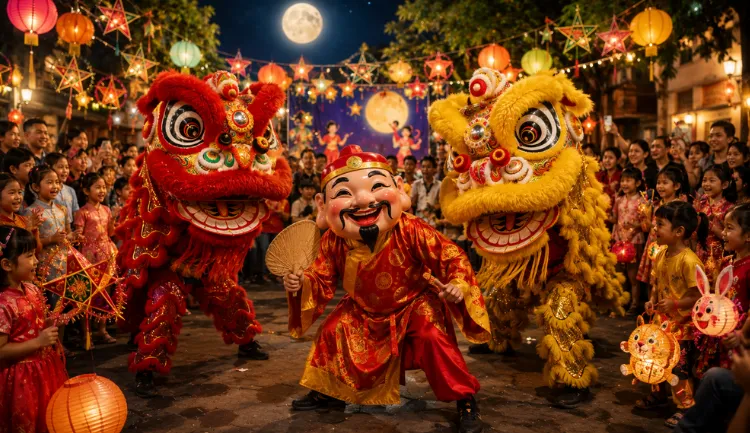
Shopkeepers and families along the parade route traditionally hang a small red envelope or bundle of greens from a high window or doorway for the lion to reach up and take, a gesture believed to invite good fortune into the home or business for the year ahead. Watching a troupe work a narrow Old Quarter alley, with the lion dipping and leaping to snatch the offering while Ong Dia clowns around below, is one of the most photogenic and purely joyful things a visitor can catch during the festival season.
What do Vietnamese Mooncakes mean, and Why are they given as Gifts?
Mooncakes, or banh Trung Thu, trace back to the same moon-worship offerings described in the legend of Hang Nga, and today they double as one of Vietnam’s most important gift-giving customs, exchanged between family, friends, and business partners in the weeks before the festival.
Vietnam offers two main styles: banh nuong, a baked mooncake with a golden crust, and banh deo, a soft, chewy cake made from glutinous rice flour and pressed into a mold showing a stylized moon, flower, or fish. Fillings range from classic lotus seed paste and red bean to salted egg yolk representing the full moon, and increasingly, modern fusion flavors like matcha, coffee, or durian. The round shape itself echoes the full moon, and offering a cake to the moon before eating it is a direct, edible continuation of the old legend of Hau Nghe setting out food for his wife.

Mooncakes have also become one of the biggest corporate gift traditions in Vietnam. Companies order boxed sets printed with their logo to send to clients and partners, employees receive them from their employers, and relatives mail or hand-deliver tins to family members they cannot visit in person. One of our tour guide volunteers likes to point out that the box matters almost as much as what is inside it: a beautifully packaged tin signals real thought and status, which is why mooncake displays appear in hotel lobbies, bank branches, and shop windows across Hanoi well before the lanterns go up on Hang Ma Street.
Beyond mooncakes, autumn in Hanoi also brings com, young green sticky rice that’s harvested and pounded fresh, then wrapped in lotus leaves and sold by street vendors around the same weeks as the festival. Roasted lotus seeds, pomelo, and persimmons round out the seasonal spread you’ll see on family altars and market stalls alike, and if you want to taste several mooncake varieties without committing to a whole cake, most bakeries in the Old Quarter sell single mini mooncakes.
How is the Mid-Autumn Festival Celebrated in Hanoi?
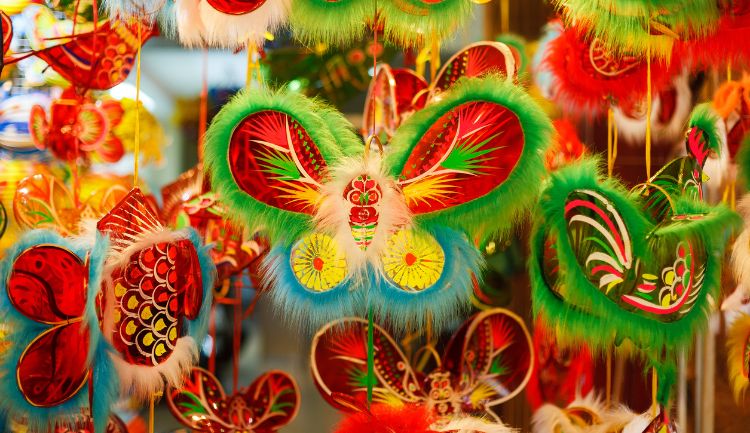
Hanoi celebrates the Mid-Autumn Festival with an intensity that few other Vietnamese cities can match, largely thanks to Hang Ma Street in the heart of the Old Quarter. For three to four weeks before the festival, this narrow street transforms into a sea of lanterns, masks, drums, and toys, drawing locals and travelers who come simply to walk through and take photos. Shopkeepers who normally sell wedding decorations switch their entire inventory over to Mid-Autumn goods for the season.
The festive mood isn’t confined to Hang Ma. Cafes and restaurants across the city, from the Old Quarter to newer neighborhoods like Tay Ho, hang lanterns, set up photo corners with mam co displays, and sometimes run limited-edition mooncake-flavored drinks and desserts for the season, a trend especially popular with young Hanoians who post the decorations online. Hotels and office lobbies often display an elaborate mam ngu qua centerpiece for guests and staff to admire throughout the month.
The city also hosts larger organized events in the days leading up to the festival, typically at cultural exhibition venues, with craft workshops where visitors can learn to make paper lanterns, paint masks, or mold clay figurines called to he alongside local artisans. Evenings culminate in Dem hoi Trang Ram, or Full Moon Night, with lantern parades and lion and dragon dances that draw crowds into the streets.
Our guides at Hanoi Free Private Tour Guide often suggest visiting Hang Ma Street on a weekday evening rather than the weekend closest to the festival itself, since the crowds thin out considerably and you get a much better look at the lantern displays without being swept along in a crush of people.
Where should Foreign Travelers go for the Mid-Autumn Festival in Hanoi?
For a first-time visitor, the easiest route is Hang Ma Street for lantern shopping in the late afternoon, followed by Hoan Kiem Lake’s walking street in the evening, where lion dances and live performances take place right along the water.
Hoan Kiem Lake and its surrounding walking street become a natural gathering point on the festival night itself, with the red Huc Bridge and the Turtle Tower lit up and framed by lantern displays, and families spreading out along the water to watch parades and folk performances. If Hang Ma feels too packed, Phung Hung Street, Hanoi’s mural street, strings up its own lantern displays against a backdrop of painted walls and tends to be noticeably calmer, which also makes it a better choice for photos.
Peak energy on the festival night runs from around 6 to 9 PM, when most lion dance troupes and parades are out, so arrive by 5 PM if you want a comfortable spot near the lake. After 9:30 PM the crowds thin noticeably while the lanterns and food stalls stay open, which makes it a quieter window for wandering and taking photos. Keep an eye on your belongings in the densest crowds, hold onto children’s hands around the lake’s edge and busy junctions, bring some cash for lanterns and street snacks since not every stall takes cards, and ask a parent before photographing children you don’t know, since many families are simply enjoying a private moment together.
Quick Facts About Tet Trung Thu
| Detail | Information |
| Vietnamese Name | Tet Trung Thu |
| Also Known As | Children’s Festival (Tet Thieu Nhi), Moon Festival |
| 2026 Date | Friday, September 25 |
| Public Holiday? | No, businesses and transport operate normally |
| Best Hanoi Locations | Hang Ma Street, Hoan Kiem Lake, Phung Hung Street |
| Signature Food | Banh Trung Thu (mooncakes: nuong and deo) |
| Signature Craft | Den ong sao (star lantern), to he clay figurines |
| Neighborhood Ritual | Pha co, a shared fruit tray for children |
| Street Character | Ong Dia, the Earth God who leads the lion dance |
| Key Legends | Hang Nga and Hau Nghe, Chu Cuoi and the banyan tree |
FAQs About the Mid-Autumn Festival
No. Tet Trung Thu is a widely celebrated cultural festival, but schools, offices, shops, and public transport all continue on their normal schedule.
Pha Co is the moment when a decorated fruit and mooncake tray, first set out to honor the moon, is shared and eaten by everyone at the gathering. It marks the point where quiet admiration of the moon turns into a lively, communal celebration for children.
Ong Dia, the Earth God, is the smiling, big-bellied character who leads the lion dance troupe with a fan, clearing the lion’s path and playfully interacting with the crowd. He’s a good-luck figure distinct to Vietnamese lion dance.
Hang Ma Street in the Old Quarter is the top spot for lantern shopping, while Hoan Kiem Lake’s walking street hosts the main lion dance parades and performances on the festival night itself.