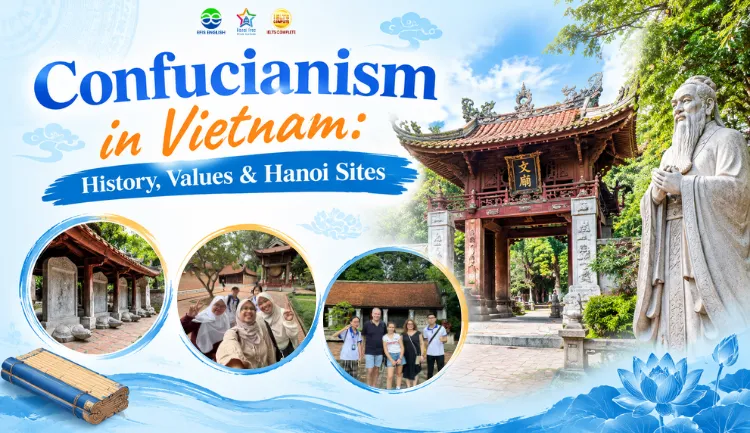
Confucianism in Vietnam is the moral tradition behind how families honour elders, how students treat teachers, and why a Hanoi courtyard of stone turtles still draws crowds. We cover what Vietnamese Confucianism is, how it took root, and where to see it in Hanoi. The main stop is the Temple of Literature, and Ngoc Son Temple on Hoan Kiem Lake makes a good second one.
Confucian ideas run through daily religious life, and our guide to religions in Vietnam covers that wider picture in full. We stay with one tradition and the places where it is easiest to see. With that background, each gate, pavilion and stone slab at the Temple of Literature starts to make sense.
What is Confucianism in Vietnam?
Confucianism in Vietnam is a moral and social philosophy, built on the teachings of the Chinese thinker Confucius, that guides how people treat family, teachers and rulers. Confucian teaching reached Vietnam during the long period of Chinese rule that began in 111 BCE. Local scholars, families and kings then shaped the tradition over many centuries.
Is Confucianism a Religion in Vietnam?
Confucianism in Vietnam is usually described as a philosophy and ethical system, not a religion, because it has no church, clergy or single creed. The government officially recognises 16 religions (as of May 2024), and Confucianism is not one of them. Even so, Confucian ideas reach religious life through temples, ancestor altars and festivals.
Which Confucian Values in Vietnam Still Matter?
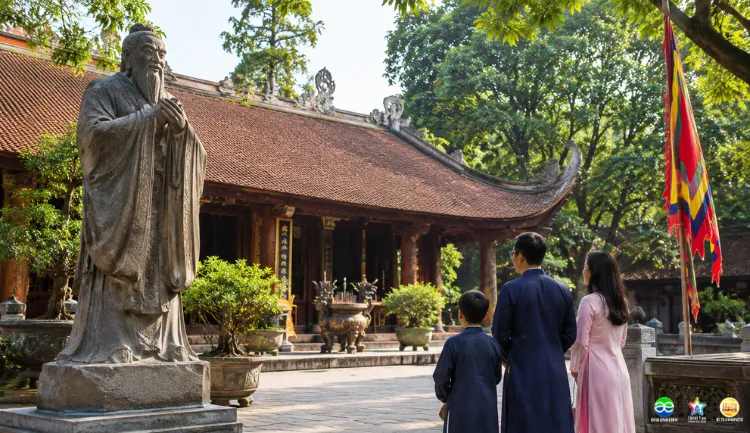
Four ideas stand out in Confucianism in Vietnam today: filial piety, respect for learning, respect for teachers and reverence for writing. These Confucian values in Vietnam shape family life, school culture and festivals, and each one has a visible home in Hanoi.
| Confucian idea | What it means | Where to see it in Hanoi |
| Filial piety | Respect and care for parents, elders and ancestors, in life and after death | Ancestor altars in homes and shops; family meals on death anniversaries |
| Respect for learning | Study and exams as a route to public service | The 82 doctoral steles at the Temple of Literature |
| Respect for teachers | Honouring teachers as moral guides | Chu Van An honoured at the Temple of Literature; Teachers’ Day ceremonies on 20 November |
| Reverence for writing | Calligraphy and literature treated as respected arts | Tet calligraphy at the Temple of Literature; the Pen Tower and Ink Slab at Ngoc Son Temple |
How did Vietnamese Confucianism Develop?
Vietnamese Confucianism developed in three broad stages: arrival under Chinese rule, state adoption under the Ly dynasty in the 11th century, and a long run of court examinations that ended in 1919. Historians still debate how closely Confucianism in Vietnam followed the Chinese model, and the women’s property rights in the Hong Duc Code, covered below, are one example often discussed. Any short timeline simplifies a long story. Each stage left a mark you can still see in Hanoi.
From Chinese Rule to the Ly Dynasty
Confucian teaching first arrived through Chinese administration, then Confucianism in Vietnam became a state project under the Ly dynasty. King Ly Thanh Tong founded the Temple of Literature in 1070, and in 1076 the Imperial Academy, Quoc Tu Giam, opened there as Vietnam’s first national university. The academy taught the Confucian way of life until 1779. The year 2026 marks 950 years since Quoc Tu Giam opened, and a ceremony is planned in Hanoi on 14 November 2026.
How Do Confucianism, Buddhism and Taoism Blend?
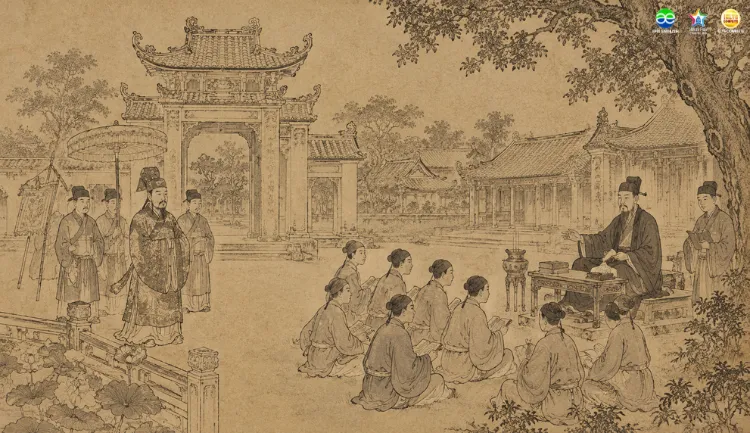
Confucianism, Buddhism and Taoism are known together as Tam Giao, the Three Teachings, and many Vietnamese temples and family rituals draw on all three. In practice, Confucianism in Vietnam rarely stands alone, and the three are often hard to separate as religious affiliations. For the Buddhist side of the story, read Buddhism in Vietnam, and for the Taoist side, see Taoism in Vietnam.
How did Imperial Examinations in Vietnam Work?
Imperial examinations in Vietnam tested candidates on the Confucian classics in stages, and the top scorers became officials. Candidates sat three main rounds: Thi Huong, a regional exam; Thi Hoi, a national pre-court exam; and Thi Dinh, the court exam, for which the king personally set the questions and marked the papers. Graduates of the highest exams had their names carved in stone, which is why the Temple of Literature keeps so many steles.
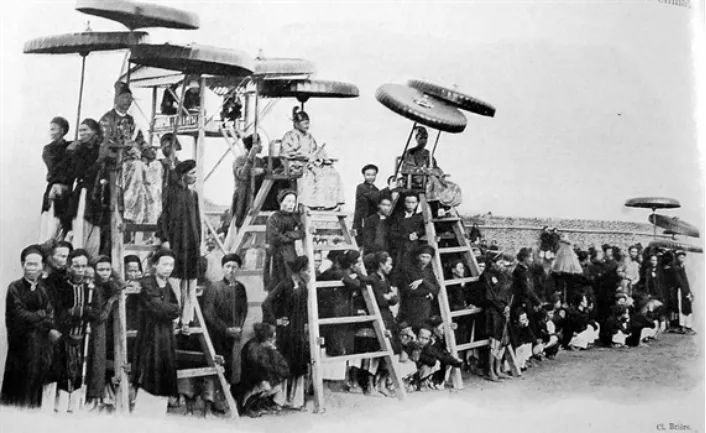
The first court exam took place in 1075 under King Ly Nhan Tong. The last was held in Hue in 1919, after which Emperor Khai Dinh issued a new education law that ended the Confucian education system. Across those centuries, the court examination system made Confucianism in Vietnam both a moral code and a route to a career in public service.
The Temple of Literature: A Confucian Temple in Hanoi
The Temple of Literature is a Confucian temple in Hanoi and the site of Vietnam’s first national university. The complex lies on Quoc Tu Giam Street and combines a temple to Confucius with the grounds of the old Imperial Academy. Its gates, courtyards and stone steles show how Confucianism in Vietnam was turned into architecture and ritual.
What Can You See in the Five Courtyards?
The complex is divided into five courtyards, walked in order from the main gate to the old academy grounds. Walls and gates separate one courtyard from the next. Pause in each one rather than hurrying to the steles.
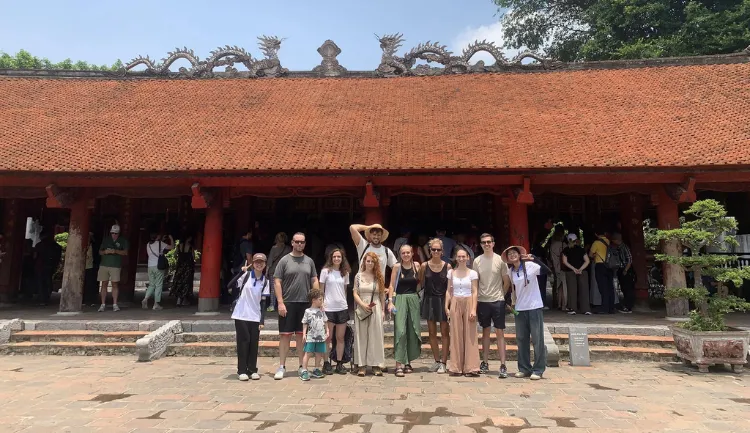
- First courtyard: Lawns and trees line the path from the Van Mieu Mon gate to the Dai Trung Mon gate, where scholars once relaxed.
- Second courtyard: Khue Van Cac, the Constellation of Literature pavilion, was built in 1805 and is the best-known building in the complex, with four round windows on its upper floor.
- Third courtyard: Thien Quang Tinh, the Well of Heavenly Clarity, is a square pond with the doctoral steles standing in two rows beside it.
- Fourth courtyard: The Dai Thanh sanctuary holds altars to Confucius and his disciples, and it is the most solemn space in the complex.
- Fifth courtyard: Thai Hoc marks the grounds of the old Imperial Academy, where students once studied.
Confucianism in Vietnam also shows up in the shapes of the courtyards. The four round windows of Khue Van Cac symbolise the sun or shining stars and stand for heaven, while the square Thien Quang pond stands for the earth, so the pair expresses the balance of yin and yang and the pavilion is mirrored in the water. Khue Van Cac also appears on the 100,000 VND banknote and has been Hanoi’s official symbol since 1997.
What are the 82 Doctoral Steles?
The 82 doctoral steles are stone slabs, each resting on a stone turtle, that record the names of the men who passed the royal exams held between 1442 and 1779. Each stele commemorates one exam, and the 82 that survive carry the names of 1,304 laureates, according to Vietnam’s UNESCO nomination file. UNESCO recognised them on its Asia-Pacific register in 2010 and added them to the global Memory of the World Register in 2011, a list of documentary heritage that is separate from the World Heritage List. As a physical record, the steles are the clearest surviving trace of Confucianism in Vietnam.
How do you visit respectfully?
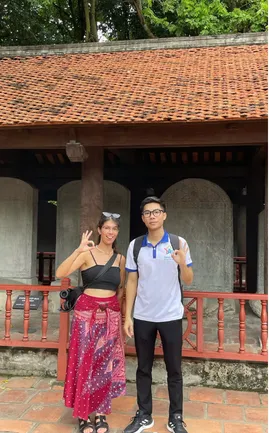
Dress politely, speak quietly in sacred areas and do not touch the steles. The Temple of Literature’s official website asks visitors to dress politely when entering places of worship, keep quiet in solemn areas, avoid touching or writing on artifacts, stone steles and structures, and stay off the grass. Exam candidates often rub the turtle heads for luck, so the temple has put up barriers around the steles to stop the rush.
The complex opens daily from 8:00 to 17:00, and a night tour runs from 18:30 to 22:00 on Wednesday, Saturday and Sunday with a separate ticket. The Hanoi Free Private Tour Guide club suggests arriving at 8:00, when the gates open, so you can walk the first courtyards at an easy pace. Covering shoulders and knees is a simple way to follow the dress request. For dress and conduct at Buddhist sites, see our guide to Pagoda Etiquette in Vietnam.
Where else in Hanoi can you see Confucian Culture?
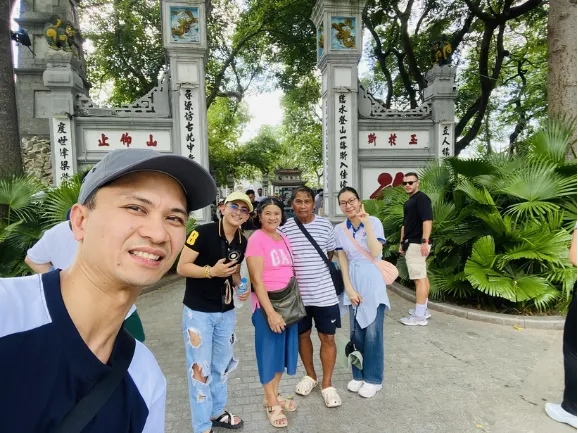
Ngoc Son Temple on Hoan Kiem Lake is the best second stop for Confucianism in Vietnam, because its Pen Tower and Ink Slab honour writing and scholarship. The scholar Nguyen Van Sieu oversaw a major repair of the temple in 1865, building or upgrading the Huc Bridge, the Pen Tower and the Ink Slab. The Pen Tower ends in a brush-shaped peak, and the Ink Slab is held up by three frogs. The temple also shows the Three Teachings in one compound: it honours General Tran Hung Dao and Van Xuong, a deity linked to literature, and visitor guides describe a hall with a statue of Amitabha Buddha.
Confucianism in Vietnam Today: Family and Festivals
Confucianism in Vietnam today is most visible in three places: the family altar, exam season and Tet calligraphy. Hanoi shows all three, from small altars in homes and shops to crowds of students at the Temple of Literature before exams. Ancestor worship, exam-season prayers and calligraphy blessings all trace back to the same Confucian respect for family and learning.
Filial Piety in Vietnam and Ancestor Altars
Filial piety in Vietnam means respect and care for parents, elders and ancestors, and it is most visible at the family altar and on death anniversaries. Adult children are expected to serve and honour their parents in life and in death. In the home, Confucianism in Vietnam centres on the family altar, which holds incense, flowers and fruit offered to deceased relatives. Visitors walking through Hanoi will often notice small altars in homes and shops.
Under traditional Confucianism in Vietnam, the duty is not shared equally. The eldest son, or the senior male of the family line, usually leads the ceremony on a death anniversary and looks after the main altar. Because a male heir was long seen as essential for carrying on these rites, many families hoped for at least one son, and UNFPA has described a long-standing preference for sons as the main cause of Vietnam’s imbalance between boys and girls at birth.
What did Confucianism Teach about Gender Roles?
Traditional Confucianism in Vietnam placed women under male authority, summed up in the Three Obediences and Four Virtues. The Three Obediences taught a woman to obey her father, then her husband, and in widowhood her son, and the Four Virtues covered her work, appearance, speech and conduct. Written law, however, tells a more mixed story.
The Le dynasty’s 15th-century legal code, known as the Hong Duc Code, recognised daughters’ inheritance rights and allowed women to own and co-own property. Historians still debate how far these protections reached in practice, and some note that women in China also had legal property claims between the Tang and Ming dynasties. A 2023 study in the RUDN Journal of Sociology concludes that Vietnamese Confucian ethics about women have changed for the better, though Confucian gender principles still have both helpful and harmful effects today.
Why is Exam Pressure so strong in Vietnam?
Exam pressure is where Confucianism in Vietnam meets modern life, because the tradition treats study as the main route to status and a way to honour the family. A Vietnamese saying holds that when one person becomes an official, the whole clan benefits. Researchers who study Vietnamese students note that honouring the family often means being an exemplary student.
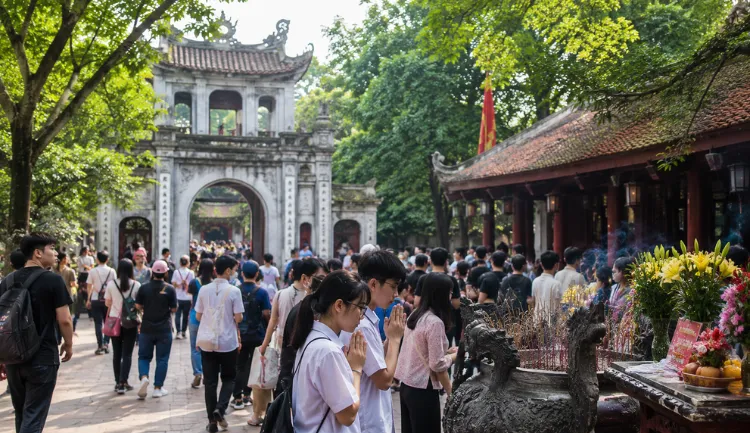
The result is easy to spot in the evening. In 2022, more than one million candidates registered for the national high school graduation exam, and many final-year students attended back-to-back extra classes that ran until about 9:00 pm. The pressure reaches the Temple of Literature too, where thousands of students and parents come to pray for luck before big exams. Reports of these crowds cluster in June and early July, around the national exams, so expect a busier temple if your trip falls in that window.
Teachers’ Day and Tet Calligraphy
Respect for teachers, another pillar of Confucianism in Vietnam, returns each year on Teachers’ Day and at Tet, the Lunar New Year. Vietnam Teachers’ Day falls on 20 November. In 2020 the Temple of Literature marked that day with a ceremony for the 650th anniversary of the death of the teacher Chu Van An.
Around Tet, Confucianism in Vietnam becomes visible in public. Ong Do, the old Confucian scholars who write blessings in brush and ink on red paper, set up at the temple, and families come for a word to hang at home for the new year. The 2026 Spring Calligraphy Festival ran at Van Lake inside the complex from 11 February to 1 March, and festival dates change each year, so check the temple’s website before you plan around them.
Confucianism in Vietnam FAQs
Confucius is honoured as a teacher and sage at Confucian temples such as the Temple of Literature in Hanoi, where altars stand in the Dai Thanh sanctuary. The tradition has no clergy or single creed, and the government does not list it among recognised religions, so what the honour means differs from person to person.
Chu Van An (1292 to 1370) was a Vietnamese teacher who led the Imperial Academy, Quoc Tu Giam, under King Tran Minh Tong. He is honoured at the Temple of Literature in Hanoi, and a separate temple in his name stands on the To Lich River.
Ancestor worship overlaps with Confucianism in Vietnam but is not identical to it. Confucian filial piety supplies the duty to honour parents after death, while a 2025 study in the VMOST Journal of Social Sciences and Humanities notes that Vietnamese filial piety also draws on Buddhism and Taoism.