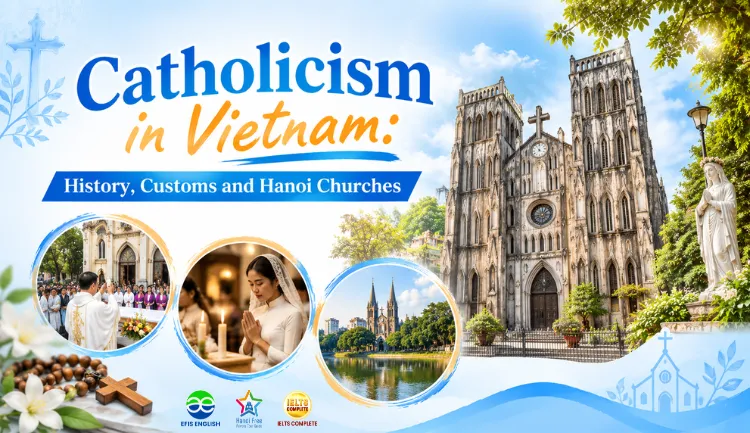
Catholicism in Vietnam begins, for most visitors, with a sound: a church bell rolling over the Old Quarter of Hanoi at first light, a choir warming up behind a courtyard wall, the first Mass of the day already under way. The faith arrived with European missionaries in the 16th century and has grown into a community of roughly 6 to 7 million people, with its northern heart in three major churches in Hanoi. Inside any of them, history, family tradition and living worship share one room.
Step into St. Joseph’s Cathedral and the story keeps unfolding. Stained glass made in France glows above the nave, the sanctuary gleams with gilt-trimmed wood in the old imperial style, and a statue of the Virgin Mary rests in a palanquin, following local custom. A few minutes’ walk from Hoan Kiem Lake, St. Joseph’s Cathedral shows how Catholicism in Vietnam sits within the wider weave of religions in Vietnam that share Hanoi’s streets.
How did Catholicism in Vietnam Begin?
European missionaries, including Portuguese and Spanish priests, first reached the Vietnamese coast in the 16th century, and Catholicism in Vietnam gained real strength after the French Jesuit Alexandre de Rhodes arrived in 1624. Missionaries won followers village by village, trained local lay teachers called catechists, and kept the community alive through long stretches when rulers banned the faith. Between 1627 and 1630, de Rhodes and the Portuguese missionary Pero Marques converted more than 6,000 people in Tonkin, the northern region around present-day Hanoi.
Missionaries and the Vietnamese Alphabet
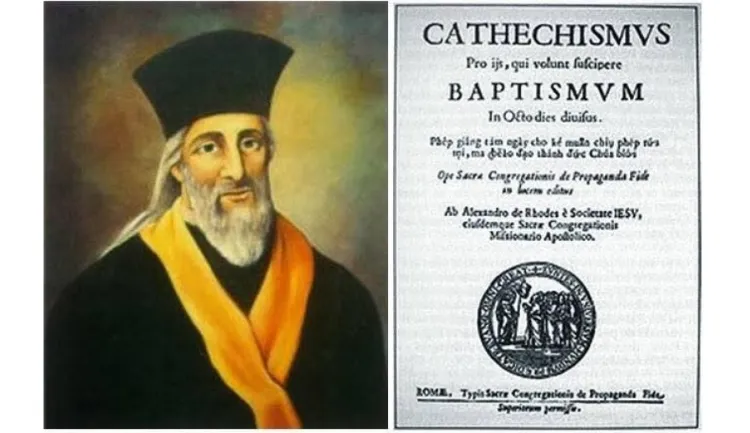
The Latin-letter script known as chu quoc ngu, or “national language script”, is the most visible legacy of Catholicism in Vietnam, and it is why Hanoi’s street signs and menus use familiar Roman letters. The Portuguese Jesuit Francisco de Pina, who reached Cochinchina in 1617, is credited with the first Latinized script for Vietnamese, and he taught it to his student Alexandre de Rhodes. Pina drowned in 1625 while trying to rescue guests from a wrecked boat. De Rhodes carried the work forward, and his Vietnamese-Portuguese-Latin dictionary, printed in Rome in 1651, helped fix the spelling.
Persecution and the 117 Vietnamese Martyrs
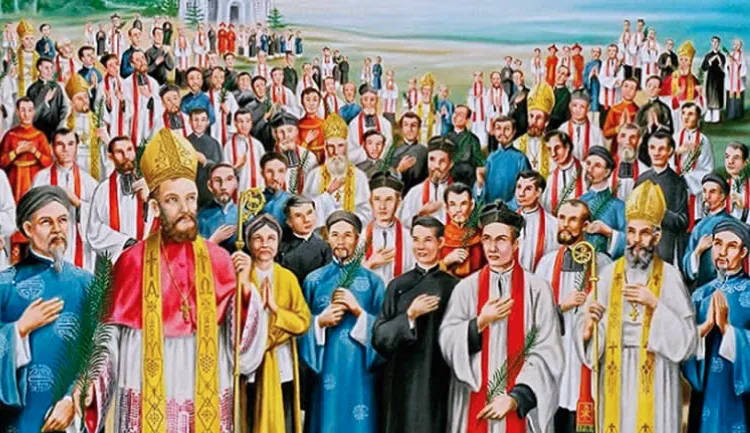
Pope John Paul II canonized 117 martyrs on June 19, 1988, honoring Catholics who died for their faith in Vietnam between 1745 and 1862. Known as the Vietnamese Martyrs, the group included 96 Vietnamese, 11 Spanish Dominicans and 10 French missionaries. They stand for a far larger group whose names are unknown, and the Church remembers them together on November 24. Edicts against the faith, issued by rulers who feared foreign influence, shaped how Catholicism in Vietnam remembers its past.
After 1954: Catholics in Northern Vietnam
The division of the country in 1954 reshaped Catholicism in Vietnam: several hundred thousand northern Catholics moved south, and church life in the north shrank for decades. Estimates of the move range from 650,000 to 800,000 people. Between 1954 and 1989, one priest and one bishop served Bac Ninh Diocese, and St. Joseph’s Cathedral in Hanoi stayed closed to Mass until Christmas Eve 1990. Worship has grown steadily since then.
How Big is Catholicism in Vietnam Today?
The 2019 census counted 5,866,169 Catholics in a population of 96,208,984, about 6.1%. The Bishops’ Conference statistics for 2023 list 6,856,563, and some estimates round up to 7 million, because each count uses different years and methods. Either way, Catholicism in Vietnam is a minority faith, shared by about 6% of the population.
In 2023 the Catholic Church in Vietnam recorded 165,111 baptisms and 274 newly ordained priests, a sign of steady growth. Hanoi tells a quieter story: the Archdiocese of Hanoi counted about 333,200 Catholics among nearly 8.9 million people at the end of 2022, roughly 3.7%. Catholic life in Hanoi therefore unfolds among pagodas, temples and street markets.
How does Catholicism in Vietnam Meet Local Tradition?
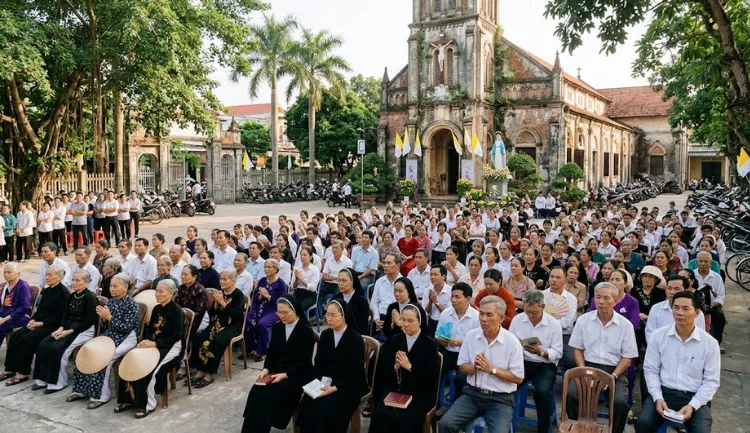
Local tradition meets the Catholic faith at the family altar and at Tet: Vietnamese Catholics honor their ancestors and celebrate the Lunar New Year, giving both a Catholic form. Catholic customs in Vietnam grew out of a long conversation between missionaries and village life, and the conversation continues today. Rather than standing apart from Tet or local custom, Catholic communities have developed their own way of keeping them.
Ancestor Veneration in Catholic Homes
Few questions in Catholicism in Vietnam took longer to settle than ancestor veneration. Bowing and burning incense before the family altar had been prohibited for Catholics since the 17th century, which set Catholic households apart from their neighbors in a culture built around family memory. Rome’s 1939 instruction Plane compertum est allowed Chinese Catholics to bow before the dead and their images, and the Vietnamese bishops applied the same reasoning to Vietnam in 1965. The roots of that filial piety lie in Confucianism in Vietnam.
The Vietnamese bishops went further in 2019, approving experimental guidelines to be tested for three years. Catholics may bow, offer incense and keep an ancestor altar with candles, flowers and fruit, with the picture of the deceased placed beneath the altar of God. Families are encouraged to hold death anniversary prayers at home without superstition. The gestures express respect for the dead and faith in the Resurrection.
Xom Dao: The Catholic Neighborhood
In cities such as Ho Chi Minh City, Catholic families often cluster in the lanes around a parish church, in a neighborhood Vietnamese people call a xom dao, or Catholic hamlet. Christmas shows these communities at their brightest: neighbors raise scaffolding, tarp and lights together to build nativity caves, called hang da, along the alleys. The lanes of District 8 around Pham The Hien Street hold some of the biggest scenes in Saigon, all built by residents. Travelers who want to see Catholicism in Vietnam at street level should visit in December.
Tet in the Parish
Tet is where Catholicism in Vietnam turns most domestic: families celebrate at home first and at church second. Parishes hold Masses on the first three days of the new year, praying for peace on day one, for the deceased on day two and for work and livelihoods on day three. Churches are decorated with spring flowers, and families gather for the holiday as other Vietnamese households do. Visit a church during Tet and you will find a quieter, more reflective mood than on Christmas Eve.
Catholic Churches in Hanoi: Where to Go and What to See
Hanoi is a rewarding place to meet Catholicism in Vietnam up close, with three major Catholic churches within a short ride of Hoan Kiem Lake. St. Joseph’s Cathedral stands near the lake, Ham Long Church lies south of it, and Cua Bac Church faces the northern gate of the Imperial Citadel of Thang Long. Phat Diem Cathedral, a Vietnamese-style landmark in Ninh Binh Province, makes a longer day trip.
| Church | Address | What to look for | Good to know |
| St. Joseph’s Cathedral | 40 Nha Chung Street, Hoan Kiem District | Twin Neo-Gothic towers, French stained glass, a palanquin statue of Mary | Main gates open mostly during Mass; at other times, use the side door in the diocese compound wall |
| Ham Long Church | 21 Ham Long Street, Hoan Kiem District | Dedication to St. Anthony of Padua; present building from 1934 | Shares its street with Ham Long Pagoda |
| Cua Bac Church | 56 Phan Dinh Phung Street, Ba Dinh District | Asymmetrical design, tall bell tower, yellow facade restored in 2013 | Stands by the old citadel’s northern gate |
| Phat Diem Cathedral (day trip) | Kim Son District, Ninh Binh Province | Gothic ideas set under Vietnamese temple roofs | Plan a half day from Ninh Binh |
St. Joseph’s Cathedral: What to Look For
Look up first: two square towers rise about 31 meters, each holding five bells, in a Neo-Gothic design that echoes Notre-Dame de Paris. As the seat of the Archdiocese of Hanoi, the cathedral is the spiritual heart of Catholicism in Vietnam’s north. The cathedral was consecrated on December 24, 1886, though sources disagree on whether construction began in 1882 or 1884. Inside, look for the rib-vaulted ceiling, as in medieval Europe, and outside, for the statue of Regina Pacis, Our Lady Queen of Peace, at the front. A restoration finished in May 2022 refreshed the weathered stone, and a pipe organ with 1,850 pipes arrived in November 2022.
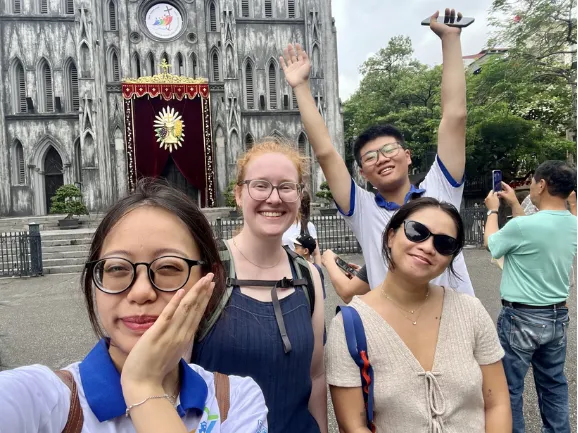
The ground holds an older story. Before the cathedral, the site belonged to Bao Thien Pagoda, founded under the Ly dynasty in the 11th century, whose ruins had collapsed in 1542 and were cleared for construction. Pagodas like Bao Thien belong to the story of Buddhism in Vietnam, which shaped Hanoi long before the first church bell.
Cua Bac Church and Ham Long Church
Cua Bac Church stands out for its asymmetrical design and tall bell tower, while Ham Long Church honors St. Anthony of Padua. Cua Bac means “Northern Gate,” and the church faces the old northern gate of the Imperial Citadel of Thang Long at 56 Phan Dinh Phung Street. English-language sources credit the French architect Ernest Hébrard, who led Indochina’s architecture and town planning service, while a Vietnamese government portal credits a French priest who was also an architect. Dates vary just as widely, from 1925 to 1932.
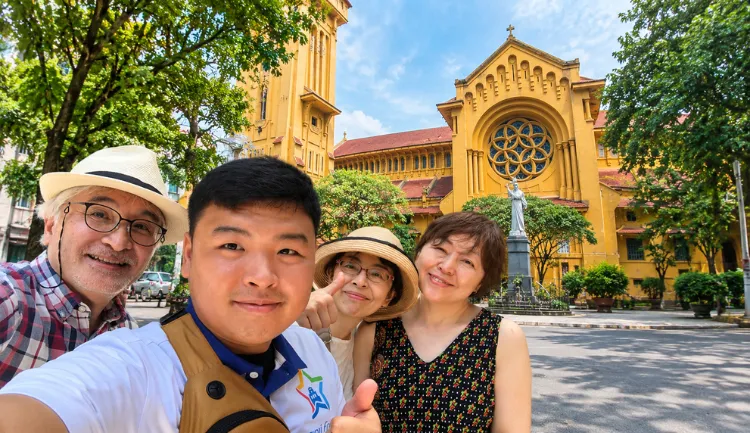
At 21 Ham Long Street, the present Ham Long Church was built in 1934 to a design by a Vietnamese architect, on a site where a church had stood since the end of the 19th century. The street shares its name with Ham Long Pagoda, whose history reaches back to the 11th century. Visitors tracing Catholicism in Vietnam on foot can walk south from Hoan Kiem Lake to Ham Long Church, while Cua Bac Church is better reached by a short taxi ride.
Christmas Eve Around the Cathedral
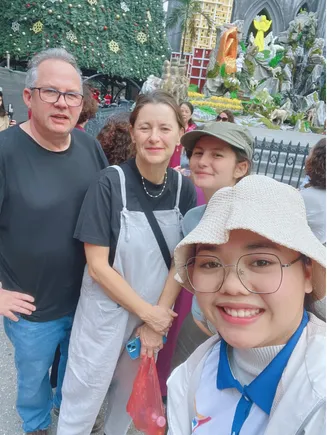
Christmas Eve is the most public day of Catholicism in Vietnam, and in Hanoi the celebration centers on St. Joseph’s Cathedral. Thousands of people gather around the cathedral for lights, carols and Midnight Mass, and the crowd mixes worshippers with young Hanoians and visitors who come for the atmosphere. Streets near the cathedral fill early, so arrive well before evening and pack a warm layer, since December nights in Hanoi turn cool. Visitors who do not attend Midnight Mass can still enjoy the lit square and the tall decorated tree outside.
How Should You Behave in a Catholic Church?
Dress modestly, speak softly and treat Mass as worship rather than a photo stop, and a church visit becomes one of the easiest ways to meet Catholicism in Vietnam. Services run throughout the day, so choose a moment that suits you. A few simple habits keep every visit smooth:
- Cover your shoulders and knees; shorts and tank tops are not appropriate.
- Follow the congregation’s lead: stand when they stand and stay quiet when they pray.
- Take photographs outside or between services, in the softer light of early morning or late afternoon.
- Outside Mass times, use the side door in the diocese compound wall and ring the bell.
At the Hanoi Free Private Tour Guide club, the advice we give guests before any religious site is the same: arrive with covered shoulders, move slowly and let worshippers go first. Pagodas follow different customs for incense and donations, explained in pagoda etiquette in Vietnam. Whichever door you enter, a calm voice and a patient pace are always welcome.
Catholicism in Vietnam: Frequently Asked Questions
Catholicism in Vietnam operates under Article 24 of the 2013 Constitution, which gives everyone the right to freedom of belief and religion, and Catholic churches in Hanoi hold regular Masses. Visitors are welcome to attend a service quietly at St. Joseph’s Cathedral, the seat of the Archdiocese of Hanoi. Dress modestly and follow the congregation’s lead.
Visitors curious about Catholicism in Vietnam can join a Sunday English Mass at St. Joseph’s Cathedral and at Cua Bac Church, both listed in the late morning, roughly between 10:30 and 11:30. Mass times change, so confirm with the parish notice board before you go.
Phat Diem Cathedral is worth the trip for travelers curious about Catholicism in Vietnam beyond Hanoi, because its stone halls and curved roofs follow Vietnamese temple design inside a working church. The site lies about 120 kilometers from Hanoi, roughly a two-hour drive. The main church was consecrated in 1891, and the interior is not always open.
Hanoians use the everyday name Nha Tho Lon, which means Big Church or Grand Church, for St. Joseph’s Cathedral. Officially the building is the cathedral of the Archdiocese of Hanoi, dedicated to Saint Joseph. Guidebooks and local news use both names.