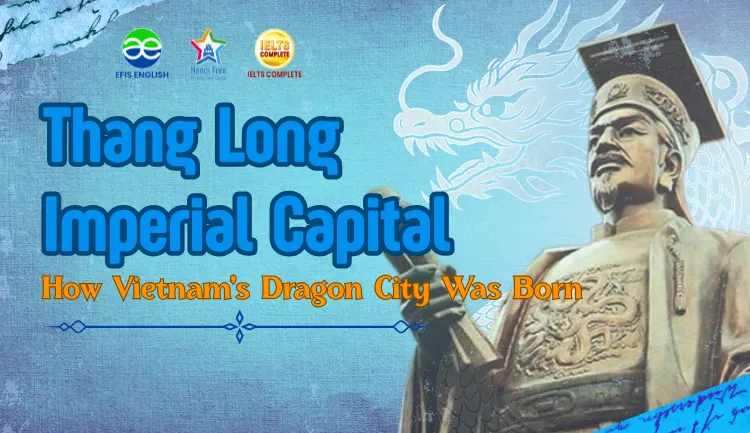
The Thang Long imperial capital, founded in 1010, is one of the most consequential acts of statecraft in all of Southeast Asian history. In a single autumn decision, Emperor Ly Thai To took the ruins of a Chinese fortress on the Red River, proclaimed it the “Rising Dragon”, and created a city that would serve as the heart of Vietnamese civilization for eight continuous centuries. This article goes deeper than the founding legend. It asks the harder questions: What exactly did Ly Thai To build? Why did he build it the way he did? And what of Thang Long still breathes inside the Hanoi you can walk through today?
» History of Hanoi: A Thousand-Year Capital’s Epic Journey
Why did Ly Thai To choose Thang Long over All Other Sites?
Ly Thai To did not choose Thang Long on impulse or legend alone, he chose it because it was, by every strategic and geomantic measure available in 1010, the only correct answer for an independent Vietnamese nation with ambitions to last.
The emperor had been on the throne for less than a year when he issued the Chieu Doi Do. His predecessor dynasty, the Early Le, had ruled from Hoa Lu (in modern Ninh Binh), a valley fortress ringed by dramatic limestone karst mountains, perfect for survival, impossible for growth. Ly Cong Uan articulated the problem with brutal clarity in the Edict: Hoa Lu was a damp, narrow place where the dynasty could not be prolonged, the population could not multiply, and all things could not thrive. He was not wrong. A mountain valley capital could field armies but could not govern a delta. It could defend a fragile new state but could never project the confidence of an empire.

Thang Long, by contrast, sat at what the Edict famously called the “navel of heaven and earth” – the geographical center of the Red River Delta’s communication networks, elevated above the annual floodplain, open to the fertile south, and positioned at the confluence of the Red River and To Lich River waterways that connected the entire northern Vietnamese population. This was not poetry; it was precise strategic logic. No army could hold northern Vietnam without holding this high ground. No dynasty could feed its capital without the Red River Delta’s rice harvests. And no ruler could govern the country from a mountain fortress accessible only through narrow passes.
The emperor also acknowledged, pointedly, the wisdom of his Chinese predecessors. In the Edict, he praised the Tang general Gao Pian (“Cao Vuong”) for recognizing the same qualities in this land when he built Dai La in 866 AD. This was a subtle masterstroke of political rhetoric: by citing a Chinese general’s own verdict on the site, Ly Thai To grounded his Vietnamese capital in a geography that had already been validated by the former occupiers. The land was not just Vietnamese sentiment, it was objective strategic truth that transcended dynasties.
What was the Chieu Doi Do, and Why does It still matter?
The Chieu Doi Do, the Edict on Transfer of the Capital, is one of the most important political texts in Vietnamese history, and understanding it reveals why the founding of the Thang Long imperial capital was far more than an administrative relocation.
Written in Literary Chinese (the formal language of governance across East Asia at the time), the Edict runs to approximately 214 Chinese characters, short enough to be read aloud in minutes, dense enough to carry the weight of a civilization’s self-declaration. Its structure moves through three clear movements. First, Ly Thai To surveys the great capitals of Chinese antiquity (the Shang, Zhou, and Han dynasties) that prospered by choosing their sites wisely, establishing the universal principle that a capital’s geography determines a dynasty’s fate. Second, he applies this principle directly to Vietnam, contrasting the inadequacy of Hoa Lu with the perfection of the Dai La site. Third, and most memorably, he records the founding omen: the vision of a golden dragon ascending from the river as his royal flotilla arrived at Dai La, which he took as divine confirmation of his choice, and renamed the city Thang Long.

Thang Long (昇龍) means “Rising Dragon”, or “Ascending Dragon” in equally valid translations, since the Vietnamese character Thăng carries the sense of both rising and ascending powerfully into the sky. The name was not a casual label. The dragon held profound symbolic weight: in Vietnamese mythology, the nation traces its origins to Lac Long Quan, the Dragon Lord of the sea, and Au Co, the mountain fairy. Naming the capital “Rising Dragon” was a deliberate act of civilizational branding, connecting the new imperial city to the deepest roots of Vietnamese identity and royal legitimacy.
The Edict’s final line is its most ambitious: Ly Thai To states his intention to choose this land “so as to plan for the basis of the dynasty for ten thousand generations and the thriving and prospering of the people”. He did not achieve ten thousand generations, but he came remarkably close to achieving the rest. The city he founded is still the capital of Vietnam, over a millennium later. Few political documents in any culture can claim that their stated ambitions were so precisely fulfilled.
Insider tip from our volunteers: A hand-inscribed reproduction of the Chieu Doi Do is displayed inside the Thang Long Imperial Citadel museum at 18 Hoang Dieu Street. Our guides love pausing here to read key passages aloud with guests, hearing the founding logic in the actual space where it was enacted creates a kind of historical vertigo that no photograph can replicate.
How did Ly Thai To actually build Thang Long? The Architecture of an Imperial Capital
The physical construction of the Thang Long imperial capital began as soon as the emperor arrived in autumn 1010, but the scale of what was built requires an honest timeline: the core palace complex took priority, while the full citadel system evolved gradually over years and decades, not in a single burst.
Why construction was fast, but not instant: When Ly Thai To arrived at Dai La, he did not find an intact Chinese fortress ready to occupy. Over a century of fragmented post-Tang rule, through the Ngo, Dinh, and Early Le dynasties, had left the site largely in ruins. The old Dai La palaces and administrative halls were no longer usable. What the site offered was not standing buildings but something equally valuable: a defined spatial framework, an existing outer earthwork perimeter, and the same elevated geographical position that had made it attractive in 866. The Ly Dynasty built fresh almost entirely, inheriting geography and layout rather than structures.
The Can Nguyen Palace, the principal throne hall where the emperor and court discussed affairs of state, was the first priority and was substantially complete within months. The broader palace complex and inner citadel buildings followed through 1010 and into 1011. But the outer earthen walls of the Kinh Thanh (the outermost ring enclosing the entire capital and its civilian population) were formally consolidated only in 1014, when the chronicles record the earthen embankments being built up on all four sides. The full three-ring citadel system of Thang Long was thus a process of years, not a single year’s construction.
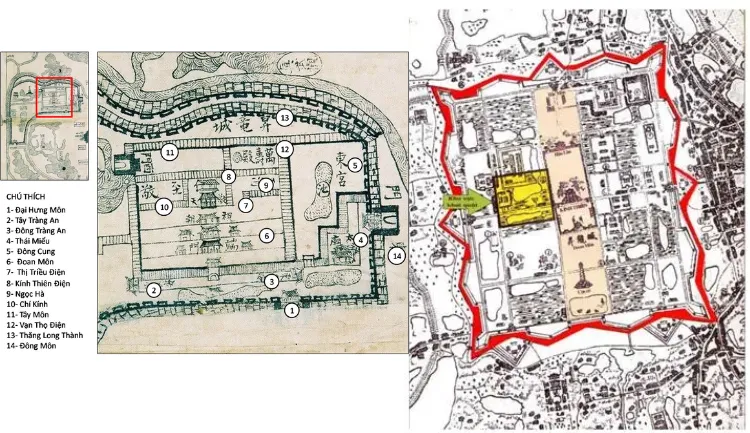
The Three-Layer Citadel System of Thang Long:
At the center stood the Cam Thanh (Forbidden Citadel), also called Long Thanh in Ly-era sources, the most sacred and restricted zone, housing the emperor’s private residence. This innermost ring was closed to all but the royal family and their most intimate attendants.
Surrounding the Cam Thanh was the Hoang Thanh (Imperial Citadel), called Long Thanh or Phuong Thanh in contemporary Ly-dynasty records; the more standardized term “Hoang Thanh” became common usage from the Le Dynasty onward. Whatever its name in each era, this middle ring contained the audience halls, royal temples, and working quarters of the government. This is what most people mean today when they refer to the “Thang Long Citadel”.
The outermost ring was the Kinh Thanh / Dai La Thanh, the great civilian city wall, enclosing markets, craft guilds, and the dense urban population that grew up in the shadow of the imperial complex. Here, Ly Thai To made a decision of profound historical significance: rather than entirely demolishing Gao Pian’s 9th-century outer earthworks, he incorporated their alignment into the new Vietnamese capital’s defensive perimeter, building the Vietnamese city on the bones of the Chinese one. This act of strategic reclamation, taking the infrastructure of colonization and transforming it into the foundation of liberated civilization, runs like a thread through everything Hanoi has done in the centuries since.
| Layer | Name (Ly Dynasty Usage) | Function | Who Could Enter |
| Innermost | Cam Thanh / Long Thanh | Royal residence; Can Nguyen Palace | Emperor, royal family, inner court only |
| Middle | Long Thanh / Phuong Thanh (later “Hoang Thanh”) | Government, administration, ceremonies | Court officials, mandarins, military |
| Outermost | Kinh Thanh / Dai La Thanh | City wall; civilian quarters, craft guilds, markets | All residents, merchants, craftspeople |
Beyond the citadel walls, the city rapidly organized itself into a commercial and craft fabric. Guild artisans settled near the citadel gates according to their specialty, silk merchants, bronze casters, paper makers, and lacquer workers each claimed their street. This organic commercial geography, shaped by proximity to the imperial market and the river trade routes, was the direct ancestor of what became Hanoi’s famous 36 Streets Old Quarter. The dragon capital and the market city grew together, inseparable from the start.
What were the Four Sacred Guardians of Thang Long, and Why did Ly Thai To build them?
The four guardian temples of Thang Long, the Tu Tran (Four Protectors), are among the least-known but most spiritually significant features of the Thang Long imperial capital, and they reveal a layer of the city’s founding philosophy that goes far beyond politics and urban planning.
Ly Thai To understood that a capital city required not only military walls but spiritual walls, a sacred perimeter of protective deities guarding the new Vietnamese civilization against malevolent forces from all four cardinal directions. Drawing on Vietnamese folk religion, Taoist cosmology, and Buddhist influence, he established or formally elevated four guardian temples positioned at the north, south, east, and west of the citadel complex.

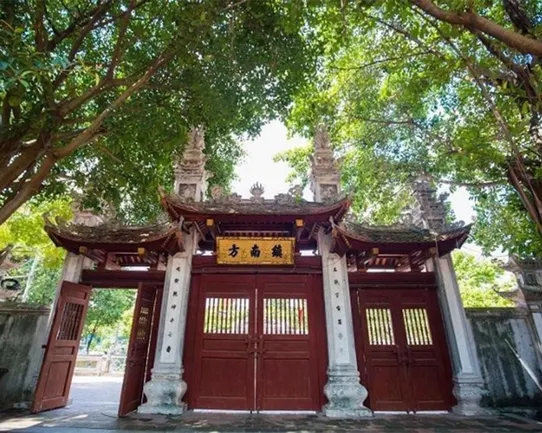
Bach Ma Temple (Eastern Guardian) at 76 Hang Buom Street, dedicated to Long Do, the earth-spirit of the Red River Delta, appearing in the form of a White Horse. This is the oldest of the four, with roots going back to the Dai La period itself (866 AD). Ly Thai To formally elevated it in 1010 as the guardian of the eastern approach. It remains an active place of worship in the Old Quarter today, and is genuinely one of the oldest sacred sites in Hanoi.
Quan Thanh Temple (Northern Guardian) on Thanh Nien Street by West Lake, dedicated to Huyen Thien Tran Vu, the Taoist deity of the north, represented by a serpent coiled around a tortoise. Built in 1010, the temple houses one of Vietnam’s most impressive bronze castings: a 3.96-metre statue of Tran Vu weighing approximately 4 tonnes, cast in 1677 during the reign of Emperor Le Hy Tong by the master craftsman Vu Cong Chan, replacing an earlier wooden image.
Kim Lien Temple (Southern Guardian) in Dong Da district (on Kim Hoa Street, Phuong Lien ward), dedicated to Cao Son Dai Vuong, the spirit of the southern mountains. This guardian protected the road from the south and was considered the spiritual counterweight to the northern threat.
Voi Phuc Temple (Western Guardian) near Thu Le park, dedicated to Saint Linh Lang, a figure of water and earth, represented by a prostrating elephant at the entrance. It guarded the western approach, where the To Lich River formed the natural moat of the old Dai La citadel.
Together, the Tu Tran formed a spiritual mandala around the Thang Long imperial capital, the visible expression of the emperor’s belief that a civilizational center required both human governance and divine protection. Walking the circuit of all four temples today, something our volunteers love doing with guests who have a full day and genuine curiosity, traces the spiritual geometry of the 11th-century city that underlies modern Hanoi.
How did the Ly Dynasty shape Thang Long into Vietnam’s Cultural Center?
The Thang Long imperial capital under the Ly Dynasty (1009-1225) was not simply a political headquarters, it became the cultural, religious, intellectual, and economic nucleus of an entire civilization, and much of what the dynasty built still defines Hanoi’s identity today.
The most enduring of the Ly Dynasty’s contributions is the Temple of Literature (Van Mieu), built in 1070 by Emperor Ly Thanh Tong to honor Confucius and the great Confucian scholars. Six years later, in 1076, Emperor Ly Nhan Tong added the Quoc Tu Giam (National College) within the same complex, Vietnam’s first national university, initially educating the sons of the emperor, royal family, and senior mandarins. This was a declaration of civilizational confidence: a Vietnamese state that built universities was not a temporary regime but a permanent civilization.

The first imperial examination was held in 1075, when the court organized the Minh Kinh Bac Hoc (Examination of the Learned in the Classics). Le Van Thinh from Bac Ninh came first among all candidates and went on to become the king’s personal tutor and later a senior court minister. It is worth noting that in 1075, the formal academic titles of Trang Nguyen, Bang Nhan, and Tham Hoa, the top three laureate ranks, had not yet been instituted (those came with the Tran Dynasty after 1247). Le Van Thinh is celebrated by history as the Trang Nguyen khai khoa (the inaugural top examinee) in the popular sense, though strictly speaking, his title was that of the highest-placing candidate in a new kind of examination, not a “Doctor” or “Trang Nguyen” in the later technical sense.
Buddhism flourished under the Ly Dynasty in ways that physically shaped Thang Long’s skyline. The emperors were devout Buddhists who built pagodas throughout the capital, Van Tue Pagoda, Dien Huu Pagoda (near what would become the One Pillar Pagoda), and Ngoc Ho Pagoda among others. The spiritual atmosphere of the Ly capital was simultaneously Confucian (in its administrative structures and examinations) and Buddhist (in its private devotional life), a synthesis that became characteristic of Vietnamese court culture for centuries.
The Ly Dynasty also established Thang Long’s relationship with its lakes and waterways. West Lake (Ho Tay), just north of the citadel, became a royal pleasure lake ringed with pagodas and temples. The network of smaller lakes, many of which survive today as Hoan Kiem, Truc Bach, and scattered ponds in the old quarters, was integrated into the urban fabric as natural cooling systems, flood buffers, and spaces for contemplation. Hanoi’s famous lake-city identity is, at its root, a Ly Dynasty creation.
A note from the Hanoi Free Private Tour Guide team: When we walk guests through the Temple of Literature, we always stop at the 82 doctoral steles on their stone turtle pedestals. These steles record the names of 1,304 scholars who passed Vietnam’s highest imperial examinations between 1442 and 1779. Touching the weathered stone of a stele that has stood for 500+ years is one of those moments that makes history feel suddenly, viscerally real.
What made Thang Long different from Dai La? The Cultural Transformation of a Capital
Understanding the Thang Long imperial capital requires grasping the precise nature of the transformation from Dai La, because it was not simply a change of rulers. It was a fundamental reimagining of what a capital city was for.
Dai La, under Chinese governance, was a colonial administrative citadel. Its primary purpose was governance and military control: to administer a subject population, collect tribute, and project Chinese imperial power into the southern frontier. That said, archaeological excavations at 18 Hoang Dieu have revealed that even under Chinese rule, Dai La was already a thriving urban center with significant pottery production, construction materials manufacturing, and river trade, not purely a military garrison. The distinction is one of purpose and identity, not of economic life.
Thang Long was the opposite in identity. Ly Thai To’s capital was designed from the outset as a generator of Vietnamese identity, not merely a seat of power. The Temple of Literature was not built to educate Chinese scholars, it was built to create Vietnamese ones, trained in the classics but serving Vietnamese ambitions. The guardian temples were not Chinese state religions but syncretic Vietnamese spiritual geography. The commercial quarters that grew up around the citadel walls were Vietnamese craft traditions clustering for mutual benefit and imperial proximity.
| Feature | Dai La (Chinese, pre-1010) | Thang Long (Vietnamese, post-1010) |
| Primary purpose | Colonial governance; military control of An Nam | Vietnamese imperial rule; cultural production |
| Economy | Thriving trade and craft already present | Vietnamese guild-street system expanded organically |
| Religious character | Tang Chinese administrative Buddhism/Taoism | Vietnamese syncretic Buddhism + Confucian examinations |
| Spiritual perimeter | None formal | Tu Tran (Four Sacred Guardians) in all four directions |
| Educational institutions | None | Van Mieu (1070), Quoc Tu Giam (1076) |
| Governing legitimacy | Imperial decrees from Tang China | Chieu Doi Do — Vietnamese political philosophy |
| Identity of inhabitants | Colonial subjects of China | Citizens of an independent Vietnamese civilization |
| Duration as primary capital | ~72 years as rebuilt Dai La (866-938) | ~800 years as Thang Long (1010-1802) |
The key word is transformation. Ly Thai To and his successors did not reject Chinese urban planning models, they were too sophisticated to discard entirely. But they layered Vietnamese values on top of the Chinese spatial framework: Vietnamese deities where Chinese administrative posts had been, Vietnamese scholars where Chinese appointees had served, and Vietnamese poetry, art, and religious sensibility filling the spaces between the citadel walls. If you want to understand why Hanoi feels unlike any other capital in Southeast Asia, why it has that peculiar density of layers, that sense of cultures and centuries compressed into walking distance, the answer begins in this transformation.
Why did Thang Long remain the Capital for 800 Years?
The Thang Long imperial capital served as Vietnam’s primary seat of power from 1010 to 1802, nearly eight centuries, through five major dynasties and countless wars, invasions, occupations, and reconstructions. Few capitals in world history can match this record of continuity, and the reasons are inseparable from the geographical logic Ly Thai To identified in the Chieu Doi Do.
The Tran Dynasty (1225-1400), which succeeded the Ly through a court marriage, made Thang Long its own with characteristic vigor. Tran architects expanded and beautified the citadel; Tran scholars produced some of Vietnam’s greatest literature. Most dramatically, the Tran defended Thang Long against three separate Mongol invasions, in 1258, 1285, and 1287-88, under the military genius of General Tran Hung Dao. Each time, rather than surrender the city, the Tran court strategically evacuated Thang Long, allowing the Mongols to briefly occupy an empty capital, then returned to drive them out. The city’s survival was not passive; it required the deliberate decision to preserve the capital as a symbol worth fighting for, even at enormous short-term cost.
The Later Le Dynasty (1428-1789), restored after Le Loi’s legendary ten-year resistance war expelled the Ming Chinese occupiers, represents perhaps the cultural peak of Thang Long’s imperial glory. The Temple of Literature’s imperial examinations reached their zenith; the 82 stone doctoral steles recording scholars from examinations held between 1442 and 1779 were carved beginning in 1484 under Emperor Le Thanh Tong. Vietnamese literature, art, law, and Confucian philosophy flourished. The city’s population grew and the Old Quarter’s guild-street structure solidified into the recognizable 36-streets geography that survives in modified form today.
The capital’s 800-year continuity was also, paradoxically, supported by its repeated near-destruction. Each time Thang Long was burned, by Mongol invaders, by civil wars, by Ming occupiers, it was rebuilt, often more grandly than before. The city became, across these centuries, not merely a physical place but a concept: the idea that there was a Vietnamese capital, a Vietnamese civilization, a Vietnamese future worth defending and reconstructing. That idea proved more durable than any individual building within the walls.
What survives of the Thang Long Imperial Capital today?
The physical legacy of the Thang Long imperial capital is more present in modern Hanoi than most visitors realize, though it requires knowing where to look and what you are actually seeing.
The Thang Long Imperial Citadel (Hoang Thanh Thang Long) in Ba Dinh district is the most direct surviving link to the 1010 founding. Designated a UNESCO World Heritage Site in 2010, deliberately timed to mark exactly 1,000 years since the founding, the site encompasses the Doan Mon Gate (the principal southern entrance, on its original Le Dynasty foundations), the Kinh Thien Palace terrace (the most significant surviving above-ground remnant of the Le Dynasty royal court), the Hau Lau (Princess’s Palace), and the extraordinary 18 Hoang Dieu archaeological excavation. This last is the most profound experience on the site: a stratigraphic display of soil layers from the 7th century through the 20th, showing in visible geological terms the compressed history of Dai La becoming Thang Long becoming Hanoi. Archaeological Zone A (the lowest level) preserves remains directly from the Dai La / early Thang Long period; Zone B contains the Ly and Tran dynasty layers above it.

The Temple of Literature (Van Mieu – Quoc Tu Giam) remains the most complete surviving complex from the Ly Dynasty era, though the buildings visible today date primarily to later restorations. The five courtyards, the Constellation of Literature Pavilion (Khue Van Cac), and above all the 82 stone doctoral steles on their turtle pedestals constitute one of the most important collections of historical evidence in the country. Each stele records graduates of Vietnam’s imperial examinations, a total of 1,304 scholars across examinations held between 1442 and 1779, a register of the intellectual class that governed a civilization for three and a half centuries.

The Tu Tran (Four Sacred Guardian Temples) remain active places of worship. Bach Ma Temple in the Old Quarter, Quan Thanh Temple by West Lake, Kim Lien Temple in Dong Da, and Voi Phuc Temple near Thu Le park all continue to receive worshippers and offer visitors a direct connection to the spiritual geography that Ly Thai To laid out in 1010. Bach Ma Temple in particular, tucked behind the tourist bustle of Hang Buom Street, rewards those who seek it out. Its interior, with the horse statue central to the Long Do legend, feels genuinely old in a way that no restoration can entirely erase.
The Old Quarter (36 Streets) preserves, in its underlying spatial logic, a Ly Dynasty inheritance, the commercial and artisan fabric that grew up around the Thang Long citadel walls from the 11th century onward. The street names still encode the guild trades of the imperial era: Hang Bac (Silver Street), Hang Dong (Copper Street), Hang Vai (Cloth Street). Walking these streets with that knowledge turns an ordinary market stroll into a walk through the economic structure of an 11th-century imperial capital.

FAQs: Thang Long Imperial Capital
Thang Long (昇龍) means “Rising Dragon” or “Ascending Dragon”, both translations are accurate to the original Vietnamese-Chinese characters. The name was given by Emperor Ly Cong Uan (Ly Thai To) in the autumn of 1010, when royal chronicles record that he witnessed a golden dragon ascending into the sky above the Dai La fortress as his royal flotilla arrived by river. The dragon was taken as a heavenly omen confirming his choice. The name also carried deliberate political symbolism: Vietnam’s mythological origins trace to Lac Long Quan, the Dragon Lord of the sea, so naming the capital “Rising Dragon” connected the new imperial city to the deepest layer of Vietnamese national identity.
The site that became Thang Long had been continuously occupied since at least the 7th century, first as the Chinese administrative center of Tong Binh and later as the fortress of Dai La. However, 1010 marks the year Emperor Ly Thai To issued the Chieu Doi Do, formally choosing the site as the capital of an independent Vietnamese state and giving the city its Vietnamese name and identity. That political act of naming and claiming is what separates 1010 from all the centuries of Chinese occupation before it. Note that the outer citadel walls were fully consolidated only by 1014; the founding year marks the declaration and the beginning of construction, not the completion of every physical structure.
It largely survived not as a single preserved structure, but as a continuously rebuilt site. The Thang Long citadel was burned, demolished, rebuilt, and expanded many times, by Mongol invaders (1258, 1285, 1288), by civil wars between the Trinh and Nguyen lords, and finally partially demolished by the French in the 19th century. What survived is the site itself: the same strategic ground, the same underground layers, and the same geographical logic on the Red River. The UNESCO inscription in 2010 honored this layered, accumulated historical significance, over 1,300 years of continuous royal occupation confirmed by archaeology.
The Thang Long Imperial Citadel (18-19C Hoang Dieu Street, Ba Dinh) is the essential starting point, with the underground archaeological display at 18 Hoang Dieu providing the most visceral sense of the city’s layered history. Combine it with a visit to the Temple of Literature (58 Quoc Tu Giam Street) and Bach Ma Temple (76 Hang Buom Street, Old Quarter) to experience the Ly Dynasty’s intellectual ambitions and spiritual geography respectively. For the deepest experience, the kind that connects history to living streets, walk the Old Quarter’s guild streets with a local guide who understands what those ancient street names actually mean.
Thang Long’s Legacy: A Capital that Became a City, and a City That Became a Soul
The Thang Long imperial capital gave Hanoi something that no subsequent ruler, French colonist, American bomber, or modern urban developer, has ever fully been able to take away: a sense of foundational identity. The city knows who it is because it remembers who it was.
Ly Thai To’s 1010 decision was not merely strategic genius. It was an act of imagination, the decision to see in the ruins of a Chinese fortress not a relic of occupation but the seed of a Vietnamese civilization. The Chieu Doi Do did not just move a court from one location to another; it named a future and staked a claim to continuity. Eight centuries of capital status, three Mongol invasions, Ming occupation, French colonialism, American bombing campaigns, and post-war reconstruction: all of these tested that claim, and the city met every test.
Walking through Hanoi today, the Thang Long imperial capital is not something confined to a museum display case. It is in the geometry of the Old Quarter streets that still follow patterns laid down when craft guilds gathered near an 11th-century city wall. It is in the turtle-supported steles at the Temple of Literature, each recording a name that meant something to a dynasty that believed scholarship was the foundation of civilization. It is in the incense smoke rising from Bach Ma Temple, a site that has been sacred since the 9th century. And it is in the simple, stubborn fact that this city, on this ground, above this river, is still the capital, exactly as Ly Thai To intended it to be.
Article by the editorial team of Hanoi Free Private Tour Guide. Historical information has been verified against UNESCO documentation (World Heritage List #1328), the Thang Long Imperial Citadel official records at hoangthanhthanglong.vn, academic sources at nghiencuulichsu.com (Prof. Nguyen Quang Ngoc, USSH Hanoi), the Van Mieu-Quoc Tu Giam official records, Wikipedia Vietnamese edition, and cross-referenced with the Vietnam National Museum of History.