The most important things a city preserves are rarely the ones behind the heaviest locks. They are the stories, layered into the walls of an old merchant house, carved into the beams of a communal hall, reflected in the surface of a lake that has watched a thousand years of history pass. The question has always been: who will tell them?
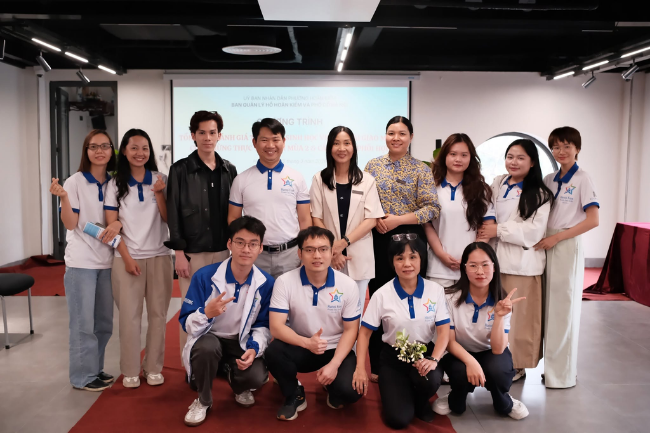
On March 20, 2026, Hanoi Free Private Tour Guide formalized one of the most significant partnerships in our club’s history, signing a Memorandum of Understanding with the Management Board of Hoan Kiem Lake and Hanoi Old Quarter, the official governmental authority entrusted with the preservation and promotion of Hanoi’s most concentrated cluster of cultural and historical heritage.
Under this agreement, Hanoi Free Private Tour Guide volunteer guides are now officially stationed at six of the Old Quarter’s most historically significant sites, guiding Hanoi’s Living Heritage, providing free English-language guidance to international visitors on behalf of both institutions. This is not a symbolic arrangement. It is a genuine, operational collaboration, one that places our volunteers at the very heart of Hanoi’s heritage landscape, with the full trust and institutional backing of the body responsible for protecting it.
We are deeply honored by this trust, and we do not take it lightly.

The Hoan Kiem Lake and Old Quarter Management Board: Custodians of a National Treasure
Hanoi’s Old Quarter, covering an area of 82 hectares across 10 wards of Hoan Kiem District, is the treasure trove of the city’s and the country’s culture, history, and architecture. It is one of the most historically layered urban environments in Southeast Asia, a place where the street names still echo the crafts once practiced there, where the narrow tube houses preserve a way of life that has largely disappeared elsewhere, and where more than a millennium of Hanoi’s story can be read in the stones and timbers of its surviving structures.
In Hanoi’s Old Quarter alone, there are approximately 120 cultural and historical relics, including communal houses, temples, shrines, and sites of revolutionary historical significance. The Management Board of Hoan Kiem Lake and Hanoi Old Quarter is the institutional authority responsible for the conservation, restoration, and public activation of this irreplaceable heritage, ensuring that the Old Quarter’s historic sites are not merely preserved as static monuments, but are kept alive as meaningful, accessible spaces for both Vietnamese citizens and international visitors.
Beyond physical conservation projects, the Management Board has consistently emphasized the promotion of intangible cultural heritage, collaborating with artists, artisans, and heritage practitioners to organize diverse activities at the sites under its management, from exhibitions and workshops to performances of traditional art forms. It is an institution that understands, as we do, that preservation without engagement is only half the work.
Six Sites, Six Stories: Where Our Guides Now Stand
The partnership places HNFPTG volunteer guides at six heritage locations managed by the Board, each one a distinct window into a different chapter of Hanoi’s history:
Heritage House – 87 Ma May Street
Ma May Ancient House offers a rare glimpse into a complete traditional tube house: a long, narrow courtyard dwelling that belonged to a merchant family. Built in the late 19th century, the house possesses ancient architecture and many old artifacts that are still preserved, conveying the lifestyle and living habits of ancient Hanoians. Recognized as a national monument since 2004, it is one of the very few structures in the Old Quarter that still preserves the full spatial logic of traditional Hanoi merchant life — front shop, living quarters, inner courtyard, and family altar, intact under one roof.
Kim Ngan Communal House – 42 Hang Bac Street
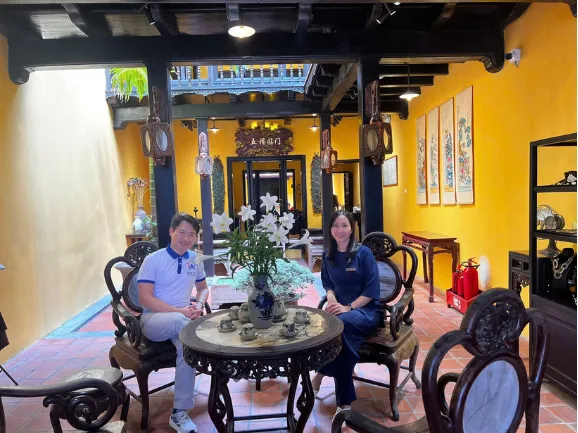
Kim Ngan Communal House, located on Hang Bac Street, is considered one of the oldest and largest houses of worship for those who created or helped local people develop traditional craft villages, originally built to worship the ancestor believed to have given birth to all traditional crafts. Recognized as a national architectural monument in 2012, the communal house hosts regular ceremonies, exhibitions, and performances of Ca Tru, traditional Vietnamese folk singing, playing a crucial role in preserving and promoting, guiding Hanoi’s Living Heritage.
Arts and Culture Center – 22 Hang Buom Street
The Arts and Culture Center at 22 Hang Buom Street, historically the Cantonese Assembly Hall, is one of the Old Quarter’s most striking architectural landmarks, reflecting the role of the Chinese merchant community in shaping Hanoi’s commercial and cultural life during the 19th and early 20th centuries. Today it functions as a living venue for exhibitions, artistic performances, and cultural programming.
Old Quarter Heritage Information Center – 28 Hang Buom Street
A dedicated space for heritage education and visitor orientation, providing context for the broader landscape of conservation work underway in the Old Quarter, and a natural starting point for visitors who wish to understand the area before exploring it.
Hanoi Old Quarter Cultural Exchange Center – 50 Dao Duy Tu Street
The Hanoi Old Quarter Cultural Exchange Center at 50 Dao Duy Tu has become one of the Old Quarter’s key venues for cultural life, art exchange, exhibitions, workshops, and seminars introducing traditional crafts and craft streets to the public. It is also, notably, the same venue where our partnership with Tinh Hoa Nghe Viet was signed, a space that has become something of a home ground for the kind of cultural collaboration we believe in.
Ho Guom Cultural Information Center – 2 Le Thai To Street
Situated at the edge of Hoan Kiem Lake, this center occupies one of the most symbolically resonant addresses in all of Vietnam, overlooking the lake that has served as the spiritual and civic heart of Hanoi for centuries. For international visitors arriving at Hoan Kiem for the first time, it is often the very first encounter with the depth of what Hanoi holds.
What it Takes to Stand in These Spaces
The Management Board did not simply extend an invitation. They set a standard, and our volunteers rose to meet it.
To earn the right to serve as official volunteer guides at these sites, Hanoi Free Private Tour Guide members underwent a rigorous, multi-stage preparation process that went considerably beyond our club’s own training programme. They studied the history of the Old Quarter in depth: its urban development, its architectural typologies, its craft guilds, its role in the political and cultural life of successive Vietnamese dynasties. They developed the specific knowledge required to guide visitors through each individual site, understanding not just what they were seeing, but why it matters, and how to convey that significance clearly and accurately in English.
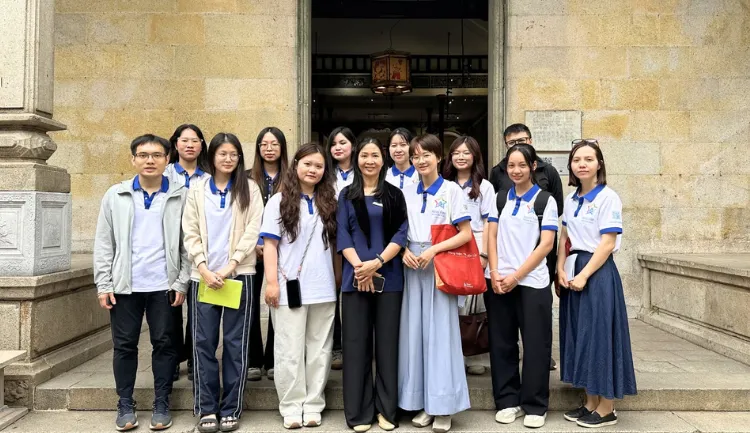
They were then assessed directly by officers of the Management Board, evaluated on the accuracy of their knowledge, the quality of their communication, and their ability to handle the full range of situations that arise when guiding international visitors through active heritage sites. Only those who met the Board’s standards were authorized to serve.
It was not a simple process. It was not meant to be. The sites these volunteers stand in are nationally significant, and the Board, rightly, holds those who speak within them to the highest standard.

That rigor is something we are proud of, not in spite of the difficulty, but because of it. Every volunteer who has completed this preparation has emerged not merely more knowledgeable, but more confident, more thoughtful, and more deeply connected to the history of the city they call home.
The Classroom That Has No Walls
There is a kind of education that cannot happen in a lecture hall or a language lab. It happens when a young Vietnamese person stands in a 19th-century merchant house and finds the words, in English, to a visitor from France or New Zealand or Brazil, to explain what this space meant to the family that lived here. It happens when they describe the significance of Kim Ngan Communal House to someone who has never heard of a guild, or walk a visitor through the long view across Hoan Kiem Lake and explain, without notes, why this particular body of water has been at the center of Vietnamese national identity for a thousand years.
The volunteer guides stationed at these sites are not simply practicing English. They are becoming something more valuable: people who understand their own culture deeply enough to share it with the world, and who have the confidence, the knowledge, and the care to do so with genuine dignity.
We have always believed that education is not merely a path to employment. It is the process by which a person becomes a fuller version of themselves, more aware, more rooted, more capable of contributing something meaningful to the world around them. This partnership places that belief into practice, at six addresses in the heart of one of Asia’s most extraordinary cities.
We are grateful to the Management Board of Hoan Kiem Lake and Hanoi Old Quarter, and to the dedicated officers who designed and oversaw this training programme, for creating a framework within which that kind of growth is possible. And we are profoundly proud of every Hanoi Free Private Tour Guide member who worked to earn their place within it.