
The craft villages in Hanoi are not museum exhibits, they are living, breathing communities where thousand-year-old traditions pulse through everyday life. If you’ve ever wondered what Hanoi looked like before the glass towers and motorbike chaos, stepping into one of these villages is the closest you’ll get to the answer. This article introduces you to 14 extraordinary artisan villages around Hanoi, each with its own identity, specialty, and soul.
Why are Craft Villages in Hanoi so special?
Unlike sterile cultural parks where everything is staged for your camera, these villages are working communities. Step into Bat Trang on a Tuesday morning and you’ll see grandmothers hunched over pottery wheels, toddlers playing among stacks of unfired bowls, and middle-aged men negotiating with wholesale buyers. That rawness is precisely what makes village visits so powerful, and why our volunteer guides at the Hanoi Free Private Tour Guide club always prioritize them for curious travelers.
Hanoi has been a craft hub since the Lý Dynasty (1009–1225 AD). The Old Quarter’s famous 36 guild streets: Hàng Bạc (silver), Hàng Đồng (copper), Hàng Chiếu (mats), were essentially the retail outlets. The craft villages were, and still are, the source.
Craft Villages in Hanoi: Comparison Table
| Village | Specialty | District | Distance from Center | Best Time to Visit |
| Quang Phu Cau | Incense making | Ung Hoa | ~35 km | Sunny mornings, any season |
| Bat Trang | Pottery & ceramics | Gia Lam | ~13 km | Year-round (weekdays quieter) |
| Van Phuc | Silk weaving | Ha Dong | ~10 km | Year-round |
| Vong Village | Cốm (green sticky rice) | Cau Giay | In-city | Aug–Nov |
| Chay Son | Traditional fans | Quoc Oai | ~30 km | Year-round |
| Chuon Ngo | Mother-of-pearl inlay | Phu Xuyen | ~40 km | Year-round |
| Thach Xa | Bamboo dragonfly toys | Thach That | ~30 km | Year-round |
| Dao Thuc | Water puppetry | Dong Anh | ~25 km | Year-round (book ahead) |
| Chuong Village | Conical hats (Nón Lá) | Thanh Oai | ~30 km | Lunar market days |
| Phu Vinh | Bamboo & rattan weaving | Chuong My | ~25 km | Year-round |
| Ha Thai | Artistic lacquerware | Thuong Tin | ~20 km | Year-round |
| Quat Dong | Silk embroidery | Thuong Tin | ~25 km | Year-round |
| Son Dong | Sacred wooden statues | Hoai Duc | ~20 km | Year-round |
| Ngu Xa | Bronze casting | Ba Dinh | In-city | Year-round |
Quang Phu Cau: The Magical Incense Village
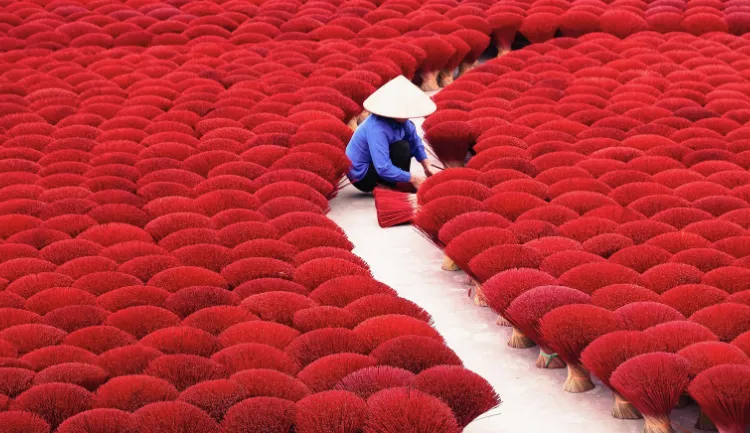
Located in Ung Hoa District, about 35 km from central Hanoi, this century-old village supplies a significant portion of Vietnam’s ritual incense market. Every household here is part of the production chain, some dye the bamboo sticks, others apply the incense compound, and the final step is always the drying spectacle you’ve seen in every travel blog. The craft is deeply connected to Vietnamese spiritual life, as incense burns in temples, family altars, and festivals across the country.
Pro tip from a real Hanoian: Arrive before 10 AM on a clear sunny day. The drying fans only go out in good weather, and the morning light makes the colors truly extraordinary. Cloudy days mean the sticks stay indoors, and the magic disappears. Our club volunteers often plan this visit for early mornings, when the colors are richest and the village is quiet.
Bat Trang: Hanoi’s Legendary Pottery Village
Located just 13 km from the city center in Gia Lam District, Bat Trang is home to approximately 1,000 pottery households producing everything from mass-market tiles to museum-quality hand-painted vases. You can join a wheel-throwing workshop (most cost $3–7 USD), browse the sprawling Bat Trang market, or visit the architecturally stunning Bat Trang Ceramic Museum. The clay soil here, drawn from the Red River banks, has a distinctively fine quality that potters say is impossible to replicate elsewhere.
Hidden gem: Skip the main market street and head into the residential lanes behind it. That’s where you’ll find single-family workshops with three generations working side by side, and where prices are often lower because you’re buying directly from the maker.

Van Phuc Village: Over 1,000 Years of Vietnamese Silk
Located in Ha Dong District, about 10 km from Hanoi’s center, Van Phuc is close enough for a half-day visit. The village’s most famous product is a fine, cloud-pattern silk that keeps you cool in summer and warm in winter, a quality that’s actually measurable, not just marketing. Today, the village has over 400 silk-weaving households, though the craft is under pressure from cheaper machine-made imports from China.
Insider tip: Don’t get lured into the flashy shops on the main “Silk Road” street, those often sell Chinese-made fabric labeled as Vietnamese. Walk into the alleys, listen for the rhythmic clack-clack of a loom, and knock on that door. That’s the real silk, and the weaver inside will be delighted to show you their work. Our guides love watching tourists’ faces when they realize the “fabric” they’re touching took three days to produce just one meter of cloth.

Lang Vong: The Edible Soul of Hanoi’s Autumn
This village sits within the city limits, in Cau Giay District, which makes it uniquely accessible. Cốm is made from young glutinous rice harvested before it fully matures, then roasted and hand-pounded in wooden mortars to achieve that characteristic flat, chewy texture. The harvest season runs from August to November, and during those months, the village smells faintly of roasted rice, a scent that triggers deep nostalgia in every Hanoian. Cốm is eaten alone, wrapped in banana leaf, or used in traditional sweets like Bánh Cốm (sticky rice cake) given at engagement ceremonies.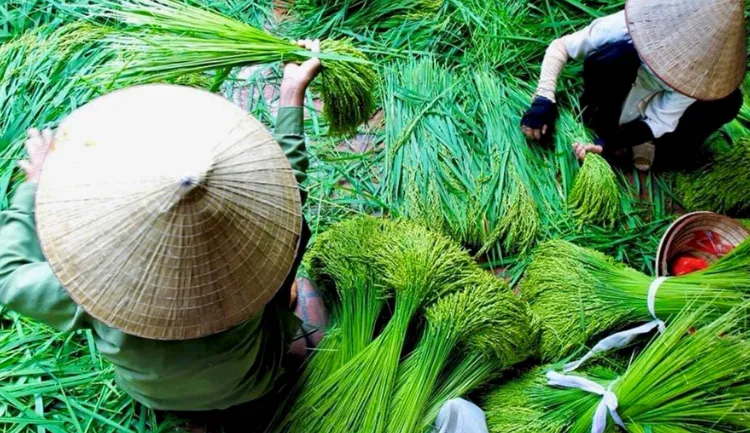
Chay Son: The Village of Traditional Paper Fans
About 30 km from Hanoi’s center, Chay Son artisans produce everything from simple hand fans for daily use to ornate decorative fans for theatrical costumes and temple ceremonies. Each fan is constructed from a bamboo frame with paper or silk stretched across it, then hand-painted with landscapes, calligraphy, or traditional motifs. This is a slower, quieter craft than the dramatic spectacles of Bat Trang or Quang Phu Cau, but its subtlety is the point. The village sits near Thầy Pagoda, making it an easy combination for a culturally rich half-day trip.

Chuon Ngo: Masters of Mother-of-Pearl Inlay
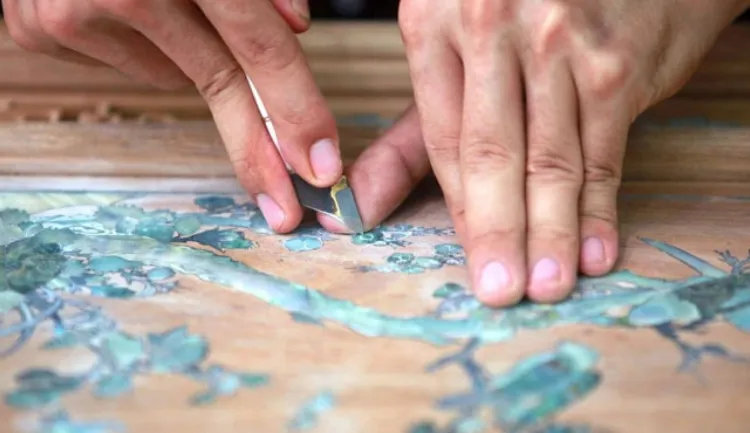
About 40 km from central Hanoi, this is one of the more remote craft villages in this list, but the journey is worth it for serious craft enthusiasts. Artisans here work with tweezers and chisels to lay thousands of tiny shell pieces, each piece no bigger than a fingernail, into designs that can depict landscapes, dragons, phoenixes, or lotus ponds in extraordinary detail. A single large panel can take several months to complete. The technique requires exceptional eyesight, steady hands, and a meditative patience that is increasingly rare.
Thach Xa: The Bamboo Dragonfly Village
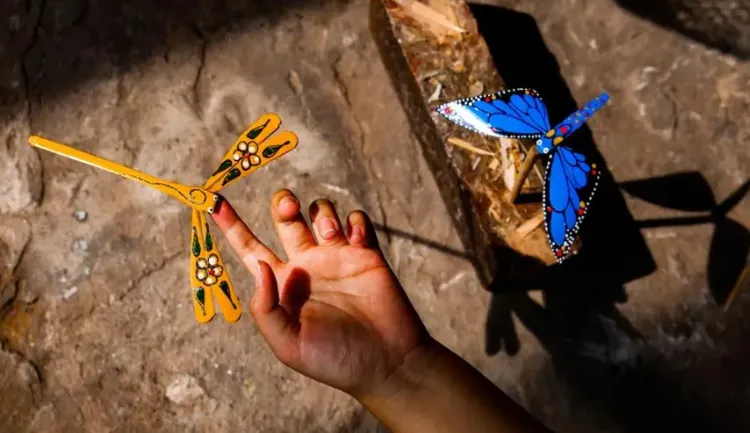
Located about 30 km from central Hanoi, this village has become the global supplier of the beloved Chuồn Chuồn tre (bamboo dragonfly). When balanced correctly on your fingertip, these toys appear to defy gravity. The balance point is calculated by feel, passed down through generations of artisans who can calibrate each dragonfly by touch alone. Visiting here pairs naturally with a trip to nearby Tây Phương Pagoda, one of the most important Buddhist sites near Hanoi. Children and adults alike will leave clutching their own bamboo dragonfly.
Dao Thuc: Where Water Puppetry Was Born
About 25 km from central Hanoi, Dao Thuc offers something truly rare: water puppetry as a living village tradition, not a tourist product. The villagers themselves are the puppeteers, musicians, and carvers. Performances happen in the village pond, with no stage lighting, no amplified sound system, just the water, the puppets, and the ancient music of đàn bầu and trống. The experience is raw, communal, and deeply moving. Booking in advance is essential, as performances are arranged for groups.

Chuong Village: The Conical Hat Capital of Vietnam
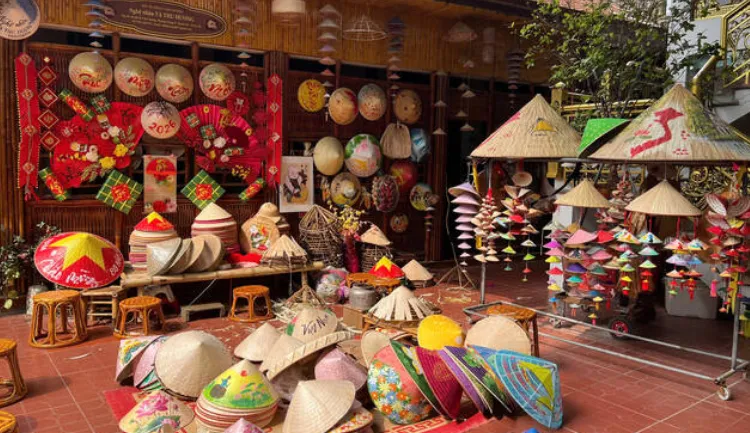
Located about 30 km from Hanoi in Thanh Oai District, the village comes alive every 4th, 10th, 14th, 20th, 24th, and 30th of the lunar month for the Chuong Hat Market, a gathering where artisans sell white palm leaves, bamboo rings, and colorful embroidery threads. Watching an artisan sew a Non La is hypnotic: needle and thread moving in perfect rhythm, each stitch invisible to the eye, every leaf perfectly overlapping. A quality Chuong Village hat can withstand years of sun and rain, and is infinitely more elegant than any factory-made imitation.
Phu Vinh: The Art of Bamboo and Rattan Weaving
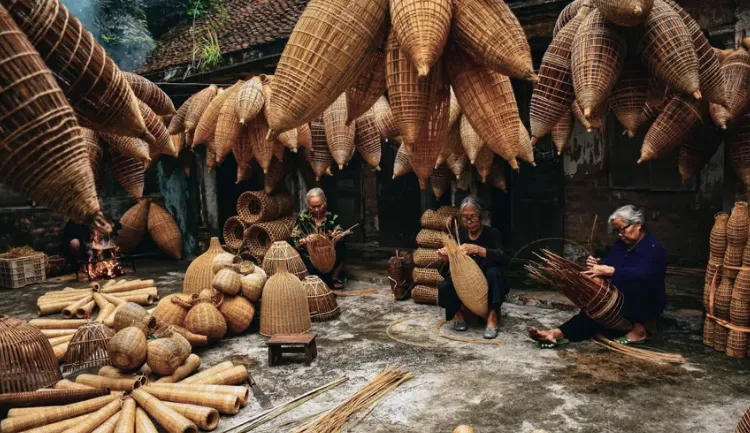
About 25 km from central Hanoi, Phu Vinh’s craft has been refined over centuries into something approaching visual art. Traditional products include baskets, trays, and furniture, but master weavers here can create incredibly detailed pictorial works, weaving landscapes and faces from natural fiber. The village actively trains younger generations, and visiting during a weaving session is like watching a meditation practice, unhurried, precise, and utterly absorbing.
Ha Thai: The Artistic Lacquer Village
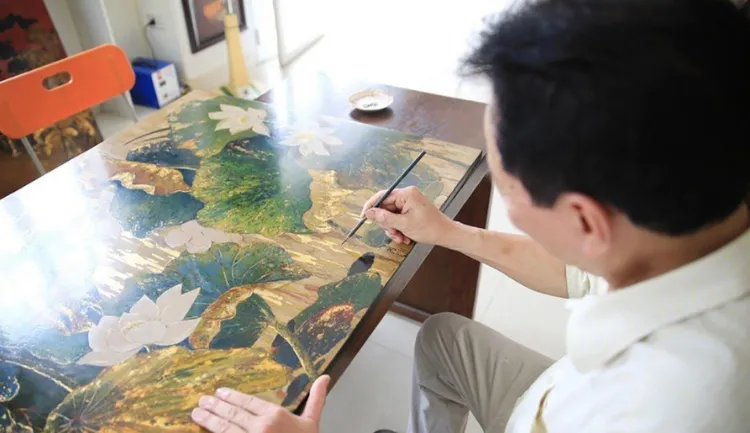
About 20 km from Hanoi, Ha Thai is not the only lacquerware village in Vietnam, but it is the most artistically adventurous. Traditional lacquer (Sơn mài) involves applying dozens of layers of resin over weeks, sanding between each layer, then carving and inlaying decorative materials. Ha Thai artisans took this ancient technique and pushed it into modern aesthetics, creating abstract and semi-abstract works that have attracted international collectors. If you want to bring home a truly unique Vietnamese artwork, not a souvenir, Ha Thai is your destination.
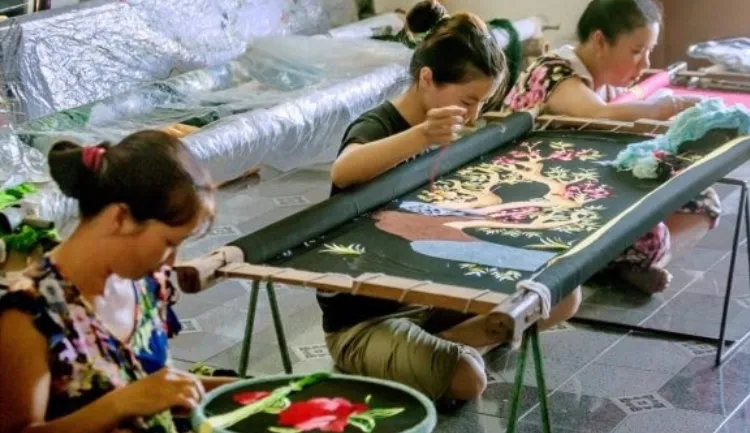
Quat Dong: Vietnam’s Silk Embroidery Capital
About 25 km from central Hanoi, Quat Dong has been producing embroidery for the royal court and export markets since the 17th century. Master embroiderers here work on individual threads, sometimes splitting a single silk thread into four to achieve a gradation of color invisible to the naked eye. A large, detailed piece, say, a portrait of a lotus pond, can take 3–6 months to complete. The village has a cooperative where you can watch artisans at work and commission custom pieces. It is a testament to what human hands can achieve when guided by a lifetime of practice.
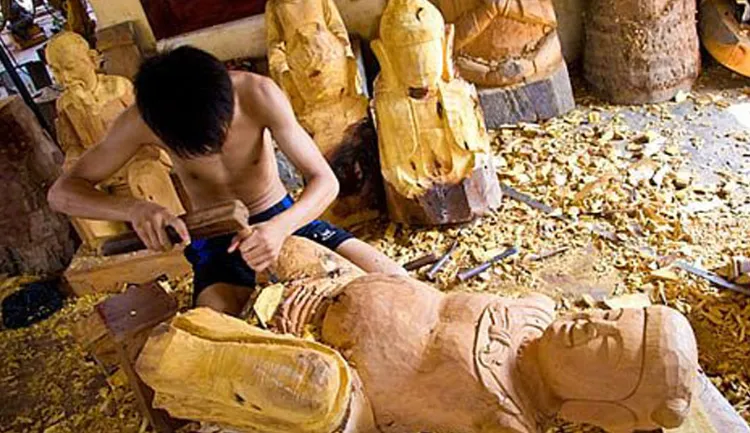
Son Dong: The Sacred Statue Village
About 20 km from central Hanoi, Son Dong specializes in Sơn son thếp vàng, the ancient craft of carving figures from jackfruit wood, then applying multiple layers of lacquer and gilding with gold leaf. If you’ve ever entered a Vietnamese Buddhist temple and marveled at the towering, gleaming statues on the altar, there’s a good chance those statues were born in Son Dong. The craft requires mastery across three disciplines: woodcarving, lacquerwork, and gilding, skills that a single artisan can spend an entire lifetime developing.
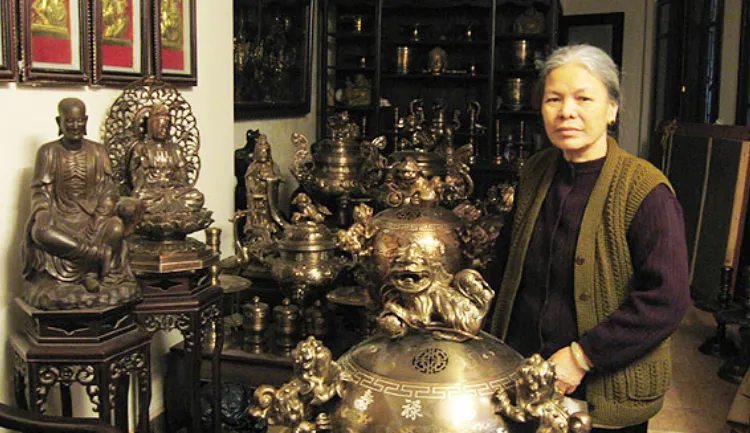
Ngu Xa: The Bronze Casters of Ba Dinh
Ngu Xa is unique among craft villages in Hanoi because it sits within walking distance of Ho Chi Minh Mausoleum. Today, the village is better known to food lovers for Phở Cuốn (rolling pho), a dish said to have been invented here. But a handful of master families still maintain the bronze furnaces, producing ritual vessels, bells, and decorative objects using techniques unchanged for 700 years. For visitors exploring the Ba Dinh area, Ngu Xa is a natural stop that combines ancient craft history with one of Hanoi’s most unique culinary inventions.
How Do You Plan a Day Trip to the Craft Villages Near Hanoi?
Here are three practical day-trip clusters our club volunteers often suggest:
Cluster A:
The Southern Run (Thuong Tin District): Ha Thai (lacquerware) + Quat Dong (embroidery) + a riverside lunch. Distance: ~20–25 km. Best by hired car.
Cluster B:
The Eastern Loop: Bat Trang (pottery) + Van Phuc (silk). Both are relatively close to the city. Bat Trang can be reached by public bus No. 47 from Long Bien Bus Station — a great budget option.
Cluster C:
The Northern Heritage Trail: Dao Thuc (water puppetry) + Dong Anh market for lunch. This works best on a weekend when the puppet troupe is active.
For the further villages (Chuon Ngo, Quang Phu Cau), renting a motorbike or booking a private car is the most flexible option. Budget roughly 300,000–500,000 VND ($12–20 USD) for a full-day car hire through a guesthouse or app like Grab.
Fourteen villages is a year of weekends. A hanoi craft village tour covers one or three in a day, depending on how far you want to travel.
What Should You Buy at the Craft Villages in Hanoi?
Here’s what to look for at each type of village:
- Bat Trang: Hand-painted celadon bowls, small tea sets, personalized name plates (can be custom-ordered in 1–2 days).
- Van Phuc: Scarves and table runners in authentic Van Silk, look for the village cooperative’s certification tag.
- Ha Thai: A lacquer panel or decorative tray, even small pieces are works of art.
- Quat Dong: Embroidered pillow covers or framed embroidery panels, specify “hand embroidery” (thêu tay), not machine-made.
- Chuong Village: A genuine Nón Lá, ask to see the stitching against the light. Quality hats will show a clean, even weave of leaf and thread.
Price tip: Always buy at the source, not at Old Quarter shops. A silk scarf that costs 500,000 VND in Van Phuc might be labeled 1,200,000 VND in the tourist district. Same product, very different margin.
The Craft Villages in Hanoi are waiting for you
The craft villages in Hanoi are one of Southeast Asia’s best-kept secrets, within an hour of a modern capital, you can find communities still practicing crafts that predate the Mongol invasions. Whether you’re watching a grandmother sew a conical hat by the light of a doorway in Làng Chuông, or spinning your first clay pot in Bat Trang, the experience will stay with you long after the flight home. These 14 villages are not just tourist attractions, they are living proof that beauty, skill, and patience still matter. Don’t just read about them.
FAQs: People Also Ask About Craft Villages in Hanoi
Bat Trang Pottery Village is the best craft village in Hanoi for first-time visitors because it is closest to the city (13 km), has excellent facilities, offers interactive workshops, and is reachable by public bus. It gives a complete experience of Vietnamese craft culture in a single half-day.
Yes, the craft villages near Hanoi are very safe for solo female travelers. These are residential communities with local families going about their daily work. Standard city-level precautions apply (watch bags in crowded market areas), but the villages themselves are calm, welcoming, and crime-free. Many of our club’s own volunteer guides are young women who explore these villages regularly.
Read more
✧ Free Tour vs Paid Tour Hanoi: Which is Better for You?
✧ Hanoi SIM Card for Tourists: Best Plans, Prices & Where to Buy
