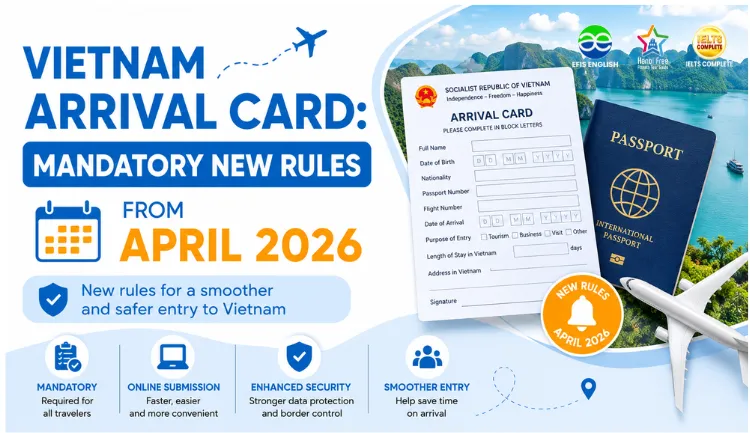
The Vietnam Arrival Card just got a major update, and if you’re flying to either Ho Chi Minh City or Phu Quoc, this directly affects you. Since April 15, 2026, a mandatory digital declaration has been in place at Tan Son Nhat Airport (SGN), and as of June 1, 2026, Phu Quoc International Airport (PQC) joined the system. Noi Bai International Airport (HAN) in Hanoi has now also been added to the mandatory declaration system. The system has now also expanded to Cam Ranh (CXR) and Da Nang (DAD) airports, as well as to the Dong Dang land border gate and a long list of seaports nationwide. Miss this step, and you’re walking into longer queues, added stress, and the very real risk of a delayed arrival. This guide gives you the complete, verified picture, including what changed today, who needs the form, and how to complete it in under five minutes.
What is the Vietnam Arrival Card in 2026?
Document 1: The Vietnam Digital Arrival Card (PAI System – New from 2026)
The Vietnam Digital Arrival Card is an online declaration introduced by the Vietnam Immigration Department. It collects your passport, flight, and accommodation details before you arrive, then generates a QR code that immigration officers scan on arrival. The form is free and hosted on the official government portal: prearrival.immigration.gov.vn.
The new system replaces the old paper arrival slip with a free electronic declaration that generates a QR code to speed up border processing. It was first made mandatory at Tan Son Nhat on April 15, 2026, and has since expanded rapidly. Importantly, the Vietnam Digital Arrival Card is not limited to air travel. It now applies to foreign nationals entering Vietnam by air (airports), by sea (international seaports), and by land (designated border gates). Regardless of how you enter the country, if you are a foreign national clearing immigration at a covered entry point, you are required to complete the declaration in advance.
Document 2: Form NA1 (Traditional Paper Entry Form)
This is Vietnam’s long-standing paper immigration form. It replaced the older M3 form and serves as a combined entry and exit declaration that immigration officers stamp in your passport. It remains required specifically for travelers obtaining a Visa on Arrival (VOA) at airport counters, and at land and sea border crossings.
The critical rule to remember: The Digital Arrival Card does NOT replace visa requirements. It is an additional pre-arrival step that applies to e-visa holders, visa on arrival travelers, and visa-exempt nationals alike.

Which Entry Points Now Require the Mandatory Vietnam Arrival Card?
The Vietnam Digital Arrival Card is now mandatory across multiple entry points in Vietnam, not just airports. As of August 2026, the system covers five major international airports, one land border gate, and a network of seaports along the coast. Whether you are flying in, arriving by cruise ship, or crossing an overland border, the pre-arrival declaration is required before you reach the immigration counter.
| Airport | IATA Code | Mandatory Since | Notes |
| Tan Son Nhat International Airport | SGN | April 15, 2026 | Ho Chi Minh City; Vietnam’s busiest international gateway |
| Phu Quoc International Airport | PQC | June 1, 2026 | Includes Phu Quoc visa-exemption travelers |
| Noi Bai International Airport | HAN | June 10, 2026 | Hanoi; part of the mandatory declaration system |
| Da Nang International Airport | DAD | Currently mandatory | Central Vietnam |
| Cam Ranh International Airport | CXR | Currently mandatory | Khanh Hoa / Nha Trang gateway |
Land and Sea Entry Points Now Included
The mandatory Vietnam Digital Arrival Card is no longer limited to air travel. It currently also applies to:
Land border gate:
- Dong Dang Border Gate (Lang Son province)
Seaports:
- Hai Phong Port
- Cam Pha Port
- Nghi Son Port
- Cai Lan Port
- Da Nang Port
- Chan May Port
- Quy Nhon Port
- Vung Ang Port
- Nha Trang Port
- Saigon Port
- Tan Cang Port
- Cat Lai Port
- Cai Mep Port
- Vung Tau Port
Travelers entering Vietnam through the Dong Dang border gate or any of the seaports listed above must complete the same online declaration as air travelers, before arrival.
Visitors entering Vietnam under the Phu Quoc visa exemption program should select “Phu Quoc Visa Exemption” in the Visa Type/Purpose section when completing the declaration. This is a detail that catches many travelers off guard, the portal has a specific option for this entry pathway, and selecting the wrong visa type can cause delays at the immigration counter.
Why the rapid expansion? The system is being deployed as part of a gradual rollout expected across other entry points, driven by increasing pressure on airport infrastructure where immigration queues can exceed 500 passengers at peak times and waiting times may reach one to two hours during high-traffic periods.

Who Must Complete the Mandatory Vietnam Arrival Card?
Almost every foreign national flying into either Tan Son Nhat or Phu Quoc must now complete the Vietnam Digital Arrival Card, including travelers who are visa-exempt. The rule applies broadly, with only a handful of exceptions.
| Traveler Type | Digital Arrival Card Required? | Notes |
| Visa-exempt nationals (UK, France, Germany, Japan, etc.) | YES | Required even without a visa |
| e-Visa holders (all nationalities) | YES | Submit PAI form plus your e-Visa |
| Visa on Arrival (VOA) applicants | YES | Plus complete Form NA1 at the VOA counter |
| Phu Quoc visa-exemption visitors | YES | Select “Phu Quoc Visa Exemption” on the portal |
| Overseas Vietnamese entering on a foreign passport | YES | |
| Vietnamese citizens on a Vietnamese passport | NO | Exempt |
| Same-day airside transit (no immigration clearance) | NO | Exempt |
| Travelers entering via Hanoi Noi Bai (HAN) | YES | Now mandatory, submit declaration via prearrival.immigration.gov.vn |
| Travelers entering via Da Nang (DAD) | YES | Currently part of the mandatory system |
| Travelers entering via Cam Ranh (CXR) | YES | Currently part of the mandatory system |
| Travelers entering via Dong Dang border gate or the listed seaports | YES | Currently part of the mandatory system |
All foreign travelers arriving in Vietnam via applicable international airports must complete the digital declaration, including travelers from the US, UK, EU, and Australia, even if they are eligible for Vietnam’s 45-day visa-exemption scheme.
Regarding children: every foreign traveler who passes through immigration requires a separate declaration regardless of age. Parents or guardians can complete the Vietnam Arrival Card form on behalf of minors using the child’s passport and travel details.
Insider tip from our club: “Check your passport expiry date before anything else. You need at least 6 months validity from your planned departure date from Vietnam, not your arrival date. We see guests turned away for this every single month.”
» Planning a Trip to Hanoi: The Complete 2026 Guide
» Evisa Vietnam and VN Visa: Latest updates

What Are the Current Vietnam Arrival Card Entry Requirements?
Having the correct combination of documents is essential for smooth immigration clearance. Here is the complete picture at a glance:
| Document | Who Needs It | How to Obtain | Deadline |
| Vietnam Digital Arrival Card (PAI) | Most foreigners entering via SGN | Free at prearrival.immigration.gov.vn | Within 72 hours before arrival |
| Form NA1 | VOA applicants; land/sea border crossers | Download online or collect at VOA counter | On arrival (pre-fill strongly recommended) |
| e-Visa | Nationals of countries not on the visa-exempt list | Online at xuatnhapcanh.gov.vn | Several days before travel |
| Passport only | Nationals of the 24 visa-exempt countries | N/A | Valid passport, 6+ months remaining |
Before traveling to Vietnam, every international visitor should ensure they have: a passport valid for at least six months beyond the intended entry date; a valid visa, e-visa, visa exemption certificate, or other approved immigration authorization if required; confirmed flight information; accommodation details in Vietnam; a completed pre-arrival declaration when applicable; and the QR code generated after successful submission.
Which nationalities are currently visa-exempt for 45 days? Citizens of the UK, France, Germany, Italy, Spain, the Netherlands, Denmark, Sweden, Norway, Finland, Switzerland, Austria, Belgium, Luxembourg, Ireland, Portugal, Japan, South Korea, Australia, New Zealand, Canada, and several others. Always verify the current official list before you travel, as this policy is subject to change.
How do You Fill Out the Vietnam Digital Arrival Card? (Step-by-Step)
Completing the Vietnam Digital Arrival Card takes less than five minutes on the official free portal, provided you have your documents ready. The only legitimate, free government site is prearrival.immigration.gov.vn. Be cautious of any third-party websites that charge a fee for this service, as the official process is completely free.
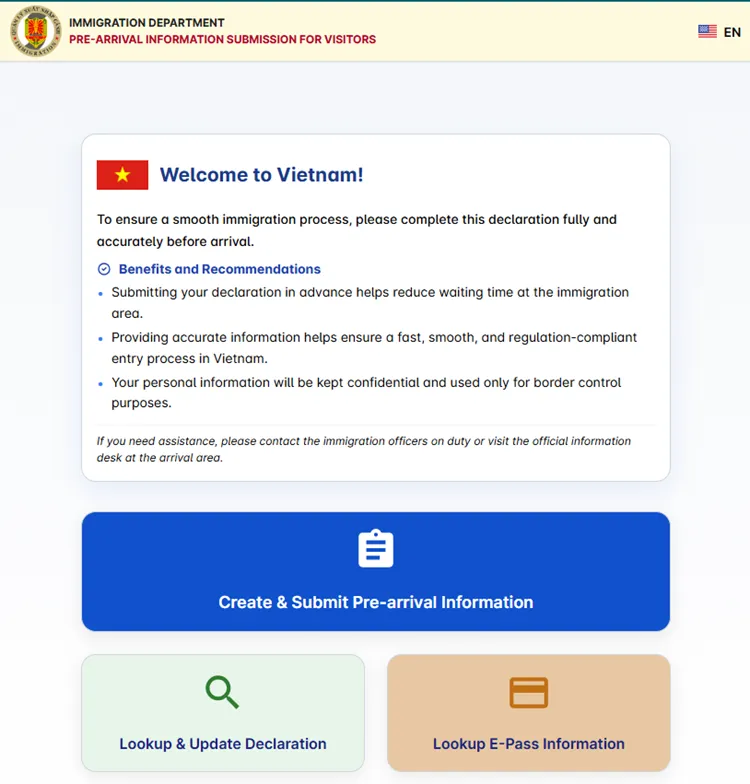
Prepare these before you start:
- Valid passport (bio page visible, you can upload a photo to auto-fill)
- Confirmed flight number and your expected arrival date in Vietnam
- Full accommodation address (hotel name, street address, district, city, phone number)
- A working email address to receive your OTP verification code and QR code
- Your visa or e-Visa reference number (if applicable)
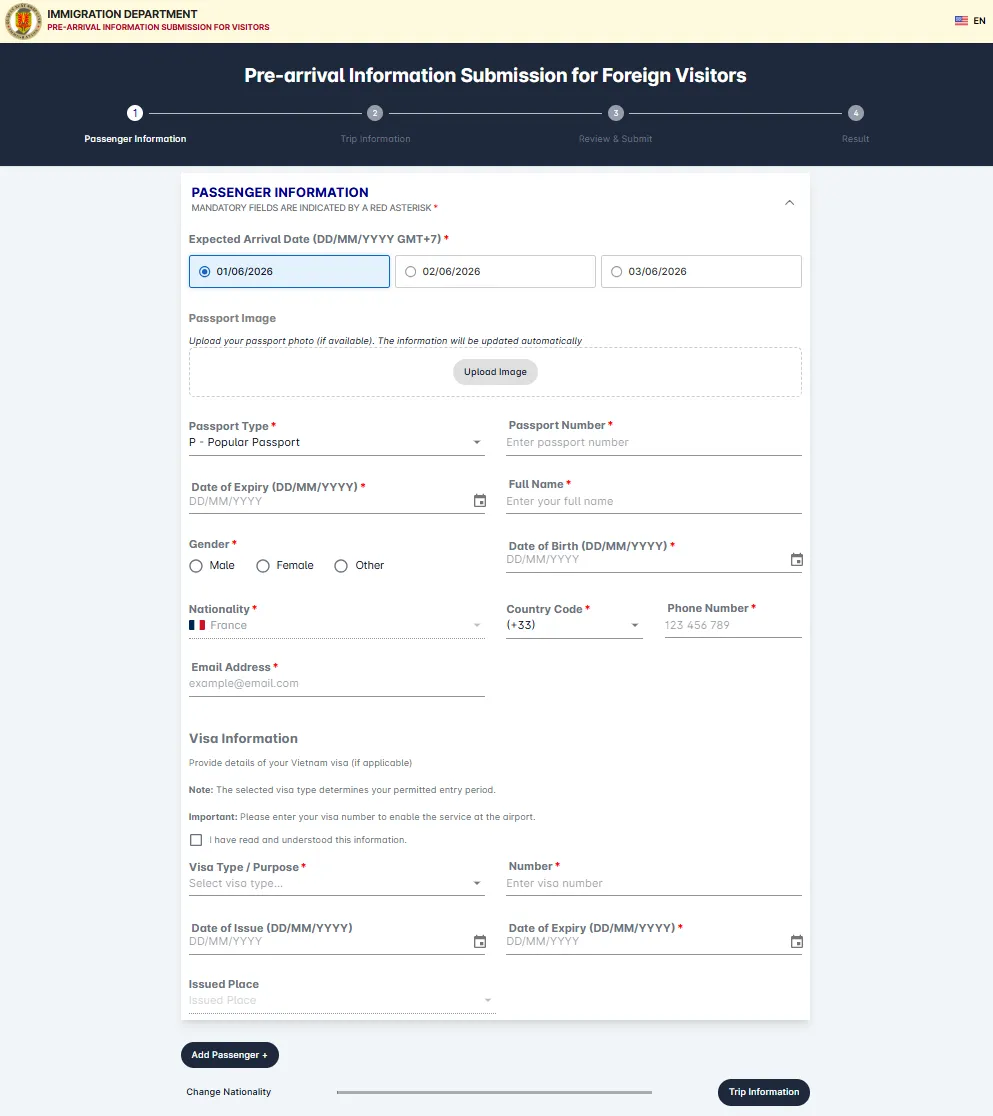
Step 1: Enter passenger information
Select your expected arrival date (the portal only accepts dates within the next 72-hour window). Upload a clear photo of your passport bio-page to auto-fill your name, date of birth, and passport number. Confirm gender, nationality, phone number, and email. Add your visa or entry document details.

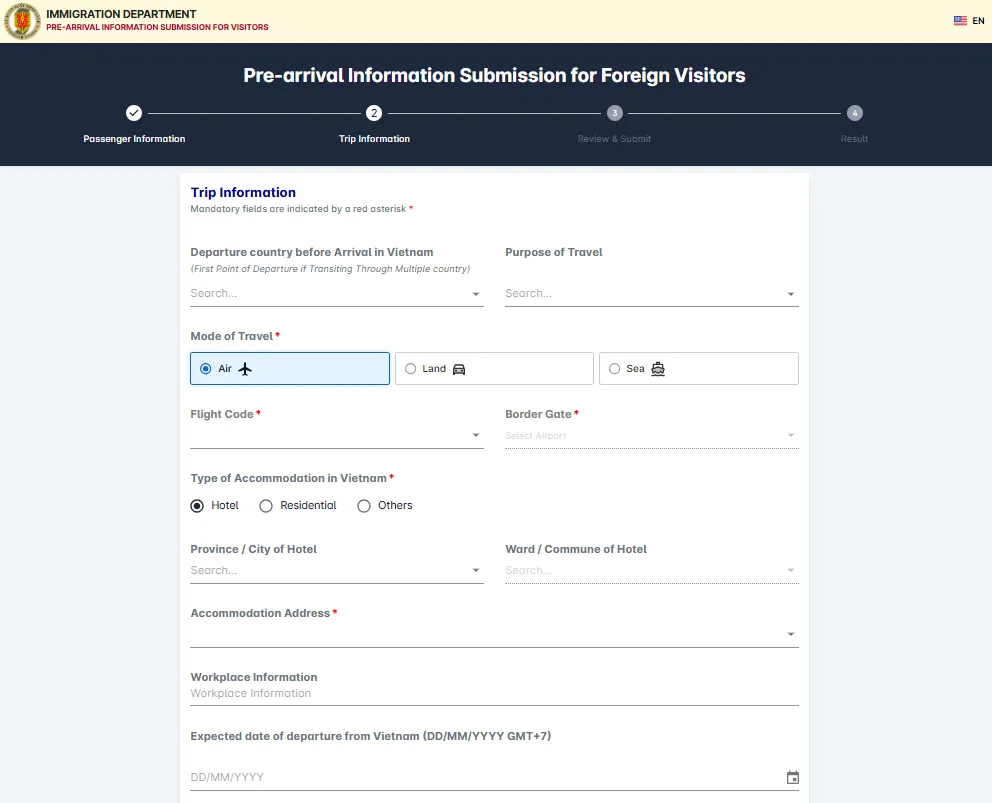
Step 2: Provide travel information
Enter your country of departure, purpose of visit (tourism, business, study, etc.), mode of transport, and flight number. Select your port of entry: Tan Son Nhat, Phu Quoc, Noi Bai (Hanoi), Cam Ranh, Da Nang, the Dong Dang border gate, or one of the listed seaports. Add your full accommodation address. Travelers entering under the Phu Quoc visa exemption program must select “Phu Quoc Visa Exemption” in the Visa Type/Purpose section.
Step 3: Review and verify with OTP
This step matters enormously. Check every field carefully against your actual passport and documents. When ready, request a 6-digit OTP code sent to your registered email address. Enter the code to confirm your declaration. Errors here are far easier to fix before submission than after.
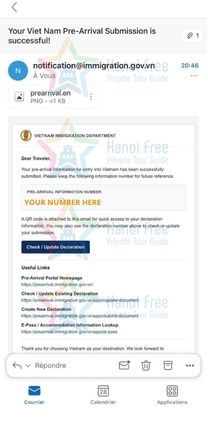
Step 4: Save your QR code
After verification, the system assigns a reference number and generates a downloadable PDF confirmation containing your QR code. Screenshot it and print a hard copy. Save your QR code: once submitted, you will receive a QR code, take a screenshot and print a hard copy for backup. This QR code is what you present to immigration officers when you arrive.
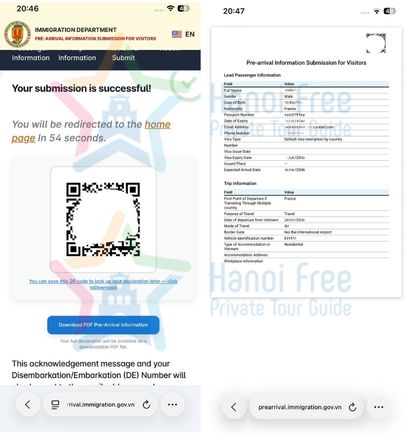
When Should You Submit the Vietnam Arrival Card Form?
Submit the Vietnam Digital Arrival Card within the 72-hour window before your scheduled landing at Tan Son Nhat, not before, not after boarding if you can avoid it. The portal enforces this window automatically.
The system does not accept submissions earlier than a specific window before your arrival. You can submit the pre-arrival registration on the day of your arrival or up to two days before. The portal’s arrival-date selector will not let you pick any date further in advance. For example, if your flight lands on April 25, you can start the submission any time after midnight on April 23.
The practical sweet spot is 24–48 hours before you board your flight, you’re still at home, you have a stable internet connection, and you have time to fix any errors before check-in closes.
What if you forget before flying?
Technically, you can complete the Vietnam Digital Arrival Card at the airport after landing, QR codes linking to the portal are posted in the immigration hall. But this is a last resort, not a plan. Here is the reality on the ground:
Airport Wi-Fi is unreliable. Hundreds of passengers land at the same time, all attempting to connect to the same network simultaneously. Congestion is the norm, not the exception, connections drop, pages time out, and loading the portal can take far longer than expected.
The immigration queue does not wait. While you struggle with connectivity, the line keeps moving, and then stops moving for you. Immigration queues at peak arrival times (especially evening international flights) can exceed 500 people. Passengers who have not completed their declaration create a bottleneck at the counter. In the worst cases, travelers without a QR code have waited one to two hours just to resolve the issue before they could proceed through immigration.
The OTP code is the hidden trap. The portal requires a 6-digit one-time password sent to your email. If your email app needs mobile data to load, or the airport Wi-Fi keeps dropping during the verification step, the process stalls completely, and each OTP code expires quickly.
The simple rule: do it before you board. Complete the form 24 to 48 hours before your flight, from home, with a stable internet connection, when there is no pressure and no queue. It takes less than five minutes. That five minutes at home can save you two hours at the airport. Do not let an avoidable technicality be the reason your first impression of Vietnam is standing in an immigration hall, phone in hand, trying to connect to a crowded Wi-Fi network.
What Is Form NA1 and Do You Still Need It?
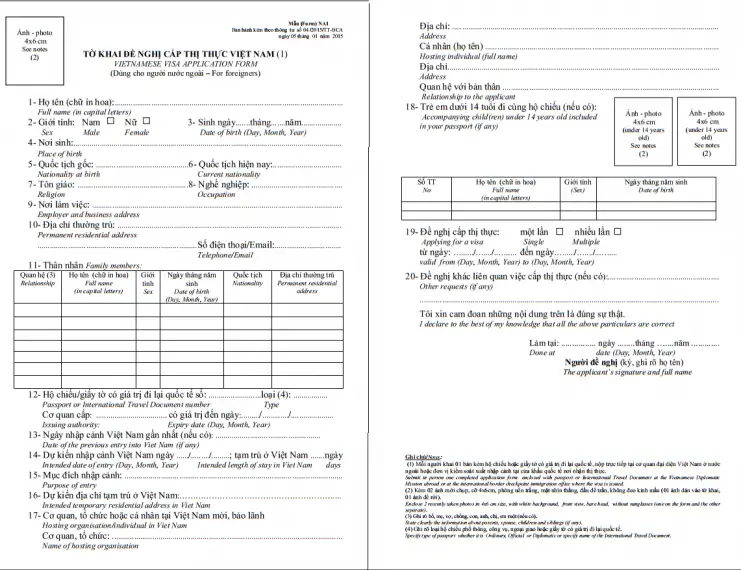
Form NA1 remains a required document in 2026, but only for travelers obtaining their Visa on Arrival (VOA) at the airport counter. If you already hold an e-Visa, or if your nationality qualifies for visa-free entry, Form NA1 does not apply to you.
The NA1 Form replaced the old M3 form and serves as a combined entry and exit declaration that immigration officers stamp in your passport. It is still required for Visa on Arrival (VOA) applicants and used at land and sea border crossings.
What to bring for the VOA process:
- Completed Form NA1 (pre-fill before your flight)
- Original valid passport
- Printed Visa Approval Letter
- 2 passport-sized photos (4×6 cm, white background, taken within 6 months)
- Stamping fee in cash only: approximately USD 25 for single-entry or USD 50 for multiple-entry (verify current rates on the official portal before departure)
Pre-filling Form NA1 before your flight is strongly recommended. At peak evening arrival times, the VOA counter at Tan Son Nhat can have queues of 500 or more people, and arriving with everything ready is a genuine time-saver.
Why Is Vietnam Expanding Its Mandatory Arrival Card System?
The system is being deployed primarily at Vietnam’s busiest international airports, with a gradual rollout expected across other entry points as the country continues modernizing its immigration infrastructure.
Vietnam introduced a mandatory digital pre-arrival declaration on April 15, 2026, making it the latest country in Southeast Asia to roll out this kind of system, following Thailand, Indonesia, Singapore, and Malaysia in the past twelve months. The June 1, 2026 extension to Phu Quoc reinforces that this is a national policy, not a single-airport pilot.
Vietnam’s immigration policies and arrival procedures may continue to be updated. Before your trip, check the latest information from official immigration authorities to ensure you are aware of any changes that may affect your arrival.

Common Mistakes to Avoid with Your Vietnam Arrival Card
A small error on your Vietnam Arrival Card can cause real delays at immigration. These are the most reported mistakes in 2026:
- Entering the wrong passport number: Double-check O vs. 0 and I vs. 1, they look identical on many passports.
- Selecting the wrong visa type: Phu Quoc visa-exemption travelers must specifically select “Phu Quoc Visa Exemption”, not the standard country-based exemption option.
- Using an inaccessible email: You need to retrieve an OTP from that inbox; use one you can access without relying on airport WiFi.
- Submitting too early: The portal blocks arrival dates more than 72 hours ahead.
- Leaving accommodation details incomplete: Enter the full street address, not just a hotel name or city.
- Not saving the QR code offline: Screenshot it, save the PDF, and consider a paper backup, airport WiFi and battery issues are common.
- Treating the arrival card as a visa: The Digital Arrival Card does not replace visa requirements. E-visa holders, VOA travelers, and visa-exempt nationals must all complete both the digital arrival card and their visa process separately.
- Waiting until you land: Completing the declaration shortly before departure increases the risk of technical issues or submission errors. Travelers should ideally complete the form at least 24 hours before departure.
- Relying on airport Wi-Fi to complete the form on arrival: Airport networks are heavily congested at peak times, with hundreds of passengers connecting simultaneously. Slow speeds, dropped connections, and OTP verification failures can turn a five-minute task into a two-hour ordeal. Always complete the declaration before your flight departs, ideally 24–48 hours in advance.
FAQs: People Also Ask About the Vietnam Arrival Card
Yes, completely. The official portal at prearrival.immigration.gov.vn charges nothing. Any third-party website charging a fee for this service is not official and should be avoided.
Yes. Since June 1, 2026, travelers arriving at Phu Quoc International Airport must complete the pre-arrival declaration through the official portal. Visitors entering under the Phu Quoc visa exemption program should select “Phu Quoc Visa Exemption” in the Visa Type/Purpose section when completing the form.
You clear immigration at your first Vietnamese port of entry. If you are connecting through SGN to another domestic destination in Vietnam such as Phu Quoc, you still need the Vietnam Arrival Card form. That is because you have to clear immigration in Ho Chi Minh City before boarding your onward domestic flight. Submit the SGN form; you do not need a second form for Phu Quoc.
Yes, as of June 10, 2026. Noi Bai International Airport (HAN) in Hanoi is now part of the mandatory Vietnam Digital Arrival Card system. All foreign nationals arriving at Noi Bai must complete the pre-arrival declaration at prearrival.immigration.gov.vn within 72 hours before landing. Da Nang (DAD) and Cam Ranh (CXR) are now also part of the mandatory system, along with the Dong Dang land border gate and a wide network of seaports nationwide.
Yes. The mandatory declaration is no longer limited to airports. It currently also applies to the Dong Dang border gate and a number of major seaports, including Hai Phong, Da Nang, Nha Trang, Saigon Port, and others. Travelers entering through these points must submit the same online declaration as air travelers.
Getting your Vietnam Arrival Card right is now the essential first step for any foreign traveler flying into Ho Chi Minh City or Phu Quoc. The process is straightforward: complete the free Vietnam Digital Arrival Card at prearrival.immigration.gov.vn within 72 hours of landing, save your QR code, and present it with your passport at immigration. If you’re applying for a Visa on Arrival, pre-fill Form NA1 and bring your approval letter and cash fee. With Tan Son Nhat, Phu Quoc, Noi Bai, Cam Ranh, and Da Nang airports covered, plus the Dong Dang border gate and a wide network of seaports now included, Vietnam’s mandatory pre-arrival declaration has effectively gone nationwide rollout is clearly on the horizon, so make checking this portal part of your pre-trip routine before every Vietnam visit.
One final word of caution: do not wait until you land to complete the form. Airport Wi-Fi is notoriously congested when flights arrive, OTP emails can be slow to deliver, and immigration queues move fast. The five minutes you spend completing the declaration at home could save you hours of stress at the border. Get the paperwork sorted before you board, and the moment you land, Vietnam’s extraordinary culture, landscapes, and flavors are waiting to welcome you.