
Private Hanoi City Tour
The easiest tour to add the workshop to, since it already goes to Ba Dinh.

An army walked the length of Vietnam in sandals cut from worn-out lorry tyres. One workshop in Hanoi still makes them by hand, and will teach you to make your own pair in about an hour. The guide is free; the workshop charges its own fee.
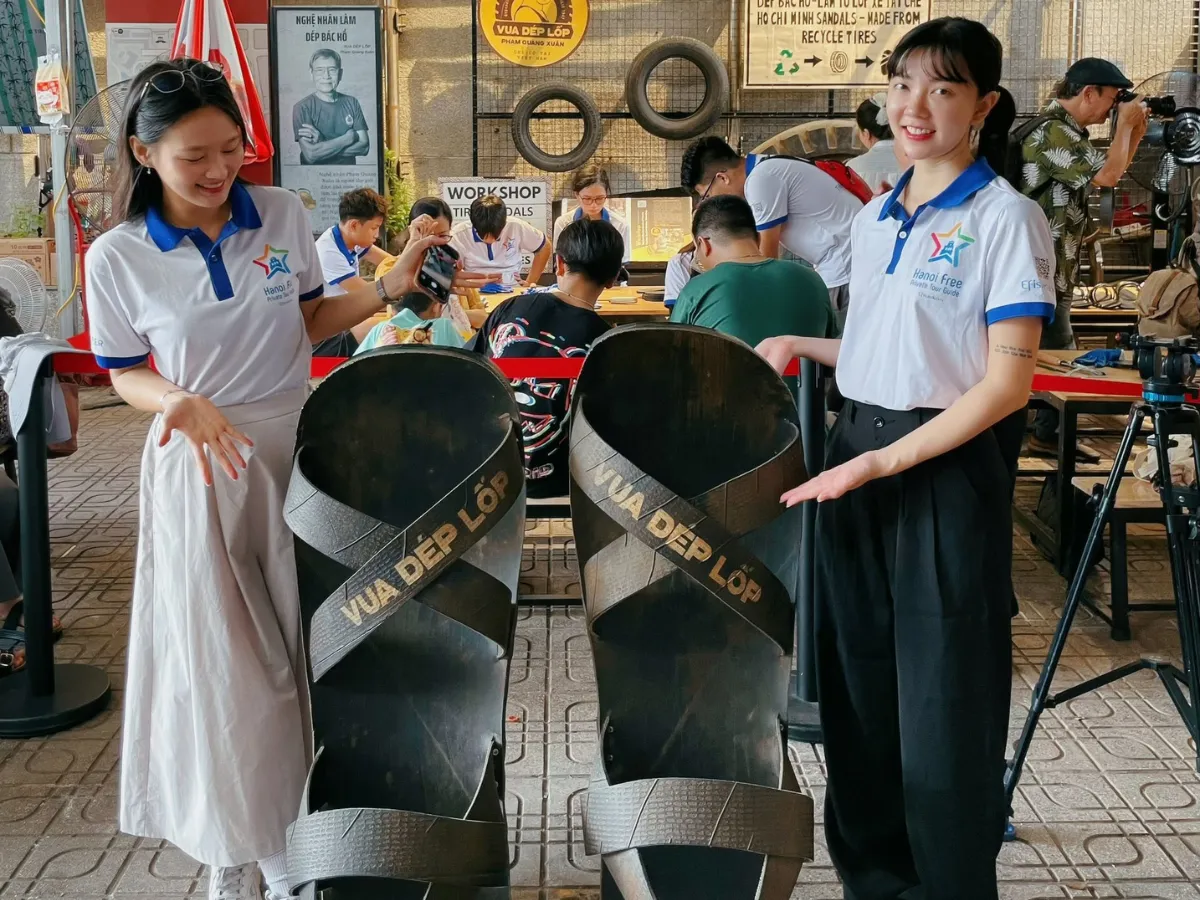

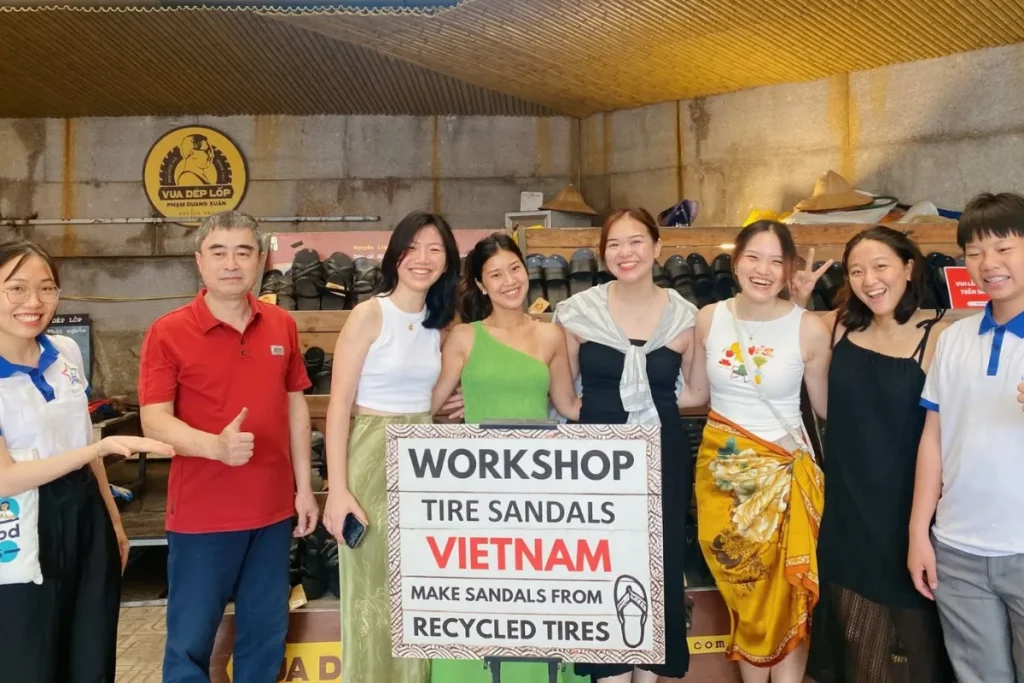

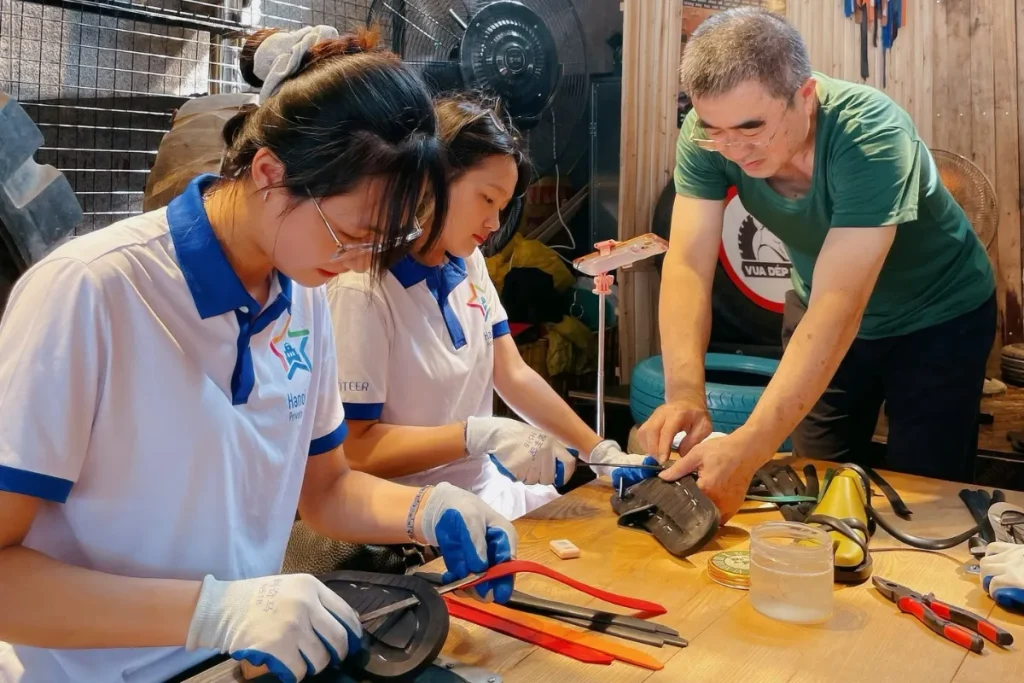
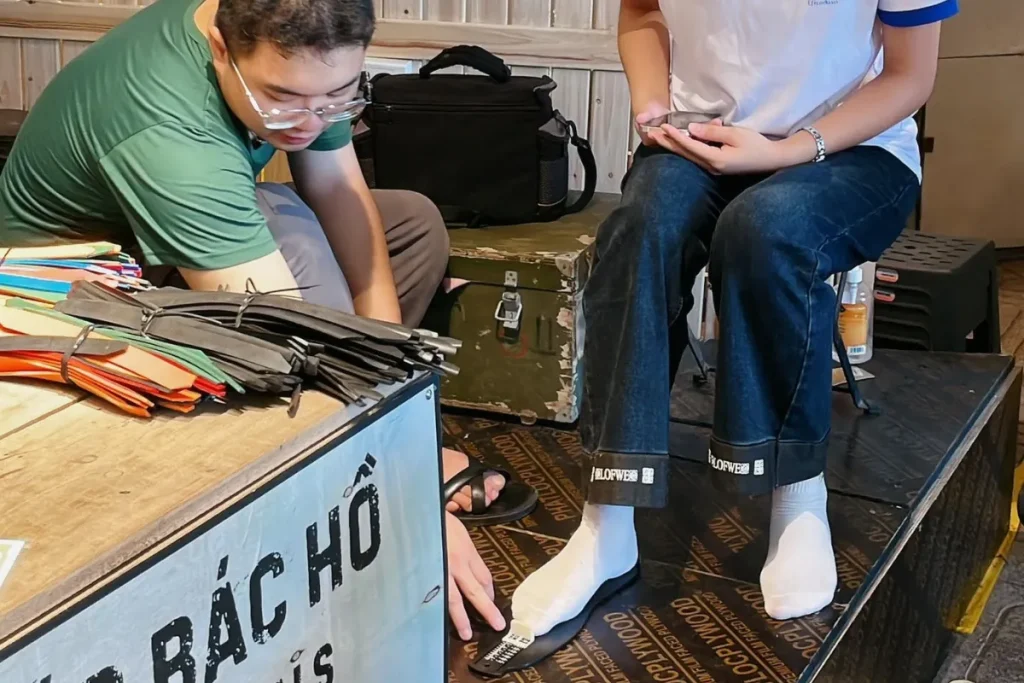
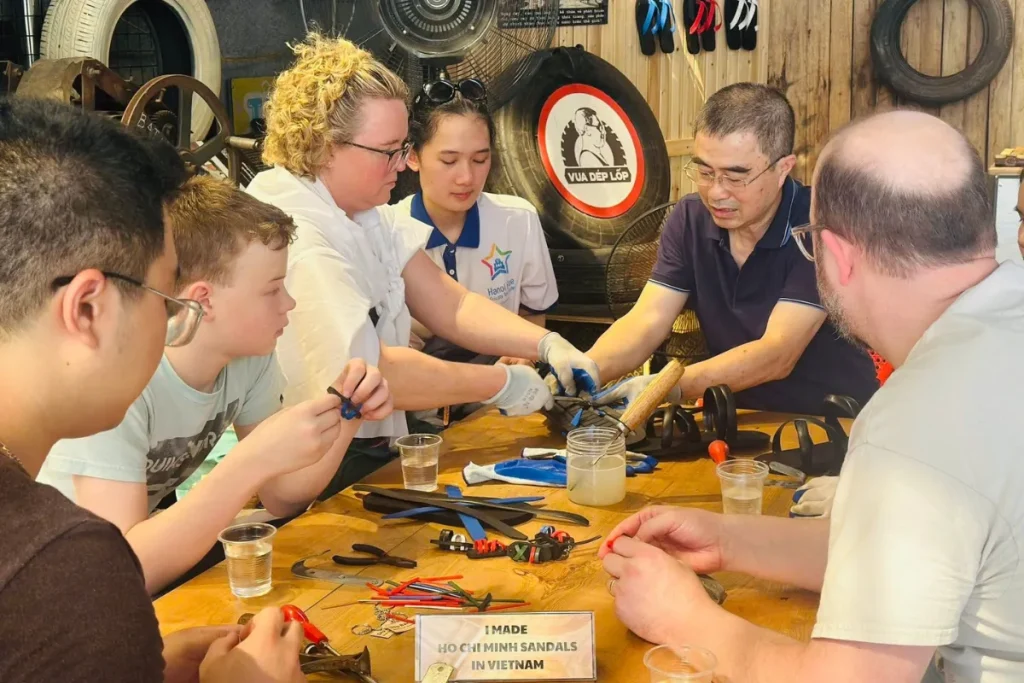


Real tours, real guests. Photographed by our own members.
Dep lop, rubber sandals, are cut from the tread of a worn-out tyre for the sole and from the inner tube for the straps. There is no glue, no stitching and no nail in them. The straps are threaded through slots cut in the sole and held by friction alone, which means they can be repaired at the roadside with a knife.
They were made in the resistance against the French and then worn by soldiers walking south for years at a time. Ho Chi Minh wore a pair, which is why English speakers usually call them Ho Chi Minh sandals and Vietnamese sometimes call them Uncle Ho’s sandals. In a country fighting an enemy with far better equipment, a shoe that could not be destroyed and could be mended anywhere was not a hardship. It was an advantage.
You will have seen a pair behind glass at Hoa Lo Prison or the Military History Museum, and read a label beside it. This is where you cut the rubber yourself, thread the straps, and walk out of the workshop wearing them.
The whole thing takes about an hour, and the craftsman does the parts that need a sharp blade. Tap any stage to read more about it.
Not every tyre works. The craftsman picks from the stack by feel and by the depth of the tread, because a sole cut from worn rubber bends where it should not and a sole cut from a truck tyre is too stiff to walk in. He will show you the difference by making you bend two pieces. This is the part of the craft that cannot be written down and is the reason there are very few people left doing it.
The sole is cut freehand with a heavy knife, following the curve of the tyre so the finished sandal has a slight arch built into it rather than lying flat. There is no template and no machine. It takes real strength, and the craftsman does this part himself while you watch from close enough to see how the blade is angled. The tread pattern on the underside is whatever the tyre had, which is why no two pairs match.
You stand on the rubber and he marks around your foot. European and American shoe sizes mean nothing here; what matters is the length from heel to longest toe and the width across the ball of the foot. Most visitors discover their two feet are different sizes, which the sandals will account for and their normal shoes never have.
The straps come from the inner tube, not the tyre: softer rubber, cut into long strips of even width. This is a job you can do yourself with a straight blade and a guide, and getting the width right matters more than it looks. Too narrow and the strap cuts into your foot; too wide and it will not pass through the slot.
Eight slots are punched through the sole with a chisel, angled rather than straight down, and this is where the whole design lives. The angle is what makes the strap grip when your weight goes onto it. Get it wrong and the sandal falls apart on the first hill; get it right and it holds with no glue and no stitching for years.
The part you do. Each strap is pulled through its slot with a hook and worked back and forth until it sits at the right tension, which takes more force than you expect and leaves your hands smelling of rubber for the rest of the day. Then you put them on, walk around the workshop, and he adjusts. Ask him to fit them properly rather than approximately: that is what decides whether they rub.
They are waterproof, effectively indestructible, and need breaking in like any hard-soled shoe. A good number of our guests wear them for the rest of their time in Vietnam and then find they are the most-asked-about thing they brought home. They also weigh almost nothing, which matters if your luggage is already full.
The workshop happens to sit beside the Ho Chi Minh Complex, so many guests walk over afterwards. The stop that connects most directly to what you have just made is the stilt house: two wooden rooms beside a fish pond, which Ho Chi Minh had built rather than live in the mustard-yellow Presidential Palace next door, with a pair of rubber sandals beside the bed. The Mausoleum opens mornings only and closes on Mondays and Fridays.
The workshop is about an hour and that is the whole of it. You can come, make a pair, and leave. Plenty of guests do exactly that between other plans, and nobody will push you to stay longer.
Because the workshop sits beside the Ho Chi Minh Complex, the obvious thing to add is the Mausoleum, the museum and the stilt house, which turns an hour into a half day. Your guide will suggest it and drop it just as happily.
You can also fold the workshop into a longer day. Several guests add it to the private Hanoi city tour, which already goes to the Ho Chi Minh Complex, and take the sandals as the hands-on part of a full day. Say so when you book and we will build the day around it. If making things is what appeals rather than this object in particular, the hanoi craft village tour goes out to the pottery, silk and incense villages instead.
Both are normal, and the second one costs you nothing extra in guide time. Decide when you book or decide on the day.
Tell us when you book so your guide keeps the afternoon free rather than planning a route.
Must be morning: the Mausoleum closes at 11am and does not open on Mondays or Fridays.
Send your dates and how many pairs. We reply by email within 24 hours with the name of your guide, and confirm the workshop can take you.
This is the one tour where that distinction matters, so it is worth being blunt about it.
Our guides are not paid a wage. They join this club to practise English with visitors, which is why every tour we run costs nothing for the guiding. That has not changed here.
But the workshop is somebody’s livelihood. The fee of roughly 500,000 dong per pair goes to the craftsman for the materials and the hour of his time, and we take no commission from it and never have. If you would rather watch than make a pair, say so and there is nothing to pay at all. Tips for your guide are optional, as always.
| Item | Price per person |
|---|---|
| Making your own pair of sandals | around 500,000 VND · about $19 |
| Watching rather than making | Free |
| Taxi from the Old Quarter, each way | 60,000 to 90,000 VND for the car |
| Ho Chi Minh Museum, if you add it | 40,000 VND · about $1.50 |
| Mausoleum and stilt house grounds | Free |
The workshop fee is effectively the whole cost of this tour, and it is the largest single fee on anything we run. It buys you a pair of sandals you made with your own hands, which most guests then wear for the rest of their trip. If you do not want a pair, watching costs nothing and the guide is still free.
Not a tour company employee. Your guide is a young Hanoian who joined a volunteer club to practise English with visitors, and who trained for two and a half months before being allowed to lead anyone anywhere.
Some are still at school or university. Some graduated years ago and kept coming back. Some fit tours around a full-time job at a company in the city. What they share is that they grew up here, and that nobody pays them a wage to be here with you.
The craftsman does not speak English. Without a guide beside you the workshop becomes a silent hour of copying what somebody else is doing, which is a different and much poorer experience. Every instruction, every question you want to ask, goes through your guide.
The fee you pay goes entirely to the craftsman. We have never taken a commission from him and we do not take one from anywhere else. If your guide suggests you skip the making and just watch, that is honest advice rather than a sales tactic in reverse.


If your hotel is inside the Old Quarter, your guide comes to the lobby and you travel to the workshop together, which is a short taxi ride west. If you are already going to the Ho Chi Minh Complex that morning, it is simpler to meet at the workshop door, and your guide will send a photo of it the night before.
Around 500,000 VND per pair, about $19, paid directly to the craftsman on the day in cash. It covers the rubber and roughly an hour of his time, and you keep the sandals. The guide remains free and no tips are expected. If you would rather watch than make a pair, there is nothing to pay.
Because the workshop is somebody’s livelihood rather than part of our club. Our guides volunteer their time to practise English; the craftsman is a working artisan cutting up rubber he has bought. We take no commission from the fee and never have.
About an hour from choosing the rubber to walking out in them. You can come, make a pair and leave. Many guests add the Ho Chi Minh Complex afterwards, since the workshop sits beside it, which makes it a half day instead.
The sole is cut freehand from the tread of a worn tyre, following its curve so the finished sandal has an arch. The straps are cut from inner tube. Eight slots are punched through the sole with a chisel at an angle, and the straps are threaded through and worked to the right tension. No glue, no stitching, no nails: the angle of the slots is what holds the whole thing together.
They are extremely durable, waterproof and nearly impossible to destroy, and plenty of guests wear them for the rest of their trip. They need breaking in, like any hard-soled shoe, and they are not what you want for a long walk on the first day. Ask the craftsman to fit the straps properly rather than approximately, because that is what decides whether they rub.
Yes, and it is one of the better activities in Hanoi for a child who is tired of temples. The craftsman does the cutting that needs a sharp blade and lets them do the threading and fitting. The idea that an old tyre becomes a shoe lands well at almost any age.
Yes. The most common combination is with our Hanoi city tour, which already visits the Ho Chi Minh Complex a few minutes away, so the workshop becomes the hands-on part of a full day. Tell us when you book and we will build the day around it.
At least one day, and tell us how many pairs you want. This is one craftsman in a small workshop, and he needs to know how much rubber to prepare. Same-day requests for a group rarely work.
Send your dates and how many pairs you want. We reply by email within 24 hours with the name of your guide.
The easiest tour to add the workshop to, since it already goes to Ba Dinh.

More to make: pottery, silk, incense and conical hats, out beyond the city.